




RELATED: Sound Transit adding 30 more Siemens light rail vehicles
2017 Rail Project Focus: Detroit, Phoenix, and Seattle
An in-depth look at the recently completed QLine streetcar in Detroit, as well as rapid expansions and community support for Ariz.’s Valley Metro Rail and Seattle’s Sound Transit, where both agencies are spearheading aggressive plans to grow their rail systems.
June 12, 2017
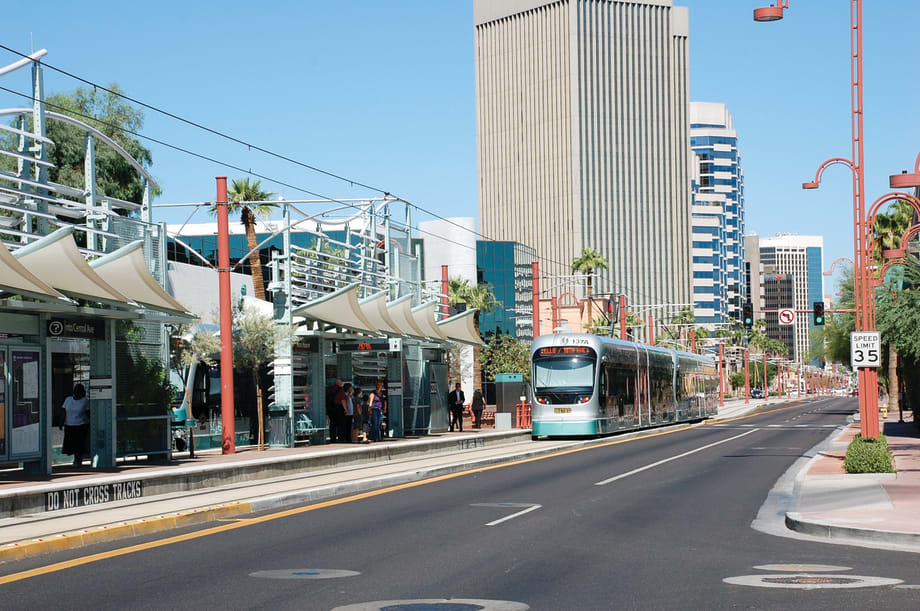
In just 12 short years, Valley Metro has implemented 26 miles of light rail, which has generated more than $9 billion of public and private investment along the corridor.
10 min to read
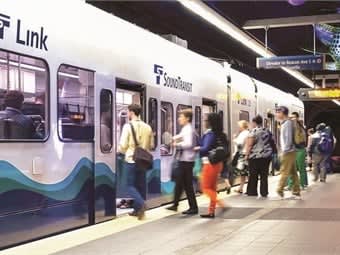
Through the recently passed Sound Transit 3 ballot measure, the agency will grow its light rail system by 62 miles and expand frequency and capacity on its Sounder commuter rail system.
Sound Transit Taking a Measured Approach to Quintuple Light Rail
After missing on an opportunity to build out a regional rail network due to the defeat of major ballot measure in the late 1960s, Sound Transit CEO Peter Rogoff says the agency is now playing “catch-up ball” to build its light and commuter rail systems as fast as it can as the region deals with explosive population growth and worsening traffic congestion.
“There was a time when pretty much anyone in the Puget Sound region found it pretty reasonable to expect to get from one place to another in about 20 minutes,” Rogoff explains. “Because road congestion has gotten so much worse in such a short period of time, it has really gotten people to understand the only path out of it is through building a separated rail network, rather than trying to add more and more bus service.”
In response to that need for an extended rail network, voters in the region recently passed the Sound Transit 3 transportation ballot initiative, which expects to generate $54 billion over 25 years to extend light rail and other services across the region using federal grants and three tax increases.
“We are not the campaign arm, obviously, but what we did with the measure was craft a plan that the people wanted,” says Rogoff about the agency’s success at the ballot box. “We did a lot of community outreach, a lot of discussion, and a lot of back and forth with municipalities as to what the appropriate solutions were, and went through many gyrations and machinations to develop a comprehensive plan that really met the needs of each of what we call the five sub-areas of our taxing district.”
The measure will help Sound Transit quintuple the size of its light rail system by adding 62 miles with stations serving 37 new areas, growing the overall system to 116 miles between Tacoma, Seattle, Everett, and the Eastside by 2041. It will also expand frequency and capacity on Sound Transit’s Sounder commuter rail system, where ridership has been growing by 15-plus percent a year, and create the agency’s first bus rapid transit system, which will run the length of the I-405 freeway and connect to its light rail system to the north and south of the line.
“When you look at our project map, every three to five years we will be rolling out a major expansion in one corner of the district or another,” Rogoff says. “Given the extraordinary growth that we are already experiencing here, one of the frustrations that we know is coming is that the road congestion will get worse before we can deliver each and every one of these projects, but we are going to work as fast as we can to try to get the service in the ground.”
Rogoff also attributes the recent success at the ballot box to projects that have already been completed, including its ULink extension, which opened in March 2016 six months ahead of schedule and about $200 million under its $1.9 billion budget. Although the project only extended the ULink line by two stops, Rogoff says the project had an immediate impact on the region.
“It was absolutely transformational, because it went under one of the major waterways and connected the University of Washington and the densely populated Capitol Hill neighborhood with our light rail system,” he explains. “We knew the expansion would trigger ridership growth, but we didn’t anticipate the spike we got almost overnight, with growth at about 80 percent just through the opening of those two stations.”
One factor for the high usage of the line was that it cut the average 20-minute to 45-minute drive-time from downtown to the university to eight minutes via light rail. The agency also worked closely with King County Metro to expand its bus services, enabling commuters to get downtown to pick up the light rail system more efficiently.
“To the extent that anybody wanted to continue to argue that we could build these projects and people would not ride them, that argument got completely blown out of the water with the ULink extension,” says Rogoff. “It was an important milestone in our development, but we have many more to come.”
In addition to the agency’s rapid expansion, Sound Transit is also set to run its light rail system on 100% clean energy starting in 2019. The agreement, the first of its kind in Washington state, will enable Sound Transit to purchase wind energy directly from Puget Sound Energy’s Green Direct program.
“The region’s commitment to sustainability brought forth a plan to launch a wind power plant, and we were given the opportunity, along with a number of other corporate partners, to buy into that plant,” says Rogoff. “It is an opportunity for us to buy a cleaner source of energy, but also to cap rate increases for many years. So, while we may pay a little more per kilowatt hour in the early years, it will more than pay for itself in the later years.”
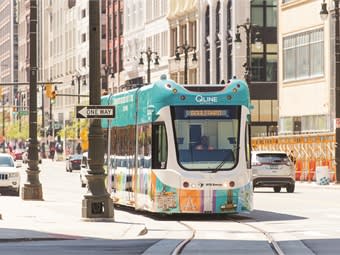
M-1 Rail’s QLine, which launched May 2017, was built through a public-private partnership, generating more than $100 million in private investment.
M-1 Rail Completes Detroit’s Long Road Back to Streetcar with QLine Launch
Some 60 years after the last streetcar operated in Detroit, M-1 Rail launched the 3.3-mile QLine, featuring 12 stations along a recently revitalized Woodward Avenue in May 2017.
The project had been in development for more than 10 years and survived the bankruptcy of the city, as well as two of its largest employers — GM and Chrysler.
“This project survived a time in Detroit, that in theory, should have killed every project on the books,” says Dan Lijana, communications officer for M-1 Rail.
A key to the project coming to fruition was the more than $100 million of private investment, led by entrepreneur Roger Penske, who serves as chairman of the M-1 Rail board; chairman and founder of Rock Ventures and Quicken Loans Inc. Dan Gilbert; and Rip Rapson, CEO of The Kresge Foundation, as well as the support of former Secretary of Transportation Ray LaHood, who was instrumental in working with the group to secure $25 million in funding from the U.S. Department of Transportation.
“From a financial standpoint, we really needed private investment; the project would have never happened without it,” says Lijana. “Also, with Mr. Penske serving as chairman of the board, you could not ask for a person of greater credibility to be making an argument to the federal and local governments and businesses along the route to support this project.”
The goal of the streetcar project was to essentially serve as a demonstration project for a region that has historically been reticent to support a regional transportation system, Lijana explains. He adds that though the streetcar system just launched, it is already a key first step for transit in the region for many reasons, including that it was accomplished during one of the most challenging times in the city’s history, that the unique public-private partnership approach could perhaps set the template for other projects to come, and because it was completed on time and on budget.
Lijana adds the QLine ties together more entities along its route than any other system in North America, including four major professional sports facilities; a major university; two hospitals; cultural institutions, including concert venues and museums; the central business district; and New Center, which is one of the fastest growing residential centers in the city.
“When people are questioning what ridership will be, they are ignoring the underlying fundamentals of where the streetcar system is operating in Detroit,” says Lijana.
In addition to all of that, since 2013 there has been $7 billion in completed projects, currently under construction projects, or projects planned along the corridor.
“When we started this, the expectation within the industry was something like four to six times the value in terms of every dollar invested, and what you see here is that $140 million generated $7 billion, which is like 50 times the investment,” Lijana says. “We are not saying all the investment is attributable to the streetcar system, but it would be foolhardy to think it hasn’t had a dramatic effect on residential, business, and investment interests in the corridor, as well as the surrounding neighborhoods.”
Another unique aspect is that an operational reserve is being set up to essentially hand the streetcar system over to the Regional Transit Authority after 10 years.
M-1 expects its ridership to begin at about 5,000 rides per day, eventually growing to 8,000 rides per day in the future. During the first weekend of operation, Lijana says the QLine provided 8,300 rides per day.
“The demand was overwhelmingly high, and you saw a lot of people riding the full route, which actually led to some overcrowding and a little longer headways than we expected,” he says. “That amount of interest so far is really a great sign.”
Lijana adds that M-1 extended its free-fare period to enable riders to test out the full route, as well as take advantage of the system for upcoming special events, including Tigers baseball games and festivals. The agency also launched a transit education program to help passengers learn how to navigate the system and connect to bus service and other transportation options in the region.
In just 12 short years, Valley Metro has implemented 26 miles of light rail, which has generated more than $9 billion of public and private investment along the corridor.
Valley Metro Rail Spurring Growth, Investment Along Corridor
In just 12 short years, Ariz.’s Valley Metro Rail has gone from zero to 26 total miles of light rail, beginning with the first 20 miles being completed in 2008, which serves downtown Phoenix and Tempe traveling east into Mesa. Most recently, the agency launched six additional miles — three to the west and three to the east — in 2016.
The goals of the light rail system were to meet rider demand along a dense and well-traveled corridor, as well as support future growth and enhance the quality of life in the communities served by Valley Metro Rail, explains Susan Tierney, communications manager for the agency.
“The plan to build light rail was met with excitement by many, however, there was concern over disruption to travel and business during construction,” she says of the initial phase of the build out. “Once the service began operations in December 2008, value to the region became apparent as it supported economic revitalization, connections to education and employment, and provided congestion relief.”
Tierney adds, ridership on the light rail system has exceeded expectations, which has resulted in a strong momentum to advance the 66 miles of rail initially approved by voters in 2004. In August 2015, Phoenix voters approved “Transportation 2050,” allowing the advancement of extensions, along with increasing bus service frequencies in Phoenix and hours of service to match Valley Metro Rail hours.
What has perhaps been the hugest impact of the light rail system, though, is the $9 billion of public and private investment that has taken place along the system’s 26 miles.
“Besides attracting commercial business, retail, restaurants, and residential development, [the light rail system has] helped bring mega events to the Valley, such as the Super Bowl, National College Football Championship, and Final Four Basketball Championship,” says Tierney.
Additional projects in the works include a 1.9-mile light rail extension, which began in October 2015 and will take the system further east into Mesa, serving historic neighborhoods and local businesses, as well as providing another regional transit connection for residents living in the East Valley. That project, as well as an additional project to build a new rail station that will serve Ability 360, an independent lifestyles resource facility, in addition to surrounding businesses and cultural sites, is set for 2019.
In addition, Valley Metro Rail is in the early phases of construction on the Tempe Streetcar project, which is set to open in 2020 and will add three miles of service that will connect to the light rail system, and has several projects in the works that will add an approximate 34 more miles of light rail by 2034.
“The future is very exciting. We are in a mode of major expansion by adding lines to the system, developing branding, adding fleet, and partnering with local cities to support future transit services in their communities,” says Tierney. “We have also been awarded a $1 million Mobility on Demand Sandbox grant from the FTA to enhance our current app with mobile ticketing and trip planning, while working with key partners to provide real-time travel information, fare purchasing, and optimized trip planning with bike-share and ride-hailing companies.”
Subscribe to Our Newsletter
More Rail

New York MTA Advances Final Contract for Second Avenue Subway Expansion
Contract Four is the largest in the Second Avenue Subway Phase 2 project and includes construction of station infrastructure, tracks, and signals for the subway expansion, MTA officials said. Work on Contract Four will begin in 2027.
Read More →
San Diego MTS Breaks Monthly Trolley Ridership Record
Agency officials said July’s ridership indicates MTS’s continued recovery from the pandemic.
Read More →
Report Examines NJ TRANSIT Reliability, Funding Challenges
The Garden State Initiative analysis examines the roles of Amtrak infrastructure, fleet management, and agency operations while recommending a more performance-based approach to improving reliability.
Read More →
Stadler, CapMetro Sign Long-Term Rail Fleet Support Agreement
Beginning in 2027, Stadler will provide on-site technical expertise, spare parts support, training, and obsolescence management to help extend the reliability and longevity of CapMetro’s GTW fleet.
Read More →
Biz Briefs: Alstom Lands Canadian Contract, LYT to Supply California TSP, and More
In METRO's latest installment, we take a look at recent news from Complete Coach Works, Beep, FlixBus, and more partnerships making headlines across the transportation sector.
Read More →
CATS Gold Line Marks 5 Years of Service, 2.8M Passenger Trips
With a six-mile expansion planned, the Charlotte streetcar is positioned to connect more neighborhoods and major transit hubs across the region.
Read More →
Why Simulating Pedestrian Movement Has Become Essential for Modern Rail Stations
Pedestrian microsimulation is helping rail planners identify bottlenecks, test station designs, and prepare complex transit hubs for growing passenger volumes.
Read More →
Amtrak Begins Major Construction at New York’s Sunnyside Yard
The new maintenance facility will support Amtrak’s Airo trainsets while improving maintenance efficiency and turnaround times in New York.
Read More →
Chicago Leaders Unveil Plans for O’Hare Airport Express Train
The privately developed project would offer a 15-minute trip between downtown and O’Hare’s Terminal 2, with trains operating every 15 minutes on a dedicated track. The service would use battery-electric trains and three existing freight rail rights-of-way.
Read More →
OCTA Maps Out 30-Year Strategy to Protect Coastal Rail Corridor
The draft feasibility report identifies strategies to protect the coastal rail line for decades as the agency continues near-term stabilization and sand placement efforts.
Read More →