



A Closer Look at GILLIG, Cummins Battery Electric Bus Partnership
Two of the longest-running brands collaborate to bring to market a new 40-foot bus with a 444 kWh battery capacity and an estimated 150-mile range.
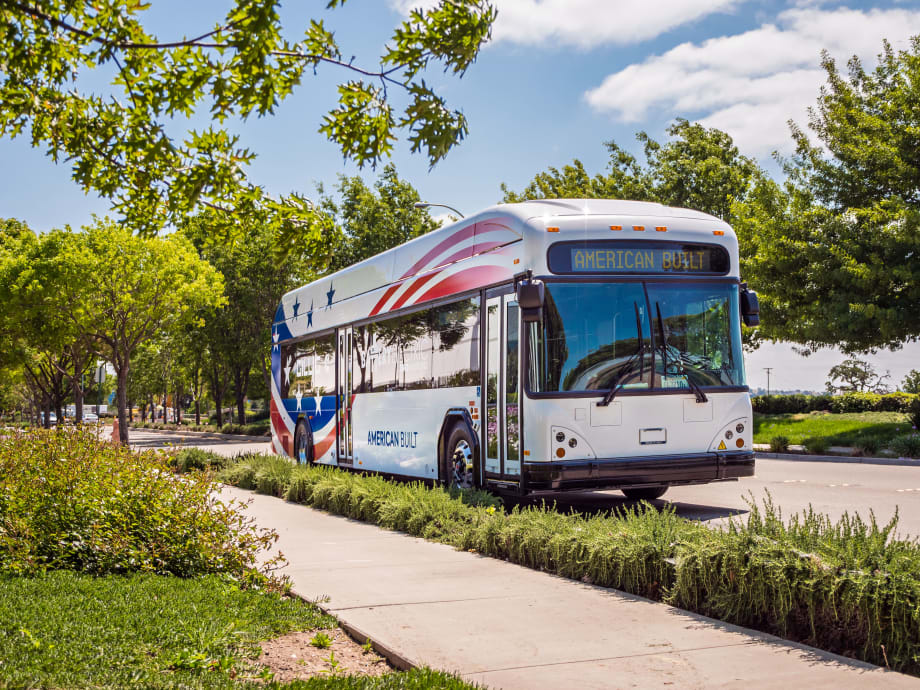
The GILLIG Battery Electric Bus will have a battery capacity of 444 kWh, with company officials expecting a real-world range of 150 miles based on an energy usage of 2.3 kWh per mile.
Todd Gardner
The GILLIG Battery Electric Bus will have a battery capacity of 444 kWh, with company officials expecting a real-world range of 150 miles based on an energy usage of 2.3 kWh per mile.
Todd Gardner
(This article originally was published July 1, 2019)
In May 2019, GILLIG, in partnership with Cummins, unveiled its new 40-foot Battery Electric Bus to its customers at an event held at its Livermore, California headquarters. The introduction was the culmination of GILLIG’s newest partnership with Cummins, but also another step on a long journey between two of the industry’s biggest stalwarts.
“Our two companies have been working together for many years. In fact, I believe we’re approaching close to 70 years since we first started using their product offerings,” says VP, Sales and Marketing at GILLIG, Joe Policarpio.
“Together, we have more than 200 years of knowledge and experience in the marketplace, and customers trust Cummins and GILLIG to make high-quality and reliable products,” adds Julie Furber, VP, Electrified Power, at Cummins. “With all of this as a foundation, we knew our battery-electric bus partnership would be best-in-class.”
The Bus
The new GILLIG Battery Electric Bus features a direct-drive traction motor with peak torque of 3500 Nm (2,582 lbs.-ft.), and utilizes energy recovered from a regenerative braking system. A package of e-accessories will be powered through various convertors, with the initial bus deployment utilizing plug-in charging. GILLIG officials add that inductive- and conductive-charging capabilities will also be available shortly.
The bus is designed on GILLIG’s proven Low Floor bus platform, which ensures parts and training commonality with existing GILLIG fleets. Since it incorporates the Cummins electrified powertrain, the bus provides transit agencies with the advantage of accessing full local service support with hundreds of Cummins service centers throughout the country to provide the necessary training, warranty administration, and aftermarket parts for the electrified power system.
“We have over 500 different customers throughout the U.S. in hundreds and hundreds of cities, so as we were getting ready to deploy battery-electric buses we wanted to make sure we had the appropriate service support in each one of those metropolitan areas,” says Policarpio, adding that each bus will come with two years of service and support.
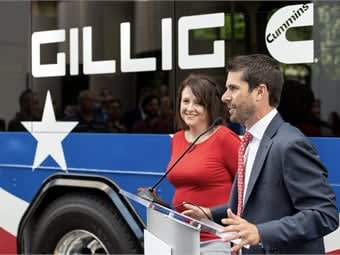
In May, GILLIG President and CEO Derek Maunus and Cummins’ VP, Electrified Power, Julie Furber introduced the new GILLIG Battery Electric Bus at the APTA Mobility Conference.
Cummins
“GILLIG’s existing customers will find it helpful that they’ll be able to call the same phone number and work with the same distributors and dealers they already know to help them with their service needs,” says Furber.
Furber adds the company is currently training its technicians to get them up to speed with the new electrified powertrain, particularly in the 20 or so service centers located closest to the agencies that will be receiving the initial GILLIG Battery Electric Buses. All told, she says that Cummins will be able to leverage the knowledge and best practices developed across the company’s 3,500 service centers located globally.
“We’re able to leverage the brick-and-mortar around those systems, processes, and technicians already in place, which is a tremendous benefit we bring to the equation,” she says.
Policarpio says the battery-electric bus was about four years in the making. At both its own event in May and this year’s APTA Mobility Conference, both Policarpio and President/ CEO Derek Maunus have stressed that the development of the battery-electric bus reflects the company’s values to offer products only when GILLIG is able to stand behind them, while continuing to forge strong relationships with its transit agency partners.
“We’re not always first to market, because we feel it is more important to get it right before we unveil a new product,” says Maunus, who also has apologized on several occasions that it took so long for GILLIG to take the leap into the battery-electric market.
“There’s no doubt that people look around and say, ‘hey, aren’t you two a little late to the party?,’” says Furber about both companies’ leap into electrification. “But, both companies want to make sure that when we put a product out on the market that it does exactly what we say it will.”
The GILLIG Battery Electric Bus will have a battery capacity of 444 kWh, with company officials expecting a real-world range of 150 miles based on an energy usage of 2.3 kWh per mile; GILLIG noted that they could claim 210 miles at the industry-advertised 1.7 kWh per mile, but that is not a realistic transit operation energy usage.
“There is a lot of misinformation out in the market right now, so we are saying that we expect the realistic range of the vehicle to be 150 miles,” explains Policarpio. “But, that range is going to depend upon several factors, such as the ambient capacity of the environment, route profiles, and driver training, so each transit agency will be different.”
Furber says a critical key to Cummins’ technology is its decision to invest heavily in Lithium-Ion batteries.
“They are a core piece of the system,” she explains. “Our expertise lies in the development of the module and how the packs and enclosures are put together.”
Furber also explains that an additional key piece of the Cummins power-train technology is, as with its other engine systems, its ability to integrate into other systems, such as with GILLIG’s battery-electric bus. The controls and overall integration optimizes the vehicle performance.
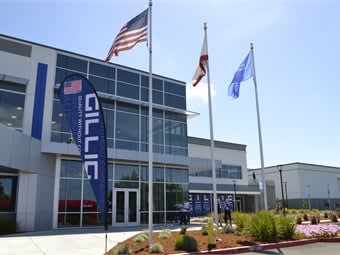
GILLIG will manufacture its new Battery Electric Bus alongside its clean-diesel, CNG, and hybrid-electric offerings at its plant in Livermore, Calif.
Alex Roman
The road ahead
Policarpio says that GILLIG is set to begin production of its battery-electric bus, which is built to SAE, UNECE, and CharIN standards, in May 2020, with the first bus set to be delivered to Santa Monica, Calif.’s Big Blue Bus.
“We’ll be delivering that bus soon, and once it’s placed into service it should give us some more data points as we move forward on this project,” Policarpio says, adding that the company also expects to build a 35-foot model.
The rest of the initial run of buses manufactured in 2020 are set to be delivered to FTA Low-No grant applicants, with whom GILLIG partnered in the most recent round of funding, says Policarpio. The company also has several vehicles undergoing various tests, with one touring the U.S. throughout the next year, and is partnering with ChargePoint to provide the bus charging infrastructure.
As for how many battery-electric buses GILLIG expects to produce on a yearly basis, Policarpio says the company plans on letting the market determine that number.
“We’re unique to some of our competitors in that we’re agnostic to the powertrain that our customers select — they can select a clean-diesel, CNG, hybrid-electric, or battery-electric bus from us and we’ll build it here at our plant,” he says. “So, we’re going to let the market determine what they want us to build and we will have the capacity to go in whatever direction that demand takes us.”
Policarpio also adds that the company is well aware of the opportunities that will be available in their own backyard.
“The California Air Resources Board has made it required for transit agencies to have all zero-emission bus fleets by 2040, and that regulation in fact goes into effect with 100 percent of purchases starting in 2029,” he says. “And, I think we’ll be very well positioned for that since we are a California manufacturer.”
More Bus

New York MTA Plans Largest Bus Fleet Upgrade in More Than a Decade
The agency is seeking manufacturers for 650 new CNG buses to replace aging vehicles, improve reliability, and advance its broader fleet modernization strategy.
Read More →
Building a Flexible Path to Transit Electrification
John Hroncich discusses BAE Systems’ modular and scalable approach, lessons learned from decades of real-world operations, and how agencies can identify electrification strategies that fit their fleets.
Read More →
Bus Tech Talk: Keeping Transit Technicians Ahead of the Technology Curve
LA Metro’s Obed Mejia discusses technician training, evolving maintenance technology, fleet replacement, and strategies for getting the most out of today’s transit fleets.
Read More →
Biz Briefs: RIPTA Unveils New Frontrunners, Clevland RTA Adds New Siemens, and More
In METRO's latest installment, we take a look at recent news from Siemens, Prevost, Dodge, and more partnerships making headlines across the transportation sector.
Read More →
People Movement: Holly Arnold Joins Transdev and More
In this edition, we also cover recent appointments and announcements at Pace, CamTran, MCI, and more, showcasing the individuals helping to shape the future of transportation.
Read More →
The High Cost of Transit Buses: Industry Leaders Look to Procurement Reform
Transit leaders and policymakers examine how standardized bus designs, streamlined procurement, and predictable funding could help agencies stretch budgets and deliver better service.
Read More →
The Business Voice Behind Public Transportation
As chair of APTA’s Business Members Board of Governors, Ray Melleady explains how more than 850 business members are partnering with transit agencies to advance funding, innovation, and industry-wide collaboration.
Read More →
From Surviving to Thriving: Building Stronger Transportation Organizations
Bus Business Consultants founder Brian Dickson shares lessons on leadership, organizational health, and creating options for long-term success in a changing transportation industry.
Read More →
Finding the ‘Happy Medium’: Optimizing Maintenance Without Sacrificing Reliability
The key to maintenance optimization isn’t doing less work—it’s doing the right work at the right time on the right assets.
Read More →
LA Metro, City of West Hollywood, and Partners Advance Smarter Bus Lane Enforcement
The award-winning partnership combines AI-powered detection with human oversight to improve bus reliability, accessibility, and enforcement efficiency.
Read More →