Biden Administration Marks 2nd Anniversary of IIJA
To date, the Administration has announced nearly $400 billion in IIJA funding, including over 40,000 specific projects and awards, across over 4,500 communities in all 50 states, D.C., the territories, and for Tribes.
Since President Biden took office, Amtrak has upgraded 29 stations to full Americans with Disabilities Act (ADA) compliance, and 30 more stations will be made accessible in the next year, to ensure that all passengers can access Amtrak service.
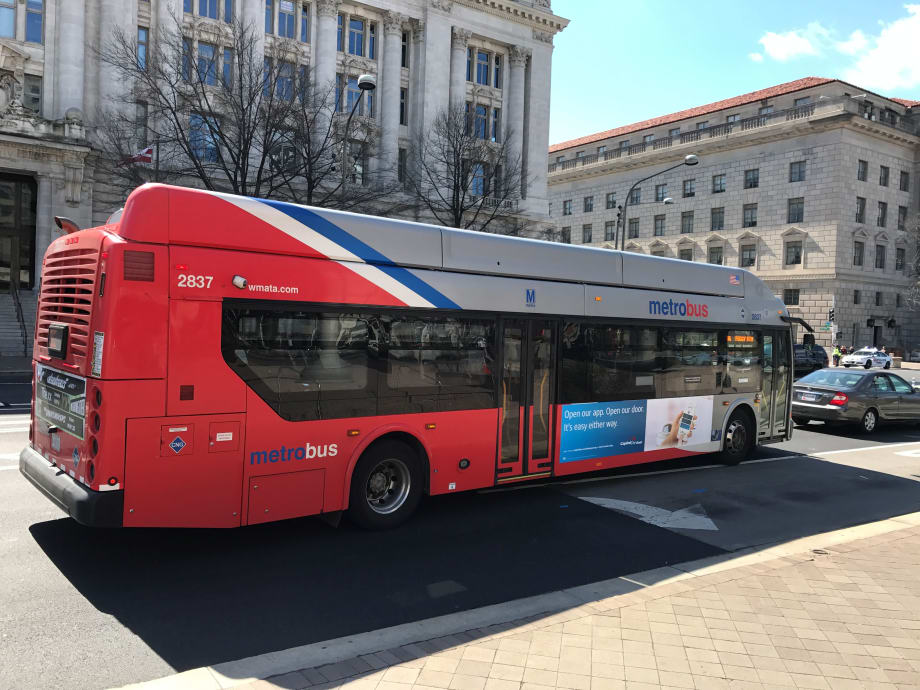
Photo: METRO Magazine
7 min to read
Ed Note: This story has been updated with quotes from Jannet Walker-Ford
Nov. 15 marked the second anniversary of the Infrastructure Investment and Jobs Act (IIJA), or Bipartisan Infrastructure Law, which was signed into law by President Biden and provided a “once-in-a-generation investment in America’s infrastructure and competitiveness.”
Ad Loading...
To date, the Administration has announced nearly $400 billion in IIJA funding, including over 40,000 specific projects and awards, across over 4,500 communities in all 50 states, D.C., the territories, and for Tribes.
“The IIJA is a generational investment in the nation’s infrastructure,” said Marcos Diaz Gonzalez, executive VP at STV. “This investment brings numerous opportunities to the transit industry, and it requires enhanced collaboration to maximize their impact.”
To highlight the wide-ranging impact of the IIJA, the White House released updated state-by-state fact sheets, along with an updated map showcasing the more than 40,000 projects and awards identified or now underway.
Progress By The Numbers
Implementation of the IIJA is a key piece of the President’s “Investing in America” agenda, which has helped drive over $614 billion in private sector manufacturing and clean energy investments in the U.S.
Specifically, there have been major private sector manufacturing announcements in electric vehicle (EV) charging, EV batteries, rail, buses, and transit infrastructure, spurred by infrastructure investments tied to the Administration’s Made in America policies.
Ad Loading...
"The steady, significant funding for transportation provided by the IIJA allows transit and rail providers to think beyond State of Good Repair and immediate needs and imagine a long-term approach to the nation’s transportation system that can transform communities and connect the nation with a focus on sustainability, resiliency, and equity," explains Jannet Walker-Ford, sr. VP, transit and rail business lead, at WSP USA.
Thanks to the IIJA, the Administration has already:
Started improvements on 135,800 miles of roads and launched over 7,800 bridge repair projects, increasing safety and reconnecting communities across the country.
Launched seven world-class Regional Clean Hydrogen Hubs with $50 billion of public and private sector investment, a historic leap forward in growing the clean energy economy across the nation.
Launched over 2,300 projects to help communities build resilience to threats such as the impacts of climate change and cyber-attacks.
“Having committed federal funding unlocks supplemental funding from state, local, and private sources,” explains Matthew Tucker, global transit director at HDR. “It also provides communities with more confidence funding will be available for their needs, one reason we’ve seen the Capital Investment Grant pipeline grow to more than 60 projects. Committed federal funding allows the industry to identify, plan, and implement projects and improvements that serve communities more efficiently and effectively.”
Accomplishments Across Key Sectors
The Biden-Harris Administration has made notable progress implementing the IIJA across key sectors, including the investment of over $300 billion in repairing and rebuilding America’s roads and bridges — the largest investment since President Eisenhower’s investment in the interstate highway system, according to the Administration.
Ad Loading...
Funding is already improving safety, strengthening supply chains, and reconnecting communities across the country. To date, the Administration has launched over 7,800 bridge repair projects.
In addition, since President Biden took office, improvements have started on 135,800 miles of roads thanks to funding provided by the U.S. Department of Transportation (USDOT).
The IIJA has also enabled the largest federal investment in EV charging in history, with $7.5 billion in available funding.
To date, almost $2.4 billion in funding has gone to states, and construction is underway to build out a network of chargers along the nation’s highways. Thanks to these investments, the number of publicly available charging ports on America’s roads has surpassed 161,000, nearly a 70% increase since Biden took office.
In addition, the IIJA invests over $7 billion to support the domestic manufacturing of batteries and the extraction, refinement, and processing of the critical materials that power them. The investment, paired with the tax credits in the Inflation Reduction Act, is hoping to help accelerate the country’s electric vehicle future, strengthen supply chains, and create good-paying jobs, according to the Administration.
Ad Loading...
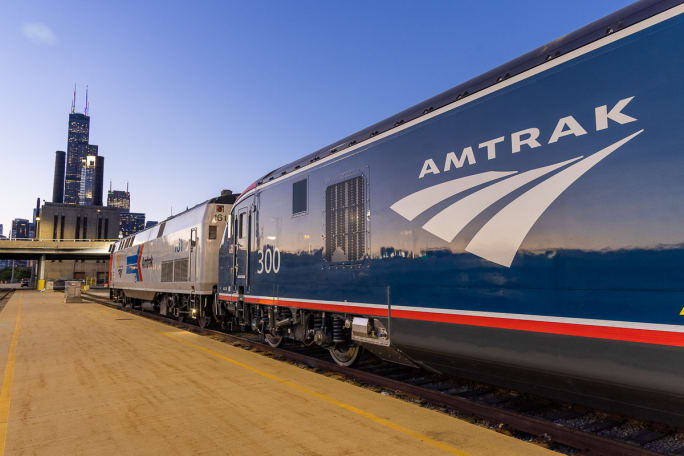
Since President Biden took office, Amtrak has upgraded 29 stations to full ADA compliance, and 30 more stations will be made accessible in the next year, to ensure that all passengers can access Amtrak service.
Photo: Amtrak
Passenger Rail Investments
The IIJA has even further impacted the public transit industry, through the investment of $66 billion for passenger rail — the largest investment since the inception of Amtrak and an unprecedented investment in rail safety.
Since President Biden took office, Amtrak has upgraded 29 stations to full Americans with Disabilities Act (ADA) compliance, and 30 more stations will be made accessible in the next year, to ensure that all passengers can access Amtrak service.
The Administration also announced:
$16.4 billion for 25 passenger rail projects on the Northeast Corridor to repair aging infrastructure, reduce delays, and improve reliability and speed. This includes the Hudson River Tunnel in New York, where the Administration has committed $11 billion to build a new tunnel to serve the 200,000 daily passengers between New York and New Jersey, and the Frederick Douglass Tunnel in Baltimore, which will replace a 150-year-old tunnel and create good-paying union jobs.
$4.6 billion in additional funding through the Federal-State National Program to expand rail service outside of the Northeast Corridor.
$1.4 billion for 70 freight and passenger rail projects, which will improve safety and benefit the supply chain in the nation’s rail.
Funding for projects that will improve safety and ease of access for 400 at-grade rail crossings in 32 states.
“New funding in the NEC is just an example of the critical role transit will continue to play as the nation transitions with a focus on sustainability and equity,” says Tucker. “The ability to provide faster and more frequent mobility options positively impacts quality of life, boosts economic growth, and reduces harmful emissions.”
Ad Loading...
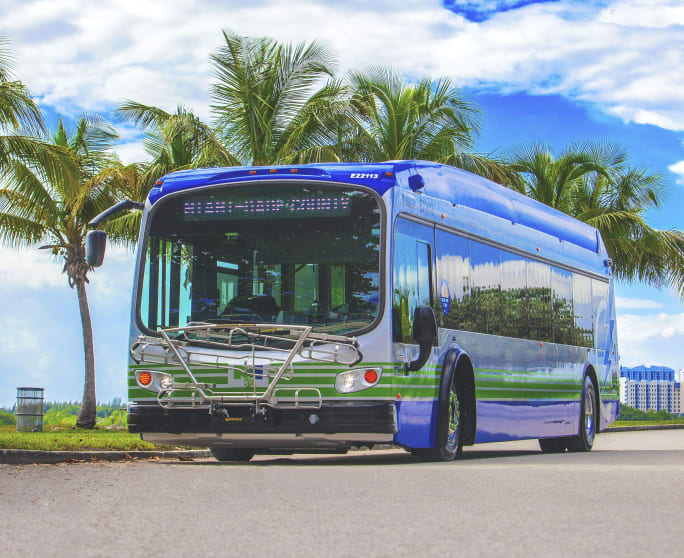
To date, the Biden-Harris Administration has funded over 2,900 low- and zero-emission transit buses through the Department of Transportation.
Photo: Proterra/Miami-Dade Transit
Investing in Electrification, Rural and Tribal Mobility
The IIJA also made the largest investment in public transit ever, at nearly $90 billion — including billions to electrify or upgrade bus, transit rail, and ferry fleets.
“The bill mandated that all transportation across the country will transition to net zero-emissions by 2050. Between the amount of money that was being earmarked for this effort, and the mandate itself, what was once viewed as a hypothetical concept had been transformed into a reality,” says Diaz Gonzalez. “The IIJA has provided the seed money to kickstart the zero-emission transformation, especially the planning phase. Looking ahead, we need to take the planning it’s funded, along with lessons learned, and operationalize these programs for the long-term.”
"With a 10-fold increase in the Lo-No program and a focus on carbon reduction for grant eligibility, the IIJA is driving a significant increase in demand for zero-emission buses across the country," adds Walker-Ford. "As a result, [firms like] WSP are also working with our transit clients on new approaches for charging infrastructure and systems that support the roll-out of ZEB."
The Phoenix Northwest Light Rail Extension, currently under construction, will transport nearly two million Phoenix residents to new stations and employ transit-oriented development to develop new housing and retail along this route.
Bipartisan Law funding has also provided support for 1,300 rural transit systems to purchase transit vehicles and infrastructure, plan transit more effectively, and fund operations.
It has also awarded $462 million in USDOT discretionary funding directly to Tribes in 28 states, with a total of 247 grant awards to improve transportation on Tribal lands. The program is one of the first designed to coordinate closely with community leaders to help begin the process of relocating crucial community infrastructure away from imminent threats and build long-term resilience to climate impacts.
Looking ahead, HDR’s Tucker emphasizes the importance of transit continuing to capitalize on the Administration’s investment in public transit.
“The industry will need to broaden the thought process of the scope of projects to include community needs and goals that support increased housing, commercial development, and economic development,” he says. “The successful implementation of projects will build confidence and community support that will be required for future funding opportunities. Finally, the industry needs to share its success stories and what the investment meant for communities, riders, and local businesses.”
Contract Four is the largest in the Second Avenue Subway Phase 2 project and includes construction of station infrastructure, tracks, and signals for the subway expansion, MTA officials said. Work on Contract Four will begin in 2027.
The new regional transit authority appointed its first board chair and interim executive director while extending reduced fares across CTA, Metra, and Pace for eligible riders.
Reliability-Centered Maintenance helps transit agencies move beyond routine checklists to focus limited resources on the assets and failures that have the greatest impact on safety, reliability, and service.
The 90-day demonstration will deploy coordinated security teams at five light rail stations while testing controlled access and gathering data to guide future investments.
Learn about delivering 1300 gates at 91 stations while managing fare evasion. Explore the large scale deployment, solution customization and real-world results that affect the region. Prepare for deployment in your region now.
Between packed transit stations and team motorcoaches, see how agencies and operators across North America tackled the transportation demands of the 2026 FIFA World Cup.
The stopgap keeps federal transportation programs moving, but missing advance funding could complicate the transit and rail projects agencies are planning next.