Building a Bridge to Hydrogen for On-Vehicle Fuel Delivery Systems
This article is designed to provide guidelines for fleet owners and manufacturers looking to make the switch to hydrogen.
by Steve Duricky
June 23, 2023
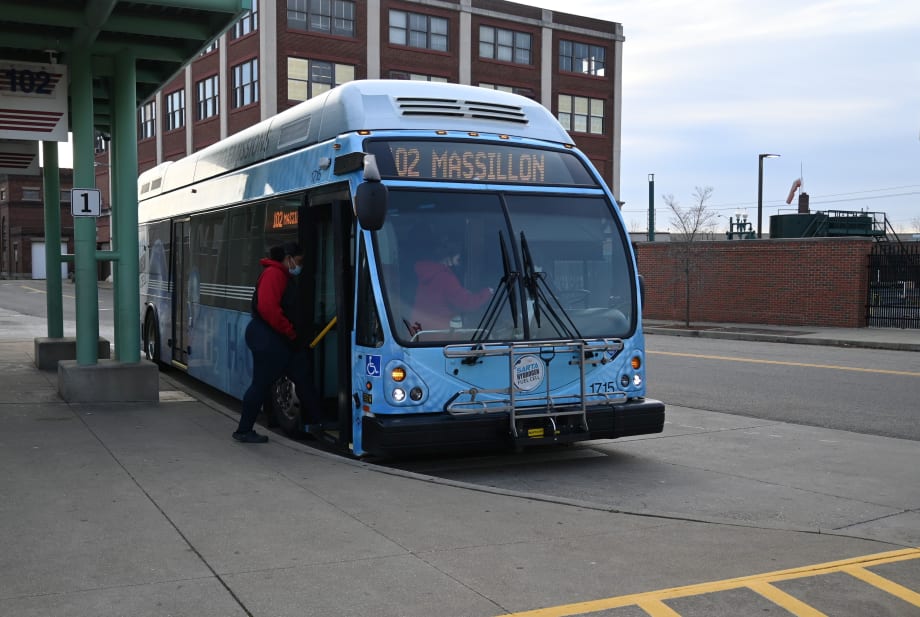
SARTA joined the “Generation Zero” pledge program in July, which consists of groups committed to clean alternative fuel solutions for the transportation industry.
Photo: SARTA
6 min to read
With all the increased regulations and incentives around the use of cleaner fuels, more bus manufacturers and operators are considering ways to convert their fleets to hydrogen.
The benefits of hydrogen are well known. However, the challenges of working with hydrogen are equally known and have, to date, prevented many fleets from taking advantage of this greener option.
Ad Loading...
This article is designed to provide guidelines for fleet owners and manufacturers looking to make the switch to hydrogen.
What should you consider when designing and maintaining an on-board hydrogen fuel system? (For purposes of the article, we are focusing on compressed (not liquid) hydrogen since more manufacturers currently use compressed natural gas (CNG) vs. liquid and, to date, there has been more market demand for compressed hydrogen vs. hydrogen in a liquid form.)
Choosing between Natural Gas and Hydrogen
Today, there are more green power source options than ever before to fuel transportation fleets. And every OEM and fleet operator needs to determine which option works best for a specific application.
As part of this evaluation, you may be trying to decide whether to go the route of natural gas (sometimes also referred to as methane) or hydrogen. Both are gases, can be used in an internal combustion engine (ICE), and are cleaner than diesel.
However, while CNG is cleaner than diesel, it still contains some carbon. Only hydrogen represents the truly zero-carbon solution.
Ad Loading...
On the downside, hydrogen isn’t as energy dense, so you need to store more of it, and it must be stored at a much higher pressure to achieve the same range. Whereas CNG vehicles typically keep natural gas at pressures of around 3,600 psi, hydrogen vehicles store their fuel at pressures of up to 10,000 psi, nearly three times as high. The higher pressure presents safety, as well as operational, challenges.
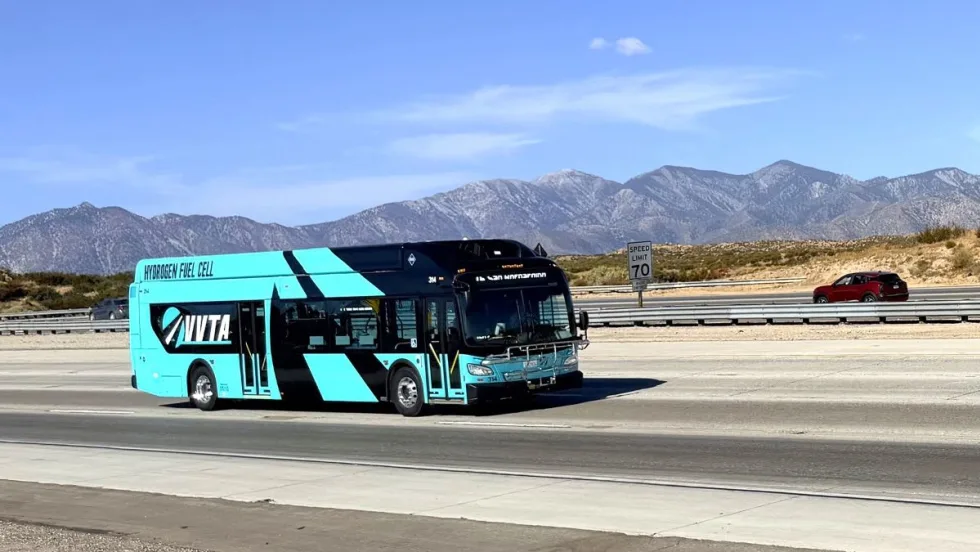
With a long history in producing and dispensing alternative fuels, the SunLine team is positioning their “small, but mighty transit fleet for long-term sustainable success.
Photo: SunLine Transit
Meeting Higher Standards/Certifications
The majority of components found on a hydrogen vehicle can be validated through HGV3.1 or the soon- to-be released ISO 19887.
HGV3.1, which was recently released, was published by ANSI and CSA and is more commonly followed in the U.S. ISO19887 is projected to be released at the end of 2023. Both standards will share similar requirements.
When choosing components for your hydrogen system today, it’s important to make sure they are certified to either EC-79 or HGV3.1 approvals. EC-79, which is being phased out and replaced by ISO 19887, is an EU-created certification that ensures the safety and performance of hydrogen equipment under different pressures, electric, mechanical, and thermal conditions. It addresses the pressure containment, performance, and safety characteristics of newly produced compressed hydrogen gas fuel system components intended for use on hydrogen gas-powered vehicles.
Components that have not met these higher standards may not be able to withstand the higher pressures associated with hydrogen-fueled vehicles. Any component in the fuel delivery system, including seals, fittings, and filters, must be compatible with the fuel to avoid premature failures or catastrophic leaks and help ensure a leak-free system.
Ad Loading...
A common problem associated with hydrogen-incompatible materials is hydrogen embrittlement, also known as hydrogen-assisted cracking or hydrogen-induced cracking. Hydrogen embrittlement is a reduction in the ductility of a metal due to absorbed hydrogen. Since hydrogen atoms are small and are under tremendous pressure, they can permeate solid metals. Once absorbed, hydrogen lowers the stress required for cracks in the metal to initiate and propagate, resulting in embrittlement.
Hydrogen embrittlement occurs most notably in steels, as well as iron, nickel, titanium, cobalt, and other alloys. Copper, aluminum, and stainless steel are less susceptible to hydrogen embrittlement, although only the right grades of stainless can be used — typically a 316 minimum.
Learning from Experience with CNG
If you’re considering converting your fleet or, at least, part of it to hydrogen, it may at first seem like an overwhelming task because of all the changes needed in system design and concerns regarding component material compatibility.
However, take comfort in knowing that you don’t need to start from scratch in addressing various challenges because, if you are already using CNG to some degree, you have already likely solved some of the challenges you’ll face in using hydrogen.
For example, there are already on the market sealing solutions that have been designed to handle higher pressures. Proper seals are critical when handling gases at elevated pressures, especially considering the amount of vibration experienced while traveling over the road.
Ad Loading...
Seal-Lok™ fittings and adapters from Parker, for example, were specially created for onboard hydrogen and CNG fuel systems. The Seal-Lok fitting design is approved for 700 bar (10,000 psi) hydrogen service and CNG service up to 250 bar (3600 psi) Seal-Lok fittings feature an enhanced flat-face sealing surface and approved O-ring compounds that meet the demands of high-pressure gaseous service.
O-rings overall have proven more effective than metal-to-metal connections in maintaining a leak-free seal despite the challenges of added vibration from over-the-road travel. O-rings are also easier to replace since you can simply drop out the damaged component. With metal-to-metal connections, you may need to replace the entire tube assembly.
Lessons have also been learned from working with CNG in the area of filtration.
Oil carryover can be a problem when natural gas is compressed to higher pressures, sometimes introducing oil into the fuel. Whether you’re using natural gas or hydrogen, you need the right filtration system to filter out particulates, oil, water, or other contaminants that could otherwise damage the engine or fuel cell. Installing a filter on both sides of the regulator has been proven particularly effective. This allows the removal of dirt and metal parts at high pressure before getting to the regulator to ensure the integrity of its performance and also removes contaminants on the low-pressure side (since some contaminants are more likely to get through at high pressure).
In the more than 20 years that CNG has been used on public buses, we have learned how to effectively convey fuel, control it, and filter it. And we’ve learned how to safely store it on the vehicle at high pressures, often using specialty hoses and seamless stainless steel tube assemblies that have proven effective for the task.
Ad Loading...
Many of these same innovations (assuming they meet the newer hydrogen-specific standards) can create the foundation for a safe, efficient, leak-free hydrogen-powered system.
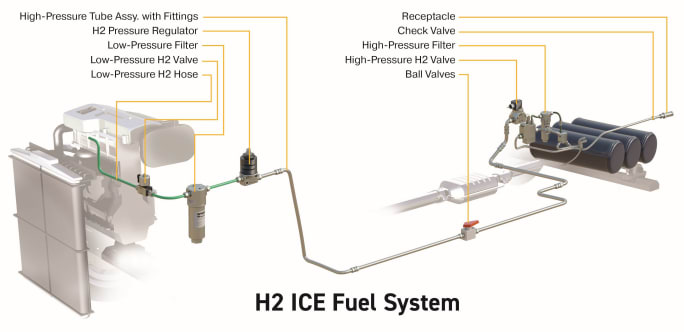
Parker offers key components used in a hydrogen fuel system for fluid conveyance, control and filtration.
Photo: Parker
Comparing ICEs to FCEVs
Even once the decision is made to convert to hydrogen, there are additional considerations. Should you, for example, go with a hydrogen ICE or a hydrogen fuel cell electric vehicle (FCEV)? A key difference is in the amount of nitrides being released as part of the reaction of burning the fuel in an internal combustion engine (ICE). These nitrides can be captured using aftertreatment systems similar to what’s found on existing diesel engines today.
Fuel cells directly convert the chemical energy in hydrogen into electricity with pure water and, potentially, useful heat as the only byproducts. With a fuel cell, you are not burning anything; rather, the chemical reaction generates electricity that charges the on-board battery, so the only emission is H2O.
Hydrogen fuel cells can act as effective range extenders because they operate more efficiently than an ICE, possessing more than two times the efficiency of traditional combustion technologies. In contrast, most of the energy in the fuel is lost as heat with an ICE, regardless of the type of fuel being used.
Weighing Your Options
There are many considerations when preparing to convert your fleet to hydrogen. That’s why it’s important to choose the right partner who has the necessary experience to understand the options and what will work best for your specific application.
Ad Loading...
When it comes to safely and efficiently designing a natural gas or hydrogen powered vehicle, you need the right kind of experience on your side.
About the Author: Steve Duricky is a global platform manager for Parker Hannifin
The Call for Papers is now open, allowing transit agency professionals and industry experts to help shape the PTC educational program by submitting session ideas for consideration.
The “Buses Mean Business” report examines the transit bus manufacturing industry’s economic footprint, supply chain, and rising demand for vehicle replacements.
See how three Gillig battery-electric buses powered festival stages while the agency’s new Park & Ride service carried approximately 1,000 attendees, demonstrating another potential use for transit agencies’ electric fleets.
The new name represents a renewed vision for the nonprofit focused on advancing clean, equitable, and affordable transportation solutions that move people and goods.
John Hroncich discusses BAE Systems’ modular and scalable approach, lessons learned from decades of real-world operations, and how agencies can identify electrification strategies that fit their fleets.
UB, transportation solutions provider WeDriveU, and fleet electrification specialist Zenobē marked the deployment in the presence of students, university administrators, and local officials.
From manufacturers and suppliers to transit agencies and motorcoach operators, these updates offer a snapshot of the projects, partnerships and business moves driving the industry forward.
The agency’s maintenance chief discusses leadership, workforce development, zero-emission technology, and preparing technicians for the future of public transportation.
The firm will work with CTDOT and RVT to define the facility layout, operational requirements, and long-term flexibility for RVT’s growing electric fleet.