Clay Payne, PE, serves as VP, Right-of-Way and Facilities, at Burns Engineering.
Photo: Burns
5 min to read
Clay Payne, PE, serves as VP, Right-of-Way and Facilities, at Burns Engineering, where he helps deliver innovative projects that enhance the traveler experience and achieve the strategic goals and visions of the transit agencies who operate them.
Payne also serves on the American Railway Engineering and Maintenance-of-Way Association (AREMA) Technical Committee 35 – Information and Technology.
Ad Loading...
METRO Magazine sat down with Payne to discuss challenges facing transit projects, alternative project delivery, high-speed rail, and much more.
What are the key challenges facing transit projects in trying to get capital projects completed?
Funding is always an issue. Even though the Infrastructure Investment and Jobs Act provides a nearly 80-percent funding bump through 2026, split across multiple federal transit programs, a lot of exciting projects still aren’t able to proceed. Agencies face a “use it or lose it” scenario, leading some to hold off initiating smaller projects in favor of fewer, larger capital projects. As costs continue to escalate, it’s the less-risky — and more efficient — use of funding.
Aside from funding, permitting remains a challenge as do operational requirements for active construction sites. These are the traps so many projects continue to fall into — particularly for agencies operating within dense urban areas — causing delays and cost overruns.
What, if any, are some new trends you are seeing that are helping projects reach completion sooner, or at least in the client’s desired time frame?
Progressive design build — while not necessarily new — is certainly gaining traction as a delivery method. The owner selects the design-build contractor based on their qualifications, ensuring maximum value rather than simply lowest cost. This comes prior to developing baseline design, enabling greater owner involvement throughout design and the budgeting process. The contractor provides a preliminary guaranteed maximum price, which they update during agreed-upon project milestones.
Having the owner, engineer, and contractor on board during all stages of a project is usually a more cost-effective approach to deliver the owner’s vision at lower risk. With progressive design-build, the contractor and design team have reasons to collaborate, resulting in fewer conflicts during construction. That said, it can still be very challenging to develop a fixed price when designs are not complete and when the scope is still not fully defined. It’s not without risk.
Ad Loading...
What sort of alternative project delivery models would you like to see take hold here in the U.S. that are being used elsewhere throughout the world?
There are a lot of innovations taking hold. But sometimes, it’s the tried-and-true methods that still have the best results. Traditional design-bid-build is one of the best ways for an owner to get exactly what they want.
With alternative delivery methods, contractors may take greater liberties interpreting how to deliver on bridging documents, which are not as granular as design-bid-build specifications. For design-bid-build, the design elements are agreed to before the project goes out to bid. From one project to the next, there’s greater consistency with the transit agency’s standards for safety, accessibility, and reliability.
Design-bid-build methods are also more accommodating of transit agencies' limited staffing resources. This method ensures a continual flow of projects; designs are ready to go when projects are ready to be funded. Otherwise, when projects are fast-tracked through an alternative delivery method, many agencies simply don’t have resources available to do their reviews.
That said, design-build is still the best option when a project needs to be completed in a short window. When the I-95 bridge collapsed in Philadelphia last year, it was a progressive design-build approach that allowed the owner, contractor, and builder to collaborate and finish the job so remarkably fast.
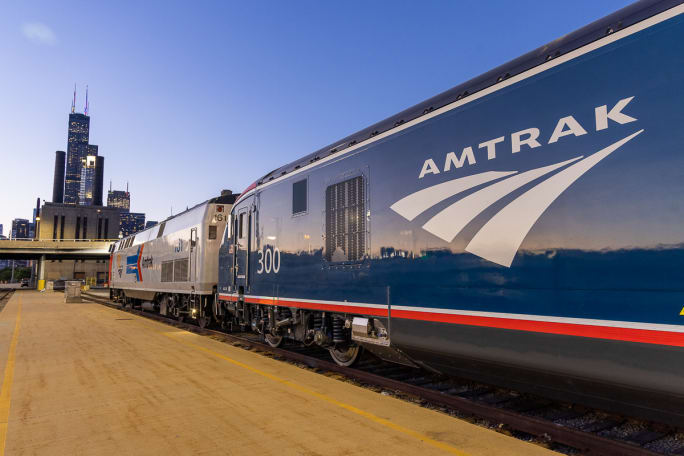
Reaching speeds of 160 miles per hour, high-speed trains are expected to shorten commutes, reduce energy use, and encourage even more riders along the Northeast Corridor — already the busiest of Amtrak’s routes.
Photo: Amtrak
After facing some serious backlash, high-speed rail seems to again be picking up steam. What do you feel needs to happen for both the mode and projects to be successful?
At Burns, we are very excited for the rollout of Amtrak’s Next-Generation High-Speed Trainsets. Reaching speeds of 160 miles per hour, high-speed trains are expected to shorten commutes, reduce energy use, and encourage even more riders along the Northeast Corridor — already the busiest of Amtrak’s routes. In anticipation, Amtrak is undertaking several upgrades to station platforms and maintenance facilities across the corridor, which we’re proudly supporting.
Ad Loading...
Earlier this year, Amtrak unveiled a brand new, high-level platform at Baltimore Penn Station. Burns has led the Penn Station renovations and we’ve worked on similar projects at New Carrolton Station and Washington Union Station. Meanwhile, signal work across the Northeast Corridor is being layered on top of existing measures to ensure the faster trains do not present new safety risks.
How can transit adapt to ensure it remains an essential service and viable mobility option?
It’s critical for transit agencies to continually challenge assumptions of who their riders will be and what those riders’ mobility needs will look like — 10, 20, or 30 years from now. Many forecasts predict urban populations — and demand for public transit — to keep growing. But changes in technology, demographics, and the future of work are creating huge uncertainties.
Equity needs to be the driver for a lot of these decisions. Transit systems remain vital for low-income communities, the country’s growing population of older Americans, and riders with disabilities transit systems remain vital. As long as resources remain limited, transit agencies must continue to prioritize infrastructure upgrades that benefit riders whose livelihoods and wellbeing truly depend on access to reliable transit.
It’s also critical that we future-proof transit systems as vehicle technology evolves. A lot of attention and financial resources are being devoted to transitioning bus fleets to zero-emission vehicles. With it will come a massive buildout of new infrastructure, a re-mapping of many bus routes, and questions of whether to install enroute charging or refueling systems.
Less appreciated, but equally important, are questions of how maintenance operations will be impacted. In the not-too-distant future, agencies will likely need entirely new maintenance depots in completely different locations to accommodate any changes in routes and vehicle maintenance systems.
Contract Four is the largest in the Second Avenue Subway Phase 2 project and includes construction of station infrastructure, tracks, and signals for the subway expansion, MTA officials said. Work on Contract Four will begin in 2027.
The Garden State Initiative analysis examines the roles of Amtrak infrastructure, fleet management, and agency operations while recommending a more performance-based approach to improving reliability.
Beginning in 2027, Stadler will provide on-site technical expertise, spare parts support, training, and obsolescence management to help extend the reliability and longevity of CapMetro’s GTW fleet.
In METRO's latest installment, we take a look at recent news from Complete Coach Works, Beep, FlixBus, and more partnerships making headlines across the transportation sector.
Pedestrian microsimulation is helping rail planners identify bottlenecks, test station designs, and prepare complex transit hubs for growing passenger volumes.
The privately developed project would offer a 15-minute trip between downtown and O’Hare’s Terminal 2, with trains operating every 15 minutes on a dedicated track. The service would use battery-electric trains and three existing freight rail rights-of-way.
The draft feasibility report identifies strategies to protect the coastal rail line for decades as the agency continues near-term stabilization and sand placement efforts.