



Clear the Way: How Bus Lane Automation Can Improve City Transit
When private vehicles use designated lanes, agencies are forced to assess the impact the behavior has on city-wide congestion and public safety.
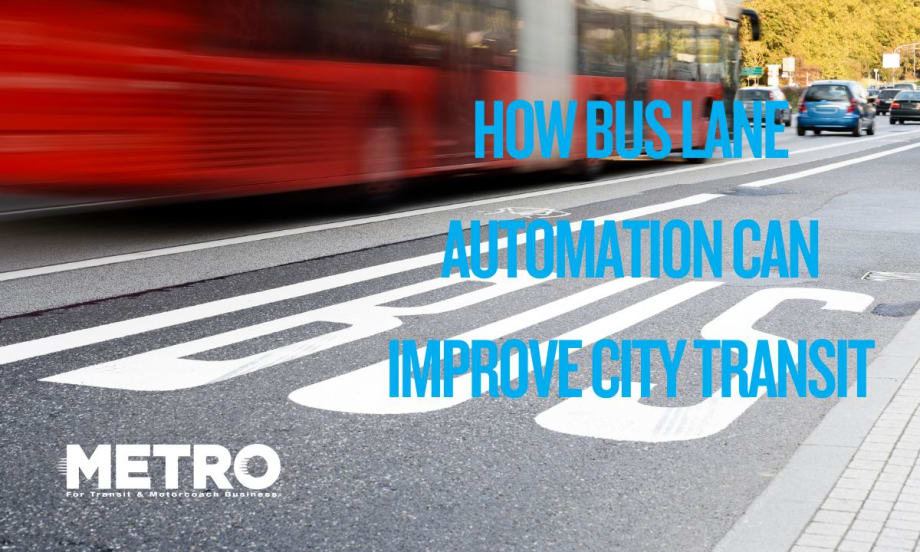
One clear sign of heightened congestion is a growing number of unauthorized vehicles occupying bus lanes.
Photo: METRO
- Private vehicles using designated bus lanes lead to increased city-wide congestion and safety concerns.
- Agencies analyze the consequences of misuse of bus lanes in order to gauge its impact on public transit efficiency.
- Implementing strict bus lane automation could alleviate traffic issues and improve overall city transit systems.
*Summarized by AI
As urban populations grow, transit agencies must determine how best to manage traffic congestion insign of heightened congestion is a growing number of unauthorized vehicles occupying bus lanes.
When private vehicles use designated lanes, agencies are forced to assess the impact of this behavior on city-wide congestion and public safety.
Obstructed lanes slow buses, leading to a domino effect of other issues. Non-transit vehicles in a bus lane can also block ambulances or fire trucks from reaching an emergency.
In response, U.S. transit agencies are introducing automated bus lane technology as a solution. This involves placing cameras and sensors on city buses or camera poles to monitor private and commercial vehicles in designated bus lanes.
The technology notifies agency authorities of violations to change driver behavior, reduce congestion, and improve public transit efficiency and safety.
The Case for Bus Lane Automation
Traffic congestion is a rising concern for many American commuters.
The INRIX 2024 Global Traffic Scorecard reported the average U.S. driver lost 43 hours — more than one whole week of work — to traffic last year.
With congestion back to pre-COVID levels in many regions, transit agencies are incentivized to improve service times by clearing transportation infrastructure slowdowns.
Adding dedicated bus lanes can reduce travel time during rush hour by 20% to 25%, and adding automated camera enforcement can improve speeds by as much as 36% on enforced bus routes, saving riders time and, most importantly, helping people get to work and back home on time.
When new bus lanes are created, agencies typically notice increased ridership and emphasize police enforcement to prevent unauthorized obstructions.
However, enforcement tends to dwindle over time due to challenges such as budget constraints, human resource limitations, and authorization conflicts.
Insufficient enforcement of bus lanes also poses safety concerns.
Without enforcement, transit agencies can’t ensure available curb space for emergency vehicles, collisions between buses and other vehicles become more likely, and wheelchair passengers are put at risk.
If a vehicle is obstructing the lane, the bus driver may be unable to lower the wheelchair ramp at the correct angle. This can prevent those passengers from boarding safely.
For these reasons, the Washington, D.C., Department of Transportation recommends using automated enforcement systems as a best practice to maintain safety along bus lanes.
Ultimately, bus transit improvement programs can only succeed when the lanes themselves are kept clear for authorized use only. For agencies focused on improving their bus routes and promoting public safety, adding bus lane automation is often a natural next step.
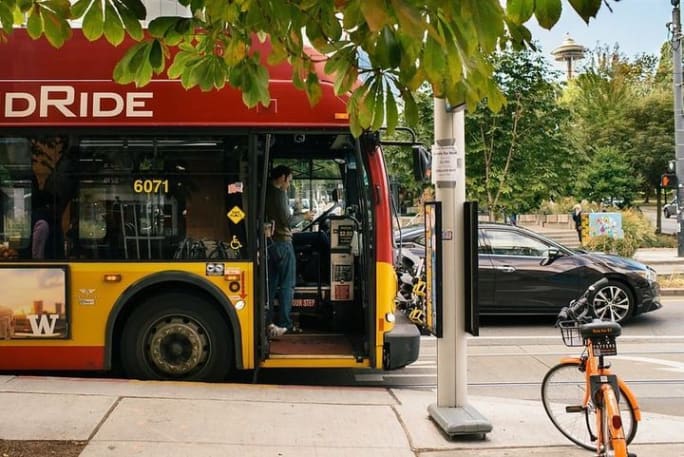
In November 2024, Seattle’s King County Metro (KCM) introduced a 60-day bus automation pilot program to assess the frequency with which drivers occupied bus lanes.
Photo: SDOT
Spotlight on Seattle
In November 2024, Seattle’s King County Metro (KCM) introduced a 60-day bus automation pilot program to assess the frequency of drivers occupying bus lanes.
To do this, the agency mounted AI-powered cameras on buses servicing Seattle’s RapidRide E Line and Route 7. These are two of the city’s busiest routes, extending far north and south of downtown Seattle.
The pilot program aimed to reduce Seattle’s bus delays and collisions, save riders’ time and taxpayer money, and address the city’s booming traffic.
In 2024, traffic congestion in the city increased by 9%. It currently ranks 10th in the U.S. for worst traffic congestion, with drivers losing 63 hours per year to delays.
Seattle’s pilot program didn’t ticket any drivers initially, the main goal was to collect data.
Within its first two weeks, KCM found that 25% of its RapidRide E and 27% of its Route 7 trips experienced delays, and the agency will continue to work to improve these numbers throughout 2025.
To prevent errors, a human reviewed each pilot infraction to validate the lane violation, while an AI system, in partnership with Hayden AI,ned on the route. Later this year, the agency will assess results to evaluate the accuracy of the AI systems and determine rollout plans.
Results From Across the Country
In June 2024, New York City’s Metropolitan Transit Authority (MTA) announced the agency had deployed Automated Camera Enforcement (ACE) on 623 buses.
In the initial deployment, the agency found that only 9% of drivers committed a second bus lane violation after receiving a fine, indicating that almost all cited drivers changed their driving behavior after their first citation.
Since implementation, average bus speeds have risen by 5%, collisions have decreased by nearly 20%, and one bus route along Manhattan’s 14th St. saw weekday ridership soar by 24% with the service improvements.
All the buses on the 14 routes currently enabled with lane enforcement technology have now been updated with state-of-the-art, artificial intelligence-based enforcement technology, allowing the agency to expand enforcement at bus stops and cite double-parked vehicles.
In 2019, the Los Angeles Metro and LADOT installed more than 40 miles of bus-only lanes. This alone initially increased ridership, but they noticed a decline in value as drivers began veering into these lanes.
Additionally, LA Metro introduced its ACE program in November 2024 to enhance safety and transportation reliability for its 700,000 riders.
Similarly, Oakland expanded its bus lane automation program just two months after its initial installation because of its effectiveness.
Verra Mobility reported improved bus route arrival times for one client, exceeding 3,000 hours in just one year, saving more than 130 days for its riders. These success examples are by no means exhaustive, but they offer a baseline for what’s possible for transit agencies across America.
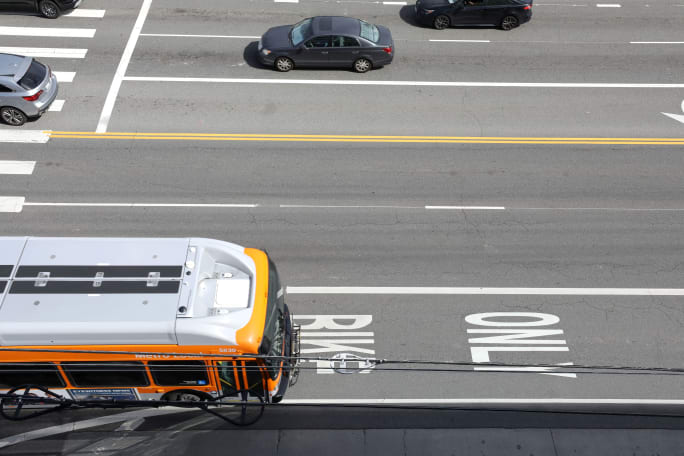
LA Metro introduced its ACE program in November 2024 to enhance safety and transportation reliability for its 700,000 riders.
Photo: LA Metro
Best Practices for Deployment
Often, the deployment of new bus violation technology can make significant changes in driver behavior. When drivers know they risk fines by using a bus lane, that knowledge can encourage them to drive a little further to find a legal parking spot.
To help educate a community, it’s helpful to proactively address resident concerns.
Commuters should be aware of bus lane rules, and enforced routes and corresponding fines should be made publicly available and easily accessible. Bus lanes should also be clearly marked for all drivers.
It’s also helpful to explain the benefits of bus lane automation to local transit users.
When they understand the impact the technology has on faster bus routes, reduced traffic congestion, and safety, they may become more open to its use.
Automated enforcement is also more cost-effective than human enforcers, saving taxpayer money and allowing authorities to focus on more urgent civil matters.
Transit agencies must also assign event review responsibilities to human officers until AI technology has enough data to understand how violations happen on a specific route. This is to prevent inaccurate citations during the training phase.
As buses repeatedly complete their routes, machine learning algorithms will improve their accuracy until the AI can operate independently.
Along with event review, automation providers typically handle everything surrounding the technology. This includes hardware and software installation, maintenance and updates, and data security management.
Bus lane automation offers transit agencies a viable and effective way to change driver behavior and improve public safety.
Cities such as Seattle, New York, Los Angeles, and Oakland are already tackling these issues by modernizing public transportation infrastructures and bus lane automation nicely complements these efforts. By taking advantage of automation technology, transit agencies can start to reduce congestion, save taxpayer dollars and transform bus lines for the better.
About the Author: Melba Rivera-Irizarry is VP, Strategic Accounts, at Verra Mobility
Quick Answers
Keeping private vehicles out of bus lanes ensures that public transit can operate efficiently, reducing congestion and improving safety by maintaining clear and dedicated pathways for buses.
*Summarized by AI
More Technology

From Hardware to Digital Partner: Luminator Charts Its Next Chapter
CEO Magnus Friberg discusses Luminator’s shift toward becoming a digital partner, the growing importance of software and interoperability, and how AI can help agencies improve operations and passenger experience.
Read More →
Beyond the Checklist: A Structured Approach to Transit Maintenance
Reliability-Centered Maintenance helps transit agencies move beyond routine checklists to focus limited resources on the assets and failures that have the greatest impact on safety, reliability, and service.
Read More →
NJ TRANSIT Advances Bus Technology Upgrades Across Statewide Fleet
More than 1,500 buses now feature upgraded technology designed to improve arrival predictions and provide free Wi-Fi, with deployment expected to reach nearly 2,000 buses by the end of 2026.
Read More →

Building a Flexible Path to Transit Electrification
John Hroncich discusses BAE Systems’ modular and scalable approach, lessons learned from decades of real-world operations, and how agencies can identify electrification strategies that fit their fleets.
Read More →
Biz Briefs: Alstom Lands Canadian Contract, LYT to Supply California TSP, and More
In METRO's latest installment, we take a look at recent news from Complete Coach Works, Beep, FlixBus, and more partnerships making headlines across the transportation sector.
Read More →
From Legacy Silos to Conversational Intelligence
What if transit leaders could ask any operational question and get a trusted answer in seconds? Conversational AI is transforming how agencies use their data.
Read More →
USDOT Announces Rail Vehicle Replacement Grants, Chattanooga AV Shuttle Funding
More than $191 million in federal funding will help three transit agencies replace aging rail vehicles and support a new autonomous shuttle service in Chattanooga.
Read More →
Bus Tech Talk: Keeping Transit Technicians Ahead of the Technology Curve
LA Metro’s Obed Mejia discusses technician training, evolving maintenance technology, fleet replacement, and strategies for getting the most out of today’s transit fleets.
Read More →
Biz Briefs: RIPTA Unveils New Frontrunners, Clevland RTA Adds New Siemens, and More
In METRO's latest installment, we take a look at recent news from Siemens, Prevost, Dodge, and more partnerships making headlines across the transportation sector.
Read More →
Why Simulating Pedestrian Movement Has Become Essential for Modern Rail Stations
Pedestrian microsimulation is helping rail planners identify bottlenecks, test station designs, and prepare complex transit hubs for growing passenger volumes.
Read More →