



CALSTART and the FTA Explore Wireless Charging for BEBs
METRO’s Executive Editor Alex Roman spoke to CALSTART’s Brian Ballschmidt, Brian Lee, Katrina Sutton about key findings from its recent report for the FTA, what the future may hold for wireless charging, and more.

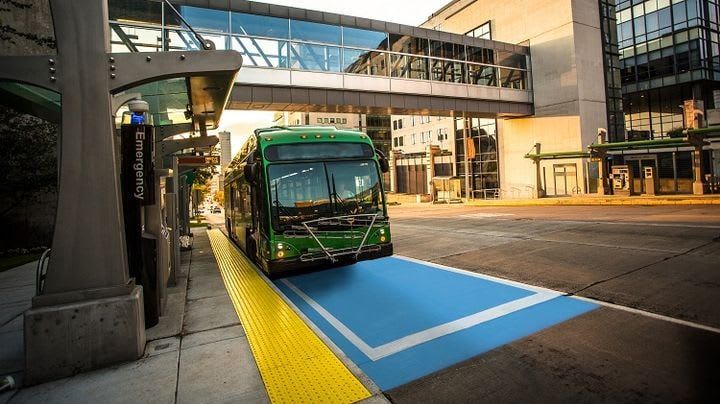
Through comprehensive literature review and stakeholder interviews, the CALSTART report explored the current state of wireless charging — also known as inductive charging — along with its potential advantages, challenges, and implementation barriers within the U.S. transit landscape.
Photo: HDR
- CALSTART representatives shared insights from their report on wireless charging technologies for battery electric buses (BEBs) with METRO’s Executive Editor, Alex Roman.
- The discussion covered potential advancements and future implications of implementing wireless charging solutions for public transit systems.
- The report aims to inform the Federal Transit Administration (FTA) on the feasibility and benefits of transitioning to wireless charging for improved efficiency and sustainability.
*Summarized by AI
In response to a federal directive, the Federal Transit Administration (FTA) tasked CALSTART with assessing the viability of wireless charging technology for battery electric buses (BEBs) as an alternative to traditional wired systems.
As transit agencies face growing pressure to decarbonize fleets, reliable and efficient charging infrastructure is essential. Wireless charging offers the promise of reduced space requirements, streamlined operations, and the ability to extend BEB range through on-route charging.
However, the technology remains nascent, with standards for high-power systems still under development, limiting widespread deployment and investment, according to CALSTART.
Through comprehensive literature review and stakeholder interviews, the CALSTART report explored the current state of wireless charging — also known as inductive charging — along with its potential advantages, challenges, and implementation barriers within the U.S. transit landscape.
The resulting report highlights practical recommendations to overcome adoption barriers, including the need for standardization, funding strategies, and industry education, while also finding that whether as a primary charging solution or a range extender, high-power wireless charging may play a pivotal role in enabling the transition to zero-emission public transit.
METRO’s Executive Editor Alex Roman spoke to CALSTART’s Brian Ballschmidt, deputy director, technology and demonstration; Brian Lee, lead project manager; and Katrina Sutton, technical project manager about key findings from the report, what the future may hold for wireless charging, and more.
CALSTART's Inductive Charging Report
METRO: Can you talk about how this report came about — what were the motivations and how did your team get involved?
Sutton: This research was funded by the FTA as part of a larger initiative called the Transit Vehicle Innovation Deployment Centers — TVIDC for short. The goal is to address the challenges around adopting zero-emission buses across the country.
The wireless charging report is one of several projects we're working on. Others include battery fire safety, zero-emission auxiliary heaters, bus specification standardization, and end-of-life applications for zero-emission buses. It’s exciting work, and CALSTART thrives on these innovative efforts.
METRO: I’ve been covering this space for a while. Wireless charging seemed promising early on, but adoption has been slow. What hurdles have kept it from scaling?
Sutton: We interviewed around five or six transit agencies, and responses varied. One of the biggest hurdles is education — many people simply don't know much about wireless charging. That’s why efforts like this report are important.
It's also about fostering good relationships and communication between transit agencies, OEMs, and wireless charging companies. The technical integration is complex, and those partnerships are critical to success.
Lee: Integrating wireless charging into vehicles requires significant upfront engineering work. Once that’s done, future integrations become easier, but that initial barrier has slowed progress.
Also, wireless charging works best for specific use cases — like fixed-route transit systems where buses can charge during scheduled breaks. For agencies with more dynamic or flexible routes, planning becomes more complicated.
Ballschmidt: I’d add that installing the infrastructure can be a challenge, especially in public spaces where permits and interagency coordination are needed. In contrast, installing chargers at depots is more straightforward because the agency controls the space.

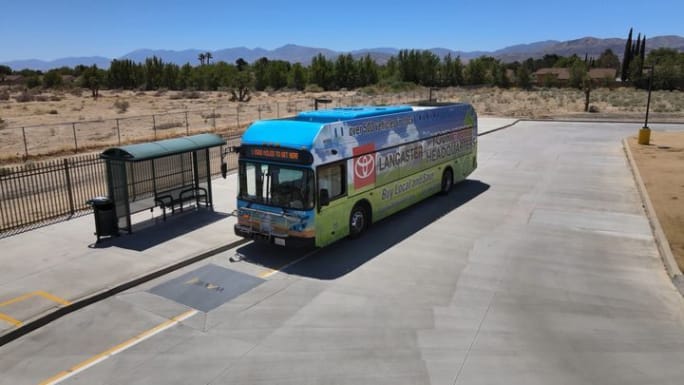
Lancaster, Calif.'s AVTA has successfully utilized wireless charging as part of its fully-electric bus fleet.
Photo: AVTA
The Impact of Wireless Charging
METRO: From a public transit perspective, how important is wireless charging for extending range and maximizing the benefits of electric buses?
Sutton: It’s interesting — there hasn’t been a ton of organic interest from transit agencies. Many OEMs don’t highlight wireless charging either; they prefer to promote pantograph or wired charging.
Again, it goes back to awareness and education. That said, I’m really interested in shared-use opportunities — like at airports where shuttles and transit buses could charge at the same station. But that opens up more coordination challenges around rights-of-way and ownership.
Lee: Sharing operational data is essential. Demonstrations — like the one we’re working on with UCLA — help prove the technology’s viability. Plus, on-route wireless charging allows smaller batteries, which lowers costs and reduces capital expenditures. It also lets agencies take advantage of daytime renewable energy sources, especially in places like California with lots of solar power.
Ballschmidt: Another issue is the slow development of standardized requirements. That’s been picking up recently, but it's been a concern. Without standards, agencies are understandably wary — especially around safety and long-term viability.
METRO: How many companies are in the market offering wireless charging right now?
Lee: For high-power transit applications, it really narrows down. We’re mostly looking at systems around 200 to 500 kW. The main players for that range are Electreon Wireless Ltd., WAVE, Induct EV, and possibly a few more.
METRO: You mentioned OEMs being hesitant, why do you feel that is the case?
Sutton: Wireless charging is definitely an add-on — it comes at an extra cost both for OEMs and the transit agencies. Some OEMs have said they don't want to touch it until the market stabilizes. Others are open but cautious, especially because the systems aren’t interoperable.
The lack of standardization is a big concern. Different systems require different tech. SAE J2954 is the standard being developed, with Dash-2 focused on stationary high-power applications like transit. It’s progressing, but we’re not there yet.
Ballschmidt: Plus, there’s a huge backlog for bus manufacturing right now — some OEMs are two-plus years out. That makes them less inclined to invest time or money into new tech like wireless charging unless there’s proven demand and a clear path forward.
METRO: Between pantograph and wireless charging, is one simpler or cheaper?
Lee: Hard to say definitively without full data, but pantographs have had issues with alignment. If the bus isn’t parked just right, the pantograph might not connect properly. There’s also mechanical complexity — if one part fails, the system doesn’t work.
With wireless, the alignment is more forgiving. You just drive over the pad and it charges. Fewer moving parts means fewer mechanical failures.
Ballschmidt: The wireless charging panels are quite large — roughly two to two-and-a-half feet on each side — so there's some room for misalignment.
The research was funded by the Federal Transit Administration as part of a larger initiative called the Transit Vehicle Innovation Deployment Centers — TVIDC for short.
Photo: WAVE
Overcoming Hurdles is Key
METRO: What’s needed to overcome the current hurdles? Is standardization the key?
Sutton: Yes — standardization is crucial. Without it, it's hard to qualify for funding or ensure long-term viability.
Hardware costs also matter — wireless usually has a better ratio of chargers to vehicles, but the vehicle-side hardware can be costly.
Demonstrations and real-world validation are essential too. Agencies want to know: Can it work in snow? Can people safely walk over it? They need that confidence before adopting it.
METRO: Given possible shifts in federal priorities, will reports like this still have impact?
Ballschmidt:CALSTART’s focus on technology and demonstration is about much more than just transit buses. The innovations we explore can ripple out into other vehicle sectors. These efforts support job creation, economic growth, and environmental benefits. Whatever happens politically, I believe we’ll keep pushing forward. This work matters — and it’s not going away.
Quick Answers
The main focus is the key findings from CALSTART's recent report for the FTA and the future of wireless charging for Battery Electric Buses (BEBs).
*Summarized by AI
More Zero Emissions

Building a Flexible Path to Transit Electrification
John Hroncich discusses BAE Systems’ modular and scalable approach, lessons learned from decades of real-world operations, and how agencies can identify electrification strategies that fit their fleets.
Read More →
California's VVTA Begins Phased Rollout of Hydrogen Fuel Cell Buses
The agency is introducing 13 zero-emission buses into revenue service while evaluating performance across its urban, rural, and long-distance routes.
Read More →
Inside Look: University at Buffalo Puts First 8 Electric Buses Into Stampede Service
UB, transportation solutions provider WeDriveU, and fleet electrification specialist Zenobē marked the deployment in the presence of students, university administrators, and local officials.
Read More →
Biz Briefs: OCTA Taps Clean Energy for Hydrogen Station, Stadler to Supply Via Rail Vehicles, and More
From manufacturers and suppliers to transit agencies and motorcoach operators, these updates offer a snapshot of the projects, partnerships and business moves driving the industry forward.
Read More →
AC Transit’s Cecil Blandon on Building the Next Generation of Transit Maintenance Leaders
The agency’s maintenance chief discusses leadership, workforce development, zero-emission technology, and preparing technicians for the future of public transportation.
Read More →
CTDOT Taps STV for Electric Bus Facility Design
The firm will work with CTDOT and RVT to define the facility layout, operational requirements, and long-term flexibility for RVT’s growing electric fleet.
Read More →
Chicago’s Pace Deploys 24 Hybrid-Electric Buses in Will County
The new buses reduce emissions and fuel consumption while advancing the agency's long-term goal of transitioning to a fully zero-emission fleet.
Read More →
DASH Breaks Ground on First On-Route Electric Bus Chargers in D.C. Region
The fast-charging infrastructure will help extend electric bus range, improve fleet utilization, and support DASH's goal of transitioning to a fully zero-emission fleet.
Read More →
Biz Briefs: Montréal Debuts Nova Electric Buses and More
In this edition of Biz Briefs, we spotlight the latest developments shaping the future of mobility.
Read More →
2026 METRO Buyer’s Guide & Directory
Searching for the right vehicles, technology, equipment, or services for your public transit or motorcoach operation? This industry guide brings together manufacturers and suppliers from across the transportation market — all in one place. Download it to connect with the companies that help agencies and operators improve mobility, enhance operations, and move their organizations forward.
Read More →