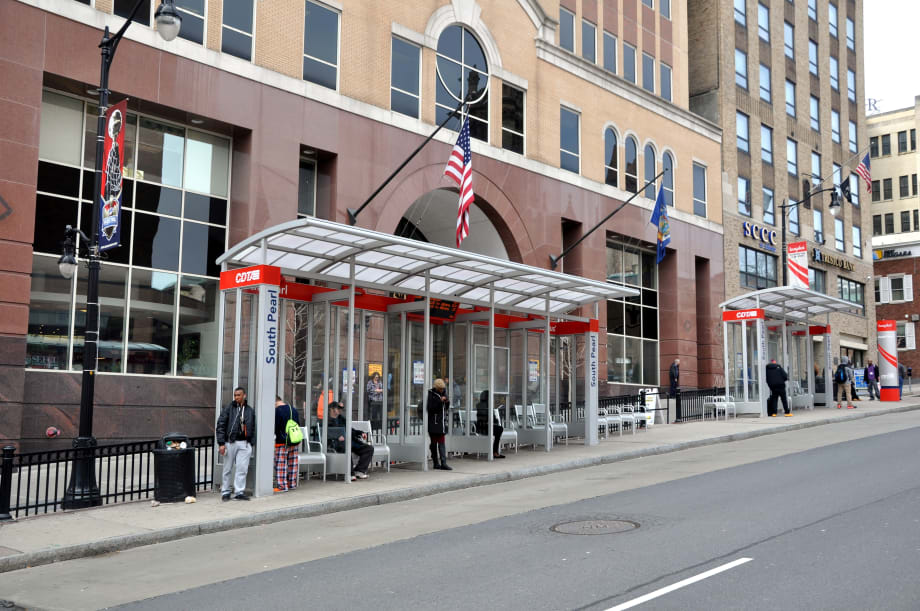
Lower-priced materials are huge factor in this shift. Amenities being implemented include LED displays and solar lighting, to make riders feel welcome.
by Roselynne Reyes, Assistant Editor
May 2, 2016
DuoGuard
7 min to read
DuoGuard
In 1961, Columbia Equipment became the first bus shelter manufacturer in North America. “At that time, if you told people that you made shelters, they thought bomb shelters,” says Arthur Cohen, co-founder of Columbia Equipment, who served as president for 40 years. “Not too many people knew what a bus shelter was.”
Cohen’s father, Al, worked in outdoor advertising in New York when he heard that the city was looking to build their first bus shelters. Hoping that this could one day be a new venue for advertising, he made a bid and won the contract to build and maintain the first bus shelters in New York, which were designed by a consulting engineer.
Ad Loading...
The original structure was simple — no signage and a 12-foot-high roof. However, the substantial height meant that the canopy did little to shield passengers from rain and wind. At the time, Cohen was studying to be an architect and worked on developing a better design.
Not long after, a more passenger-friendly shelter was introduced and spread across the country, which became the standard for decades. Half a century later, transit has transformed and shelters are following suit. Many cities are looking for smarter, more user-friendly shelters that accommodate a wide range of riders.
CHK America
These Digital Bus Stops feature high-contrast, sunlight-readable displays operated via battery or solar power, allowing transit agencies to deliver service change updates to bus stops everywhere effectively and efficiently from one central location without expensive electrical infrastructure improvements, and at the same time, provide improved service to riders with real-time departure information.
Transit agencies welcome the solution because they can be easily deployed almost anywhere without requiring electrical infrastructure at bus stops. www.chkamerica.com
Adding a personal touch “If I was talking to you maybe 15 or 20 years ago, everybody wanted to have as many shelters as they could get for a given amount [of money], which means it was a white dome roof and a dark bronze or clear anodized shelter,” says Kevin Chown, director, sales, for Duo-Gard Industries. “Now, everything is going much more upscale, much more ornate.”
All of the manufacturers agree that custom-designed shelters are becoming the standard. Lower-priced materials are a huge factor in this shift, as many transit agencies can now afford to choose more personalized elements.
“Agencies are incorporating the branding or the new color scheme of their system into the design to show both riders and non-riders alike what they’re doing with their tax dollars,” says Patrick Merrick, executive VP for Tolar Manufacturing.
Ad Loading...
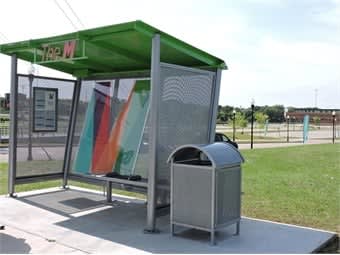
As a result, manufacturers are offering more colors and design options. Merrick says that Tolar recently developed a way to print branding directly onto perforated aluminum. Previously, they would need to print on glass and find a way to add that to the design.
Columbia Equipment
From the beginning, Columbia Equipment’s goal has been to offer well-designed, modular shelters that can be standard or customized. Although they’ve built up a large portfolio of designs over the past 50 years, Cohen says that every new project starts from scratch, with the company’s architects tailoring every shelter to meet a customer’s specific needs.
Customers can choose a size, wall configuration, framing system, roof design, glazing material, aluminum finish and base detail from a variety of options. Shelters also come with a variety of add-ons, from benches and advertising panels to lighting and heating. www.columbiaequipment.com
Other companies have experimented with “floating” glass panels, color-changing LED lights or patterned powder coats to create unique design elements.
Jennifer Evans, director, sales and marketing, for Brasco International, says that their business is now 80% custom orders. Many of these products incorporate some design that is specific to the city.
“We’ve collaborated with photographers on incredible glasswork projects and student architects on roof designs inspired by local rivers. And they’re all focused on the same thing — bringing their community together with things they all have in common,” she says.
Brasco International
The SolStop is a solar-powered bus stop that provides security lighting. The push-button LED light turns on for five-minute increments, allowing the rider to view stop information and feel safer while waiting for the next bus. It can be attached to an existing transit pole or stand alone. The SolStop can also be fitted to include a variety of accessories including a map case, digital bus stop or bench.
The unit is pre-wired and pre-assembled for easy setup and requires little maintenance. The light has a 50,000-hour operating lifespan, is powered by a 10- or 20-watt solar panel, and when paired with a bench, costs half the price of a standard bus shelter. www.brasco.com
Scaling up (and down) Many transit agencies are adding bus rapid transit (BRT) lines along their busiest routes to accommodate more riders. As a result, many are requesting bigger shelters that can accommodate large groups. Chown says that Duo-Gard recently built BRT shelters in downtown Minneapolis right outside of a college.
Ad Loading...
“Those are huge stops. When they have a game, you could have hundreds and hundreds of people, and they wanted to be able to keep them all covered at any one time,” he explains.
For regular bus stops, transit agencies are also seeking more shelters that can accommodate bicycles. As demand increases, some are finding that bike racks aren’t enough, asking for bus and bike shelter hybrids or even a separate bike shelter that can store many bikes at once.
“A lot of it is to take care of that first- and last-mile at transit agencies,” Chown says, while noting that, for many, demand increases exponentially once bike riders realize they will have a place to store their bike once they get to their bus stop."
At the same time, many agencies are looking for options that accommodate many riders while fitting within the infrastructure. Some opt for cantilever shelters, shelters with a large canopy with small walls or just columns.
“You have a very small footprint with a seven-foot canopy roof, but you get a ton of sun shade and weather protection,” says Evans.
Ad Loading...
Tolar Manufacturing
The Signature Series features three roof options: Sunset (a radius roof), Empire (an angled flat roof) and Orion (an integrated extruded rear gutter), all supported by a multifunctional integrated aluminum extrusion designed to support the structure vertically and horizontally.
The shelter design allows for roof panels achieved with three-eighths-inch heat-formed polycarbonate, aluminum or laminated glass. Wall choices include tempered or laminated glass with custom graphic branding options or perforated aluminum. Illumination is provided through either UL-listed 110-volt LED or UL-listed solar. Many additional options are available including media display kiosks. Additionally Tolar’s powder-coat application process provides over 150 color options. www.tolarmfg.com
Integrating technology Lighting was once considered a luxury item. Now, it has become a standard option for most shelters. Not only that, but many are choosing LED lighting over fluorescent and high-pressure sodium lights. LED lighting is not only environmentally-friendly, it is also long-lasting and requires little maintenance.
“It’s all about lighting,” Evans says. “That’s attached to almost every procurement we have now.”
Many agencies are choosing solar power, which can be harnessed to power lighting elements but can also be used toward additional amenities.
“There’s more solar than there would have been 10 or 20 years ago in shelters, just because the pricing is much more conducive to doing it in a large scale,” Chown says.
Bus shelters can now offer such features as heating, air conditioning, closed-circuit television (CCTV) and USB charging ports to keep riders comfortable while waiting for their bus. Some shelters are even being fitted to provide free Wi-Fi.
Ad Loading...
“People want to be connected,” says Merrick. “You hear that young people today are using mass transit because that way they’re texting or their communication isn’t interrupted. They don’t want that disconnect. And, it’s also a way that you can find out through Google Transit or whatever when the next bus is going to be there.”
Duo-Gard Industries
The Grand-Gard series is characterized by its minimal nature. Rather than the traditional square shape, Grand-Gard shelters feature round columns. Other features include hidden hinges and screen guards for an overall clean look.
The shelter design can be personalized to the agency’s needs. Customers can choose their shelter’s color, roof style, layout and wall material. Duo-Gard also offers a variety of add-ons, such as lighting, benches, trash receptacles and backlit advertising displays.
Additional amenities include vehicle locator displays, CCTV security cameras, and heaters. Push-button or motion-detection controls are also available for security lighting, or signal lights as an energy-saving option. www.duo-gard.com
Challenges The transition to newer shelters is not seamless, though. The bus shelter manufacturers say that a challenge to designing new shelters is being able to accurately predict what riders need and what can be accommodated. For this reason, they stress the importance of collaborating with the manufacturer to discuss all options.
“They’ll purchase our shelters and then insert the signage or the wayfinding later, and then they have exterior conduit running wires along the shelter when they could be running through the columns if we do it,” Evans says.
Transit agencies are often incorporating the branding of their system into the design of bus shelters to show both riders and non-riders what they’re doing with their tax dollars.
To combat this, Brasco has begun working with specific companies to suggest the add-ons during the design process that they know integrate easily with their shelter designs and power source. They’re currently working with CHK America to integrate their digital bus stops with their stops.
Cohen also says that agencies should consider all available options for their specific shelters, rather than choosing what is popular at the moment. For example, he says that although solar lighting has become a popular request in many designs, it is not the best option for all environments. Rainy or shady areas, for example, are not ideal for solar power.
Ad Loading...
Chown also notes that it can be difficult to predict demand for new amenities that didn’t exist before.
“We are seeing that as soon as places put in [bike] racks or shelters, they may think they’ll have 10 or 20 bikes per day,” he says. “All of a sudden, it’s quadruple that because they just don’t know the demand until they put it there.”
Landscape Forms
The Metro 40 Collection from Landscape Forms was designed through a partnership with Designworks, a BMW Group Co. The collection is based on a continuous visual loop, including lighting, bike racks and benches, which run through all items in the collection. However, the center of the collection is their Metro 40 Shelter.
The shelter is offered in two sizes, four ft. X eight ft. and four ft. X 12 ft., and is made from an aluminum extrusion frame with glass side and roof panels. LED lights provide soft illumination, while sitting and leaning rails offer support for riders without taking up too much space. It is also highly durable and low-maintenance. www.landscapeforms.com
Looking forward All of the manufacturers expect real-time updates to become standard in the near future and are preparing ways to incorporate this technology into their designs.
These updates will alert riders when a bus is arriving and alert a bus driver to how many people are waiting at an upcoming stop.
“People feel vulnerable at their bus stop,” says Merrick. “They are out there in the public hoping the bus comes on time, so they can get to wherever they want to go on time. The more information you can provide them at the stop, makes the perceived wait at the stop feel shorter. More information helps the passenger make a more informed decision.”
Ad Loading...
However, for these manufacturers, the future of bus shelters is about more than technology. Overall, the goal remains to provide a space that makes riders feel comfortable and adds visual value.
“I don’t think there’s really anything that new,” Cohen says. “We’re still trying to incorporate as many different features in a shelter to make it as user-friendly, as modular, as accessible as possible. And, we try to make the shelter fit aesthetically into the environment.”
Contract Four is the largest in the Second Avenue Subway Phase 2 project and includes construction of station infrastructure, tracks, and signals for the subway expansion, MTA officials said. Work on Contract Four will begin in 2027.
The new regional transit authority appointed its first board chair and interim executive director while extending reduced fares across CTA, Metra, and Pace for eligible riders.
Reliability-Centered Maintenance helps transit agencies move beyond routine checklists to focus limited resources on the assets and failures that have the greatest impact on safety, reliability, and service.
The 90-day demonstration will deploy coordinated security teams at five light rail stations while testing controlled access and gathering data to guide future investments.
Learn about delivering 1300 gates at 91 stations while managing fare evasion. Explore the large scale deployment, solution customization and real-world results that affect the region. Prepare for deployment in your region now.
Between packed transit stations and team motorcoaches, see how agencies and operators across North America tackled the transportation demands of the 2026 FIFA World Cup.
The stopgap keeps federal transportation programs moving, but missing advance funding could complicate the transit and rail projects agencies are planning next.