



RELATED: How open-source platforms helped RTD, Sound Transit
Denver 'Charges Up' Fleet for Key Downtown Route
RTD introduced an all new low-floor electric shuttle bus fleet for its 16th Street Mall route, which serves 45,000 passengers on an average weekday, making it the agency’s single-busiest bus route.
by Janna Starcic, Executive Editor
May 3, 2017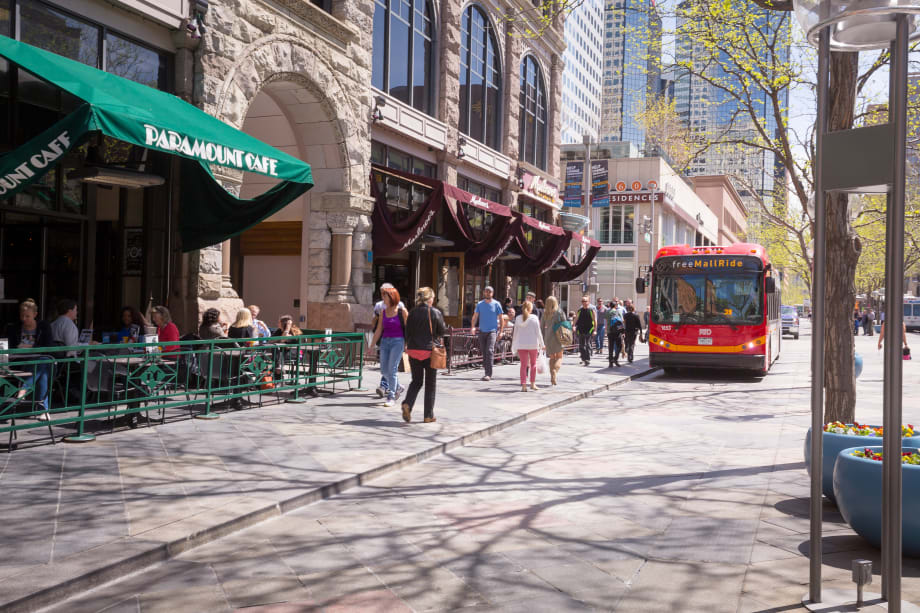
The mall shuttle provides a link between Denver Union Station and Civic Center Station and is a travel option for those who work and live in the Denver downtown area.
Photos Courtesy RTD
7 min to read
The mall shuttle provides a link between Denver Union Station and Civic Center Station and is a travel option for those who work and live in the Denver downtown area.
Photos Courtesy RTD
Last August, Denver’s Regional Transportation District (RTD) deployed 36 new low-floor electric shuttle buses for the 16th Street Mall service — the largest fully-electric bus fleet in the U.S. If that weren’t impressive enough, this particular shuttle serves 45,000 passengers on an average weekday, with a fleet of 36 buses, making it the agency’s single-busiest bus route. The 16th Street Mall, which includes the transitway and adjacent pedestrian areas, was constructed in 1982. It provides a link between Denver Union Station and Civic Center Station and provides a travel option to those who work and live in the Denver downtown area, as well as the many visitors that come to Denver each year.
Additionally, plans are underway for a “reimagining” of the mall corridor, which is in need of a revamp. “Outside of the airport train, this is the signature project that we’ve always had at RTD — everybody knows the 16th Street Mall,” says Nate Currey, senior manager, public relations, RTD. “The mall works because of our shuttle,” he says, adding that headways run anywhere from 30 seconds to seven minutes in the evenings. “[This project] is really going to be an opportunity for us to re-stamp our influence and importance in the metro area,” Currey explains.
The new electric buses, manufactured by BYD, replace RTD’s CNG/hybrid electric fleet that originally served the Mall route.
Overall, the agency operates 1,030 buses in fixed-route service. The agency’s fleet is composed of mostly diesel-powered buses, with 45 buses powered by hybrid-electric systems.
Zero-emission fleet
This is not RTD’s first foray into operating an all-electric fleet. Over a decade ago, it had operated six electric buses, explains Bruce Abel, RTD’s assistant GM, bus operations. “Because the buses are operated in a pedestrian-friendly environment; clean emissions and quiet operation were highly desirable,” he says of the agency’s fleet requirements. “The buses stop at every intersection, so this is very fitting to the regeneration feature of electric buses.”
In addition, RTD required that the buses be designed with a fully low-floor configuration for easy and fast passenger boarding and de-boarding. “Electric buses employing wheel motors do not need a differential, which allows the rear area of buses be as low as their front area, making a complete low-floor bus,” says Abel.
Each electric bus costs $750,000, while the charging stations cost $432,000 to construct. The costs for the project were partially funded by the state funds for transit, with the remaining funding coming from RTD’s local funding sources.
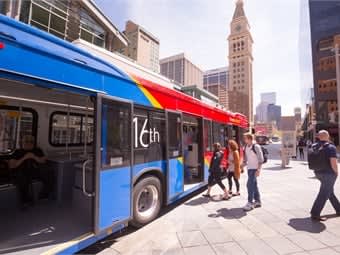
The 45-foot-long, low-floor battery-electric bus features three passenger doors, a separate driver’s entry door, and a manual ramp.
Ready to recharge
Currently, RTD schedules the electric mall shuttle buses for maximum continuous runs of eight hours a day, Abel explains. When an electric bus returns to the garage, it first goes through the washing and cleaning process and then it is driven to the charging lane where it is plugged into the battery charger. RTD has installed 30 chargers at its Platte bus parking facility to plug in the buses when they return from service.
The buses are then sorted by their state of charge (SOC) and assigned to their appropriate charging lanes. “For example, buses with SOC higher than 70% are assigned to the charging lane closest to the drivers’ area, since these buses only need a short recharge and will be the first ones to go back into service,” Abel says.
To monitor and log the SOC of the bus batteries, each bus is equipped with a Health Alert Management System (HAMS). The bus SOC information is accessible from a remote computer terminal. An RTD service group monitors the bus SOC remotely to know when the bus is fully recharged in order to unplug the charger, making the bus ready for service.
Currently, RTD hasn’t had a sufficient number of electric buses in service long enough to obtain accurate data on bus energy consumption. “But based on previous testing, we estimate the electric buses will have an energy consumption rate one-sixth to one-eighth of the rate consumed by conventional diesel or CNG buses,” Abel says. RTD will be able to report on the energy savings once the buses have been in service for at least a year, since the energy consumption in electric buses varies greatly between heating season and cooling season, he explains.
Working in conjunction with BYD, the agency provides its maintenance personnel with various training specific to the operation and maintenance of the electric buses. “This includes the safety precautions in the operation, service and maintenance of the electric buses running on high voltages; the charging of the vehicles; the bus battery service; the low-voltage and high-voltage electric systems,” Abel says.
RTD also provides first responder training to the local firefighters in case of incidents that need the fire department response.
Electric fleet takeaways
Operation: Because the electric buses operate on a pedestrian mall with busy passenger traffic, sometimes passengers are unaware that the bus is approaching because the vehicles are so quiet, explains Abel. “RTD is currently working on getting noise generators installed on the buses to provide adequate warning to pedestrians,” he adds.
Service Scheduling: Until there is sufficient operating information on the energy usage of the electric buses, RTD has conservatively set the maximum operating range for the electric buses at eight hours a day, to insure the buses would not run out of charge while in service, Abel explains.
Maintenance and Repair: Due to the uniqueness of the buses, RTD assigns the maintenance and repair of the electric buses to a group of mechanics. This arrangement takes away the flexibility in work assignment. “There is no longer the practice to assign the work of any mechanic to any subfleets in the District,” Abel says. “The service and cleaning process was also changed to require the electric buses to be sorted for different levels of charging.”
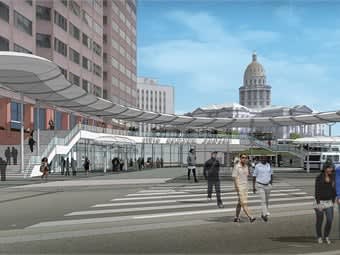
The $30 million-dollar Civic Center Station project (rendering shown), which broke ground last fall, features a welcoming and open design aesthetic.
Civic Center Station
The 16th Street Mall route connects to RTD’s Union Station, on one end, which was overhauled in May 2014, with the Civic Center Station on the other. The latter facility serves as one of RTD’s busiest regional bus transit centers with 18 routes serving an average of 15,000 passengers a day. It provides a turnaround point for the 16th Street Free MallRide and is also the location of the Civic Center Plaza.
The aging facility, which was torn down, did not “encourage good behavior,” as it was dark with lots of shadows, according to Currey. To that end, the agency collaborated with law enforcement and an architecture firm to create a much more welcoming and light-filled design.
The new state-of-the-art design proposes a complete renovation of the site including a building structure that is easier to maintain and repair long-term; open and welcoming environment design; nine bus bays; and a glass-enclosed terminal building, which will feature an open view from 16th Street Mall to the State Capitol.
The $30 million-dollar Civic Center Station project, which broke ground last fall, is slated for completion by mid-fall 2017.
Real-time app
On the heels of its Mall shuttle bus introduction, RTD launched its new Next Ride app, which incorporates real-time data to provide accurate and timely predictions for bus and vehicle locations for light rail, making it easier for passengers to plan trips and make connections. The app, available on the RTD website, does not require a separate download from a third-party applications provider (like Apple’s App Store or Google Play). It is also optimized for mobile devices, allowing riders to access it from a smart phone or tablet.
“This is transformative because you know exactly where that bus is on that map, so you know if you have time to go get a cup of coffee or you don’t have to wait in the rain,” Currey says. “We’ve seen really positive responses from the public.”
Predictions are based on the real-time position of vehicles combined with the speed to estimate arrival times. Predictions will be available 30 minutes before the start of a trip and the system will provide updates at least every 30 seconds.
Locations and predictions are available for buses while vehicle locations only are available for light rail at this time with prediction capabilities planned for the future, Currey explains. Services are not yet available for commuter rail which includes the University of Colorado A Line and the B Line.
“It’s been game-changing for us,” says Currey of the app’s launch. “It’s just another service that RTD is trying to provide to make sure that bus and rail are a great option for people as they move around the region.”
Improvement Opportunities
This summer, RTD will kick off a comprehensive community engagement process for the first time. “We will be going out to the 15 districts within RTD, and listening to what the barriers are to accessing [transit] in our communities, what are the opportunities for improvement, things like that,” Currey says. “We will be engaging with all the mayors, political leaders, business leaders, educational leaders — all of the major stakeholders in each of the districts.”
Subscribe to Our Newsletter
More Technology
Almaviva Looks to Open Architecture to Advance Transit Technology
Eric Reese discusses how interoperability, open architecture, and modular design can help transit agencies control costs, reduce vendor lock-in, and upgrade technology without starting over.
Read More →
Driving Smarter Paratransit
John Hanlon shares how AlphaRoute is leveraging AI-powered technology to help paratransit providers optimize operations, support frontline staff, and enhance the rider experience.
Read More →
From Hardware to Digital Partner: Luminator Charts Its Next Chapter
CEO Magnus Friberg discusses Luminator’s shift toward becoming a digital partner, the growing importance of software and interoperability, and how AI can help agencies improve operations and passenger experience.
Read More →

Beyond the Checklist: A Structured Approach to Transit Maintenance
Reliability-Centered Maintenance helps transit agencies move beyond routine checklists to focus limited resources on the assets and failures that have the greatest impact on safety, reliability, and service.
Read More →
NJ TRANSIT Advances Bus Technology Upgrades Across Statewide Fleet
More than 1,500 buses now feature upgraded technology designed to improve arrival predictions and provide free Wi-Fi, with deployment expected to reach nearly 2,000 buses by the end of 2026.
Read More →
Building a Flexible Path to Transit Electrification
John Hroncich discusses BAE Systems’ modular and scalable approach, lessons learned from decades of real-world operations, and how agencies can identify electrification strategies that fit their fleets.
Read More →
Biz Briefs: Alstom Lands Canadian Contract, LYT to Supply California TSP, and More
In METRO's latest installment, we take a look at recent news from Complete Coach Works, Beep, FlixBus, and more partnerships making headlines across the transportation sector.
Read More →
Sponsored•September 8, 2026
From Legacy Silos to Conversational Intelligence
What if transit leaders could ask any operational question and get a trusted answer in seconds? Conversational AI is transforming how agencies use their data.
Read More →
USDOT Announces Rail Vehicle Replacement Grants, Chattanooga AV Shuttle Funding
More than $191 million in federal funding will help three transit agencies replace aging rail vehicles and support a new autonomous shuttle service in Chattanooga.
Read More →
Bus Tech Talk: Keeping Transit Technicians Ahead of the Technology Curve
LA Metro’s Obed Mejia discusses technician training, evolving maintenance technology, fleet replacement, and strategies for getting the most out of today’s transit fleets.
Read More →