



Glowing Up: How PSTA is Thriving in the Sunshine State
The Pinellas Suncoast Transit Authority is full speed ahead on multiple projects and initiatives. The agency that serves Pinellas County outlines its keys to successfully expanding its BRT line, launching contactless payments, and using artificial intelligence.

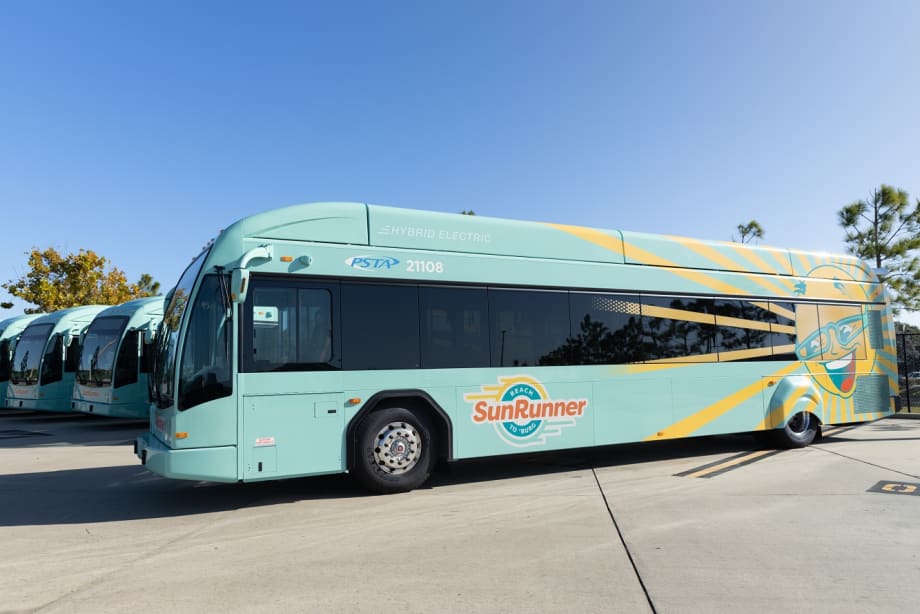
The SunRunner will be growing its footprint with a new station in downtown St. Petersburg, which is set to open for service in 2024.
Photo: PSTA
The Pinellas Suncoast Transit Authority (PSTA) is all about reaching its full potential.
The agency serving Pinellas County, Fla., is growing its bus rapid transit (BRT) line, implementing a new payment system, and pushing toward an electric future.
But wait, there’s more.
As if the agency hasn’t been forward-thinking enough, PSTA is also working to incorporate artificial intelligence across its entire fleet.
PSTA’s work is all paying off, and the details behind its recent plans are even more revealing.

The BRT line officially launched in late 2022 and celebrated its six-month anniversary in April 2023.
Photo: PSTA
PSTA Expands BRT Line
PSTA’s BRT line, the SunRunner, officially broke ground in 2020, as state and local officials gathered in St. Petersburg to celebrate the moment.
The SunRunner connects Pinellas County’s beaches with St. Petersburg.
“We were just so honored and thrilled to finally get a rapid transit system service going in the Tampa Bay area of West Florida,” says Brad Miller, CEO at PSTA. “It had a huge positive reception from the community. On the opening day of the service, the buses were packed all day with transit aficionados that had just been in the area that had been waiting to ride. Ever since that opening day, ridership has been very strong.”
The BRT line officially launched in late 2022 and celebrated its six-month anniversary in April 2023.
PSTA marked the occasion with a major announcement. The agency says the SunRunner will be growing its footprint with a new station in downtown St. Petersburg, which is set to open for service in 2024.
“There's a whole ton of restaurants there and there's a brand new pier with restaurants and activities that were built since the design of the SunRunner,” Miller says. “There was a way you could get a station closer to the pier and to the downtown restaurants. That is how we're expanding it. We were able to bring that construction project under budget by about $5 million, and we're using that money. We think that'll be a very popular stop.”
In May, the PSTA board approved the purchase of three additional SunRunner buses. The buses are expected to arrive in Spring 2024.
This expansion is possible due to the original SunRunner project coming in $5 million under budget, and Miller believes the biggest challenge is BRT expansion lies ahead.
“The Tampa Bay area has had a lot of challenges, and I've been here for 12 years and I've had my own challenges,” Miller says. “We had a referendum that did not pass in 2014 that would have added multiple centerlines. I would say that the biggest challenge now is moving forward because it's always been envisioned that the summer would be a success. The biggest challenge is how we can secure the funding and maintain our funding.”
The SunRunner has marked successful ridership numbers, though. More than 115,000 people used the SunRunner in March alone.
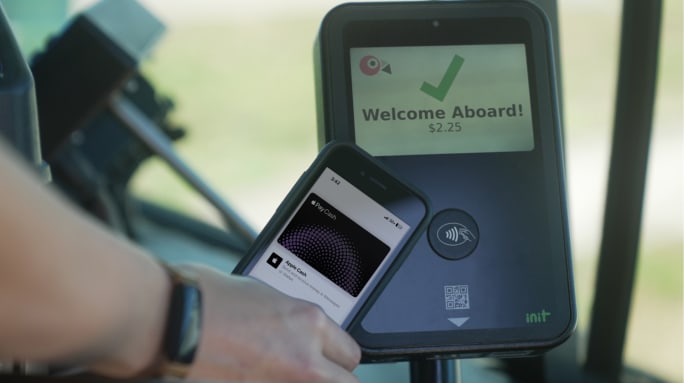
PSTA launched its contactless payment system in February.
Photo: PSTA
Payment System Becoming a Game-Changer for Transit?
PSTA hasn’t only focused on the SunRunner. It also launched its contactless payment system in February.
PSTA buses are currently enabled with contactless payment readers. The agency announced that most newer debit or credit cards and smartphones are equipped with contactless pay options.
“That is a potential game-changer for all public transportation,” Miller says. Fare policies and programs for every transit system are so unbelievably complicated, but now it goes away with this new technology with contactless payments.”
In true PSTA fashion, the agency isn’t looking to just stop there.
“The next level is to integrate the system with different modes, programs, and our partnerships with Uber and Lyft. It’s about how we can make that more seamless,” he adds.
PSTA was recently involved in Spare and Uber’s partnership that integrates Spare's cloud-based on-demand transit platform with Uber's driver network.
Deployments have already been successfully launched at PSTA. The partnership sparked the launch of the PSTA Mobility on Demand (MOD) service in the Spare platform. This means ADA-eligible riders can book on-demand rides.
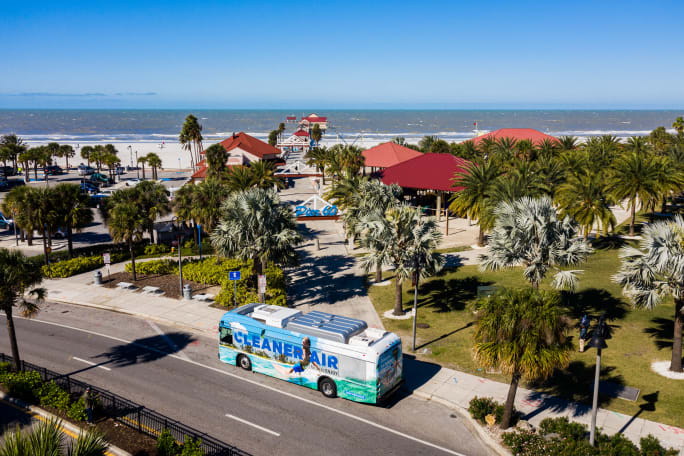
In 2022, PSTA selected NFI Group, Inc., as an approved supplier of electric transit buses and charging equipment.
PSTA
Efforts in Electrification
It’s not always easy for an agency to make the transition to electrification. From infrastructure to funding challenges, PSTA is still managing to grow its zero-emission fleet.
In 2022, PSTA selected NFI Group, Inc., as an approved supplier of electric transit buses and charging equipment.
The agency added four electric buses to its fleet the year before. This brought PSTA’s total number of battery-powered, zero-emission electric buses to six.
Miller shares where the agency is currently at with electrifying its fleet.
“We are installing a cornfield of electric chargers and rows of electric chargers in the parking lot, where the buses stay at night so they can be charged,” Miller says. “Our project management teams have been working on that. I'm proud of how we partnered with our local utility Duke Energy to get that infrastructure in place.”
A key reason why PSTA is going the electric route is because of the agency's longtime commitment to sustainability.
“Our entire agency strategic plan is actually called a sustainable strategic plan,” Miller says. “It started out as sort of just our environmental goals, and then it sort of morphed into all aspects of our organization.”
However, there are questions looming over how successful an agency can be by incorporating more electric buses into its fleet.
“You do need an infrastructure plan to make sure that you have a proper charging capacity. The other general challenge is that technology is changing all the time,” Miller says. “A lot of transit systems are moving toward hybrid or hydrogen fuel cell buses. This is a different technology that also requires a different kind of infrastructure, compressors, and things to make the hydrogen that we don't have. Electric seems to be the thing that is doable and successful now, but is that the long-term success?”
Miller recognizes the importance of electrification, despite infrastructure and technological challenges.
“The most significant carbon-reducing initiative a community can do is to give people an alternative to driving. The biggest impact is riding public transportation to your destination rather than driving,” Miller adds.
How PSTA is Implementing AI Technology
AI technology is making its way into the transit industry.
Preteckt has been a major player in the transit space, and PSTA is diving into the world of AI.
Preteckt and PSTA recently announced an agreement to help the agency maintain its bus fleet. The agreement will see Preteckt’s AI-powered predictive maintenance technology used by PSTA’s bus maintenance team after a pilot project.
“I hope that we expand on the successful pilot we had so that it also can ultimately involve our entire fleet. I think we are getting a reputation that we're open to trying new, innovative things,” Miller says. “We have this new technology with artificial intelligence that we can constantly track all of the computer systems on all of your vehicles all around on a real-time basis, as they drive around Florida here. We can bring all that data in and then connect it to all the other information that's out there about these vehicles in a way that you can actually have better maintenance.”
Preteckt’s technology can detect problems before they cause bus breakdowns. This offers technicians the insights needed to make early repairs.
The challenge for PSTA now is recruiting employees to work with the technology.
“We'll just have to see how it can scale up to our whole fleet,” Miller says. We have a partnership with a technical college to recruit new employees for our maintenance program. We're looking for advanced skill sets, working with computers and artificial intelligence and electrification.”
PSTA has learned that challenges come with every initiative.
From the launch of the SunRunner, its contactless payment system, transitioning to an electric bus fleet, and implementing AI technology, the agency has encountered every challenge imaginable. That isn’t stopping PSTA from making an impact in Pinellas County.
More Management

METRO Opens Submissions for 2026 Motorcoach Awards
Nominations are now being accepted for METRO Magazine’s Operator of the Year and Innovative Operator of the Year awards.
Read More →
New York MTA Advances Final Contract for Second Avenue Subway Expansion
Contract Four is the largest in the Second Avenue Subway Phase 2 project and includes construction of station infrastructure, tracks, and signals for the subway expansion, MTA officials said. Work on Contract Four will begin in 2027.
Read More →
Transit Agencies Highlight Safety Gains at National Summit
Leaders from 15 major transit systems shared crime-reduction results and safety initiatives while discussing the role of continued federal support.
Read More →

NITA Names New Leadership, Expands Reduced-Fare Program at First Board Meeting
The new regional transit authority appointed its first board chair and interim executive director while extending reduced fares across CTA, Metra, and Pace for eligible riders.
Read More →
Beyond the Checklist: A Structured Approach to Transit Maintenance
Reliability-Centered Maintenance helps transit agencies move beyond routine checklists to focus limited resources on the assets and failures that have the greatest impact on safety, reliability, and service.
Read More →
APTA 2026 Nominating Committee Selects Leadership Slate, Names Chair and Vice Chair Nominees
Leadership changes will help shape the association’s priorities and its representation of the transportation industry during the 2026–2027 term.
Read More →
DART Launches Major Security, Fare Enforcement Initiative
The 90-day demonstration will deploy coordinated security teams at five light rail stations while testing controlled access and gathering data to guide future investments.
Read More →
Advancing Fare Collection Through Technology and Innovation
Learn about delivering 1300 gates at 91 stations while managing fare evasion. Explore the large scale deployment, solution customization and real-world results that affect the region. Prepare for deployment in your region now.
Read More →
Game Day in Motion: Moving Millions During the 2026 World Cup
Between packed transit stations and team motorcoaches, see how agencies and operators across North America tackled the transportation demands of the 2026 FIFA World Cup.
Read More →
Surface Transportation Extension Averts Shutdown, Leaves Transit Funding Gap
The stopgap keeps federal transportation programs moving, but missing advance funding could complicate the transit and rail projects agencies are planning next.
Read More →