



High-Speed Rail Reaches a Crossroads
While projects continue to make improvements to increase speeds in key corridors, the initial federal programs put in place to fund projects are drying up, making the key question — what’s next?
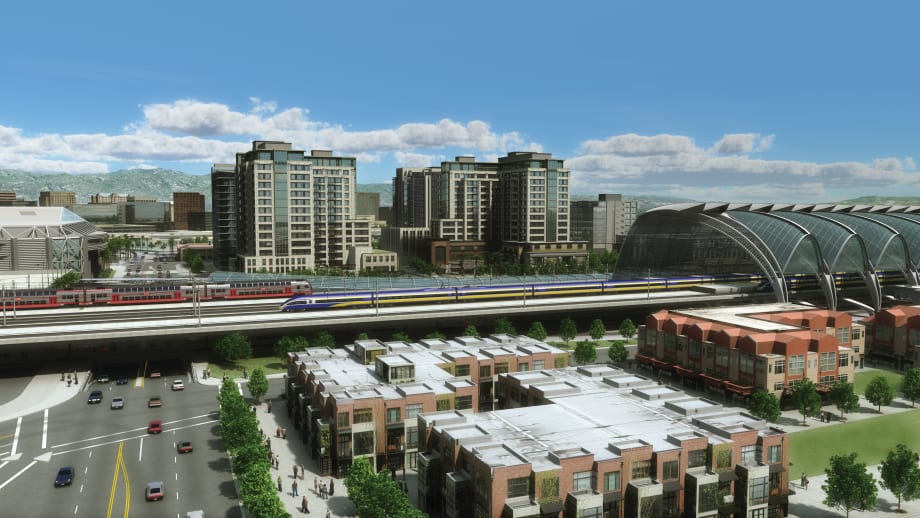
A rendering of the California High-Speed Rail Authority’s San Jose, Calif. project.

A rendering of the California High-Speed Rail Authority’s San Jose, Calif. project.
President Barack Obama’s record investment through both the American Recovery and Reinvestment Act of 2009 and the High-Speed Intercity Passenger Rail (HSIPR) program provided a shot in the arm for the nation’s high-speed rail network to begin taking shape. Since then, however, the political climate on Capitol Hill has cast a dark cloud over the program, making it difficult to see how its once bright future will finally be realized.
As the Administration and supporters of the HSIPR program regroup to figure out what’s next after the initial investments, progress continues to be made on projects throughout the nation, including on the country’s one true high-speed rail project in California.
More than four years in, how successful has the program been? How important is high-speed rail to the nation’s future and what’s next?
Current state
Obama’s HSIPR plan is often cited as the grandest transportation program since President Dwight D. Eisenhower’s Interstate Highway System in the 1950s. With much excitement and fanfare, the initial award of more than $10.1 billion in the high-speed rail program began moving projects forward; however, as many of those projects have reached completion or moved to the next step where more funds are necessary, it is unclear how much success will be found securing those funds at the federal level.
“As we engage with elected officials on the state level, few new ideas have generated as much interest and enthusiasm as America’s high-speed passenger rail program,” says Robert Puentes, sr. fellow/director, metropolitan infrastructure initiative, for Brookings Institution. “These are the kind of game changing, market-shaping investments in the next economy that we have long deferred. Yet, while the high-speed rail effort is a national program, it is important to note that this is not representative of the late 20th century federalism model in transportation with the federal government providing resources that rain down unencumbered to the state and metropolitan level. Rather, what we’re seeing is a new 21st century model that challenges our nation’s state and metropolitan leaders to develop deep and innovative approaches to solve the most pressing transportation problems. Indeed, unlike the earlier high-speed rail grants, the latest round of funding requires a state/local match.”
Meanwhile, Art Guzzetti, VP, policy, at the American Public Transportation Association (APTA) sees the slowdown in the program as inevitable.
“There was a big buzz at first, but then we got down to brass tacks,” he says “You have to understand, the nation went from a standing start to a full sprint on this program in a snap; it was really inevitable that it would slow down.”
While many, including the Administration itself, viewed the HSIPR program as a jobs initiative as much as a vision for transportation’s future, the mainstream negativity the program has experienced seems to be both surprising and a sign of the times as intense scrutiny of government plagues major decisions to invest in programs or make cuts in spending. That is not to mention the political wrangling on Capitol Hill.
Still, the money invested into projects through ARRA and the HSIPR program continues to make progress.
“There are five regions that are definitely moving ahead; the Northeast Corridor (NEC), the Southeast through Virginia and North Carolina, the Chicago Hub in the Midwest, the Pacific Northwest and California,” says Guzzetti. “There is progress being made in all those areas to the degree that they are going to have higher performing rail in those regions, so we are definitely seeing some success.”[PAGEBREAK]
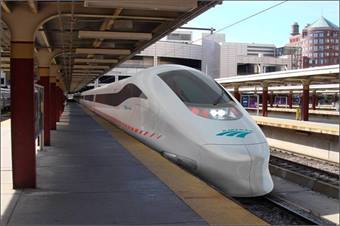
NEC Future will create a framework for the region’s rail investments.
What if…
How important is it for high-speed rail programs to take hold? To coincide with the UIC 8th World Congress on High-Speed Rail in Philadelphia last June, APTA released a report, “Opportunity Cost of Inaction: High-Speed Rail and High-Performance Passenger Rail Service,” which showed building a high-speed rail program in the U.S. results in $26.4 billion in net benefits over the next 40 years.
According to the report, as the population grows, increased pressure will be placed on the nation’s already crumbling infrastructure. With a complementary high-speed rail service, this will help mitigate the cost of maintenance, replacement and the capacity expansion needs of airport runways, highways and roadways. In many cases expansion will be difficult because of the lack of land mass.
“We could have titled it a bunch of different ways, but it’s still just a matter of mathematics,” says Guzzetti. “If you can’t do highway or airport expansions, at least on a major scale, the capacity constraints are such that you need high-speed rail, and without it, you are just going to forego a lot of benefits.”
Patterned after a seminal Federal Railroad Administration report on high-speed rail, the report shows investment in high-speed and high-performance passenger rail not only aids in solving the nation’s capacity issues, but helps mitigate overall transportation costs and helps our roadways and airports work more efficiently.
To do so, the report used corridors where information was available, including the NEC and California and measured how a modal switch to high-performance rail system usage from commercial airlines or highway travel could provide financial savings, often measured in time savings. Additional factors in determining the net benefits include economic output generated, tax revenue generated, emissions savings and others.
Numerous additional social and mobility benefits are not quantified in the report.
“The report is just one of many that we’ve worked on in support of high performance rail,” says Guzzetti. “There is much more research coming, because we feel there is a lot to figure out, to highlight and base our decisions on through these reports that we do.”
Perceptions, future
The high-profile rejection of HSIPR funds by governors in Florida and Wisconsin played some part in getting the ball rolling in terms of creating a negative perception of the program. Meanwhile, high-speed rail has become a hot-button issue in California, where detractors of the planned 800-mile line consistently refer to the project as a boondoggle or a “train to nowhere.”
Still, Puentes feels successful completion of the project in California will help sway public opinion as well as set the model for the future in other states.
“Yes, successful execution of the California high-speed rail project would help change public perception,” he says. “Continuing the evolution of Amtrak will also help — I know they are different, but Amtrak has done a lot to overcome its historical challenges, and the fact that intercity rail is now at record levels will go a long way to boosting public perception. But while Amtrak has done a lot to remake itself in recent years, states need to continue to reaffirm their commitment for the model to be sustainable.”
As for future funding, the Passenger Rail Improvement and Investment Act of 2008 is up for reauthorization, while MAP-21 is set to expire in 2014 and could possibly include some funding for the high-speed rail program. Guzzetti adds that while there isn’t a unified agreement on how the program will move forward there is support on either side of the aisle.
“I am not saying both parties agree on all the particulars of the high-speed rail program, but both Republicans and Democrats have their own way of moving forward,” he says. “It will create a great positive when there is a little more of a bipartisan agreement, but right now there is interest on both sides.”
More Rail

New York MTA Launches Historic $1.9B Signal, Track Modernization Project
Funded in part by congestion pricing revenue, the project will replace nearly century-old signals along the A and C lines in Brooklyn and Queens.
Read More →
LA Metro Breaks Ground on East San Fernando Valley Light Rail Project
The 6.7-mile line will add 11 stations along Van Nuys Boulevard, expand access to jobs and regional transit connections, and support Metro’s broader efforts to improve mobility as rail ridership grows.
Read More →
CSA Group Releases Climate Resilience Standard for Transit, Passenger Rail
Developed with support from the Standards Council of Canada, CSA D700 guides assessing climate-related risks and planning adaptation measures for transit and passenger rail systems.
Read More →
LA Metro September Ridership Climbs 3.9%, Led by Rail Growth
The agency recorded more than 27.2 million boardings, with rail ridership increasing 12.4% year over year and the D Line posting the largest gains.
Read More →
First Full MetroLink Rail Expansion Completed in 20 Years with $192M Airport Project
The project links two St. Louis-area airports by light rail while adding roadway and bike trail connections to improve regional access and mobility.
Read More →
Utilimarc Launches SmartReplace to Optimize Fleet Replacement Decisions
AI-powered SmartReplace helps fleets prioritize vehicle replacements, model budget scenarios, and build more defensible long-term strategies.
Read More →
Scenes from APTA TRANSform & EXPO 2026
Transit leaders, manufacturers, and industry professionals gathered in Chicago to explore new technologies, share ideas, and discuss the future of public transportation.
Read More →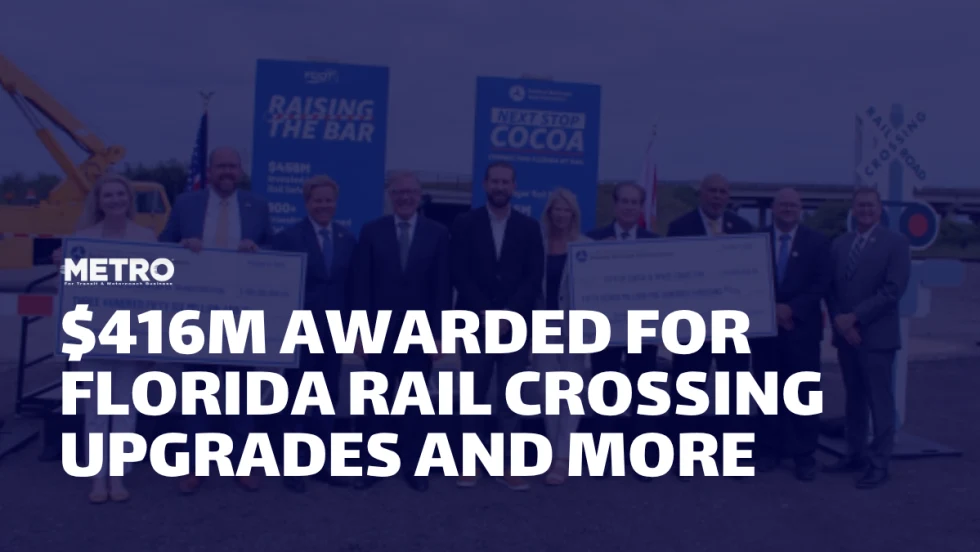
USDOT Awards $416 Million for Florida Rail Crossing Safety Upgrades, New Brightline Station
The projects aim to reduce risks for motorists and pedestrians at rail crossings while expanding passenger rail access along Florida’s Space Coast.
Read More →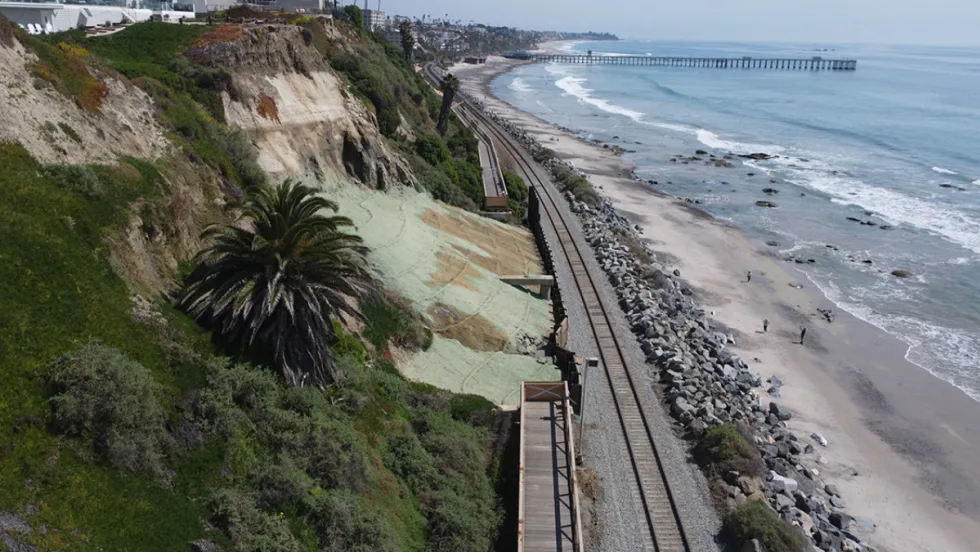
OCTA Declares Emergency to Protect Rail Corridor From Coastal Erosion
The California agency is accelerating shoreline protection and plans to place approximately 690,000 cubic yards of sand along the San Clemente coast to protect a key passenger and freight rail link.
Read More →
More Than a Summer Job: Building the Next Generation of Transit Talent
The Delaware River Port Authority and PATCO have transformed their internship program into a hands-on professional development experience that introduces students to the breadth of transportation careers — and creates a pipeline for future employees.
Read More →