



Historic St. Paul Depot Revived as Modern Multimodal Hub
The revamped design incorporates new modes, such as bicycle, bus and light rail, along with added emphasis on vehicular interfaces to the depot, which was not originally designed for modern vehicle operations.
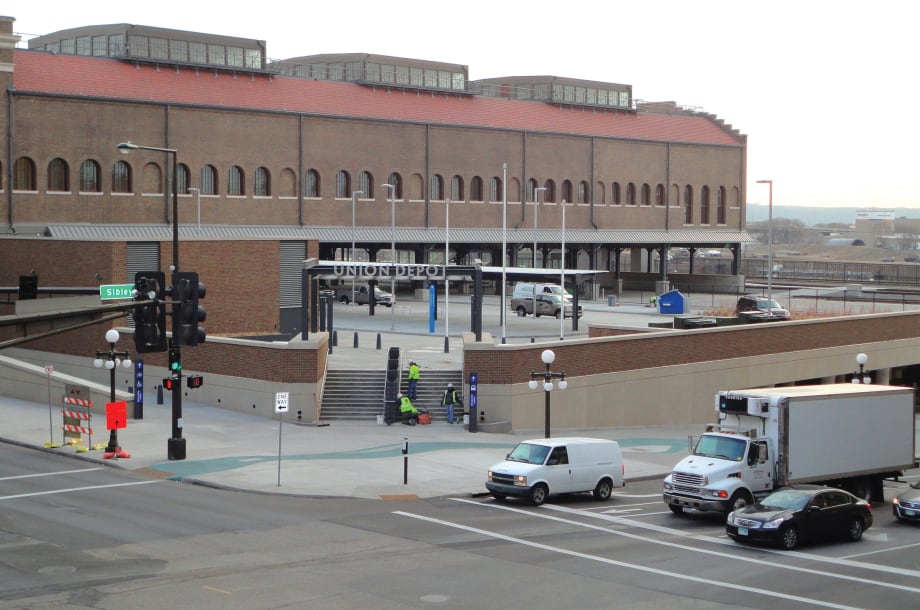

Union Depot was originally constructed in 1881 but was destroyed by a fire in 1913. It was rebuilt between 1917 and 1926 by the St. Paul Union Depot Co., which represented nine major railroads. During the boom years of the passenger rail era, the depot served more than 140 trains carrying more than 20,000 passengers a day. After rail passenger service to Union Depot ended in 1971, portions of the structure were converted to a mail sorting facility for the adjacent U.S. Postal Service and Custom House. In 1974, it was placed on the National Register of Historic Places.
Three years ago, the Ramsey County Regional Railroad Authority (RCRRA) secured federal, state, and county funding to finance the $150 million restoration and renovation project. The project involved restoring the Minnesota landmark to its original use as a multimodal transportation hub accommodating Amtrak, intercity and transit buses, pedestrians, bicycles, and future commuter rail and high-speed rail service for the state and the region. Access to light rail is available just steps away from Union Depot's North Plaza.
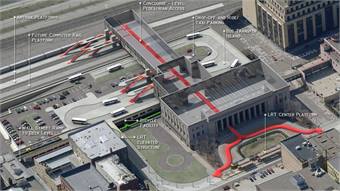
Extensive use of 3D visualization technology (rendering shown) was employed to depict proposed design elements.
State-of-the-Art Transit Center
The revitalized facility features a green overlook to the Mississippi River with views both upstream and downstream to an active working riverfront. It connects to the river physically and visually as barriers were removed and new views opened up. Air raid blackout paint from World War II was removed from massive skylights in the 27,000-square-foot vaulted waiting room where passengers embark on a range of transit services.
The new facility also provides large enclosed areas for civic gatherings and private events. The headhouse and waiting room total 140,000 square feet with a train deck platform of more than 300,000 square feet. A large area below the train deck was reconfigured to make room for a new building that provides entry from the street level for transit passengers and provides space for transit provider's ticketing and baggage handling operations as well as almost 200 public parking stalls.
The station design developed by URS Corp. incorporated new modes, such as bicycle, bus and light rail, along with added emphasis on vehicular interfaces to Union Depot, which was not originally designed for modern vehicle operations. In addition to the functional station elements, the design significantly enhanced existing roadway operations for vehicles and created safer and attractive pedestrian sidewalks along the approximately 4,000 feet of public street frontage of the site.
Union Depot is located in the most complex and active rail corridor in Minnesota. All rail layout design was developed in close coordination with Canadian Pacific, Union Pacific and Burlington Northern Santa Fe railroads as well as Amtrak and the Federal Railroad Administration. Millions of dollars’ worth of infrastructure improvements on the existing freight rail networks, extending several miles from Union Depot, were necessary to introduce passenger trains back into the depot.
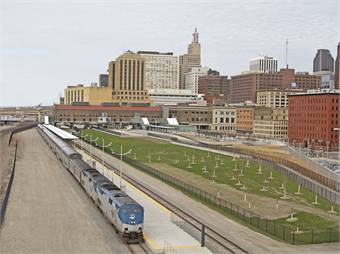
Amtrak service began arriving at the Depot on May 7th — the first time in more than 40 years, passenger trains began service from Union Depot.
Historical Considerations
Converting a historic train depot into a modern multimodal transportation hub required a thorough understanding of how people move between transit and other modes of travel while respecting the general arrangement and historical use of the existing facility. The design team determined that several additional access points and circulation pathways would be needed to increase the openness of the depot for the public. In addition, accommodation of private and commercial vehicles was crucial to the success of the renovated depot to accommodate the public’s reliance on automobiles.
The prompt assessment of the existing train deck structure was critical as it allowed the design team and owner to estimate the potential cost of assuring that the renovated deck would serve the new depot for at least 100 years. This assessment was done in conjunction with the site design, which also resulted in modifications to the deck structure and arrangement.
Proposed modifications to the historic deck for structural or site design purposes were coordinated with the consulting parties associated with the programmatic agreement between the State Historical Preservation Office (SHPO) and RCRRA. In several cases, new structural elements had to be incorporated into dated systems. More than 30,000 square feet of the 350,000-square-foot train deck was reconstructed and another 30,000 square feet required significant rehabilitation. All 478 of the concrete train deck support columns were refurbished to address deterioration and to ensure they would provide 100 years of additional service life.
The project was subject to a stringent review process and needed to move at a fast pace to respond to a TIGER Grant that was part of the American Recovery and Reinvestment Act of 2009. The design for the project involved adaptive reuse and rehabilitation of the building and site while meeting the needs of modern transit providers.
From the start of the project, the design and construction team met with the historical consulting parties on a regular basis to ensure that design approaches would meet the Secretary of the Interior's Standards.
Extensive use of accurate 3D visualization technology was employed to depict proposed design elements. This technique kept SHPO and the consulting parties up to date on the progress of the project and allowed it to proceed on schedule.
Eco-Management, Abatement
Large amounts of ACM and LBP building materials were present within the interior and exterior of the structure. A waterproofing material containing asbestos had to be removed before structural rehabilitation could begin. Redevelopment activities turned up significant quantities of poor-quality urban fill. The movement, tracking, and management of the large number of impacted soil stockpiles required the use of a complex mapping and tracking system to communicate the prioritization of piles for reuse and identification of the specific areas that were available.
Sustainable Design
As completed, the project stands as an example of sustainable design, having revitalized an existing infrastructure that had lingered for decades in a state of disrepair. The renovated facility incorporates a wide range of transportation modes, as opposed to the customary limitation to passenger rail, including future high-speed, BRT and commuter rail services. In addition, the design and construction achieved the requirements for Gold LEED status by employing efficient techniques in the mechanical systems design, recycling and reuse of site materials from windows to concrete and the effective conversion of a brownfield site into a functioning transportation facility.
Union Depot's renovation included major improvements to several blocks of city streets to enhance pedestrian movements with respect to both safety and aesthetics. Expansive sidewalks were incorporated along two busy streets to provide attractive and safe movement into the city for pedestrians as well as a connection to the river. Connections for pedestrians and cyclists to regional trails on the river were incorporated into the project in addition to a full-service bicycle station to accommodate commuter cyclists.
Union Depot has been transformed into a state-of-the-art transit center that combines historic preservation with a multimodal transportation hub. Overall, the project is expected to bring new life to St. Paul’s Lowertown District, St. Paul and Ramsey County in addition to economic vitality to the Upper Midwest region, the state, Ramsey County and St. Paul.
Greg S. Brown, PE is a project manager, URS Corp., St. Paul, Minn.
More Management

METRO Opens Submissions for 2026 Motorcoach Awards
Nominations are now being accepted for METRO Magazine’s Operator of the Year and Innovative Operator of the Year awards.
Read More →
New York MTA Advances Final Contract for Second Avenue Subway Expansion
Contract Four is the largest in the Second Avenue Subway Phase 2 project and includes construction of station infrastructure, tracks, and signals for the subway expansion, MTA officials said. Work on Contract Four will begin in 2027.
Read More →
Transit Agencies Highlight Safety Gains at National Summit
Leaders from 15 major transit systems shared crime-reduction results and safety initiatives while discussing the role of continued federal support.
Read More →

NITA Names New Leadership, Expands Reduced-Fare Program at First Board Meeting
The new regional transit authority appointed its first board chair and interim executive director while extending reduced fares across CTA, Metra, and Pace for eligible riders.
Read More →
Beyond the Checklist: A Structured Approach to Transit Maintenance
Reliability-Centered Maintenance helps transit agencies move beyond routine checklists to focus limited resources on the assets and failures that have the greatest impact on safety, reliability, and service.
Read More →
APTA 2026 Nominating Committee Selects Leadership Slate, Names Chair and Vice Chair Nominees
Leadership changes will help shape the association’s priorities and its representation of the transportation industry during the 2026–2027 term.
Read More →
DART Launches Major Security, Fare Enforcement Initiative
The 90-day demonstration will deploy coordinated security teams at five light rail stations while testing controlled access and gathering data to guide future investments.
Read More →
Advancing Fare Collection Through Technology and Innovation
Learn about delivering 1300 gates at 91 stations while managing fare evasion. Explore the large scale deployment, solution customization and real-world results that affect the region. Prepare for deployment in your region now.
Read More →
Game Day in Motion: Moving Millions During the 2026 World Cup
Between packed transit stations and team motorcoaches, see how agencies and operators across North America tackled the transportation demands of the 2026 FIFA World Cup.
Read More →
Surface Transportation Extension Averts Shutdown, Leaves Transit Funding Gap
The stopgap keeps federal transportation programs moving, but missing advance funding could complicate the transit and rail projects agencies are planning next.
Read More →