



Rising Claims, Rising Stakes: Inside the Insurance Pressures Facing Motorcoach Operators
Premiums remain elevated. Underwriting scrutiny is intense. And claims costs continue to rise at historic levels. Behind those numbers lies a complex mix of legal, medical, and cultural forces reshaping the commercial landscape.

From Lancer Insurance Company’s vantage point, several top-level factors are driving claims costs upward.
METRO
- The insurance premiums for motorcoach operators remain consistently high, contributing to financial pressures in the industry.
- There is heightened scrutiny in underwriting processes, reflecting tighter regulation and oversight.
- Claims costs are increasing at unprecedented rates, influenced by a convergence of legal, medical, and societal factors.
*Summarized by AI
For motorcoach and ground transportation operators, the insurance market is tougher than ever — and the forces driving it show no signs of easing.
Premiums remain elevated. Underwriting scrutiny is intense. And claims costs continue to rise at historic levels. Behind those numbers lies a complex mix of legal, medical, and cultural forces reshaping the commercial landscape.
From Lancer Insurance Company’s vantage point, several top-level factors are driving claims costs upward.
“Increased attorney involvement, evolving plaintiff tactics, better-funded plaintiffs, advances in medical science, litigation and medical financing, and juries’ willingness to award historically massive verdicts are all contributing to rising claim costs,” said Steven O’Shea, VP, Marketing & Customer Service, at Lancer.
In short, today’s claims environment bears little resemblance to the one operators faced a decade ago.
“Nuclear Verdicts” and Improving Operational Discipline
One of the most significant pressures comes from the courtroom.
Plaintiff attorneys are more sophisticated and better resourced than ever. Litigation financing — a system in which outside investors fund a lawsuit in exchange for a share of any recovery — has enabled cases to drag on and push harder toward trial.
Meanwhile, juries have shown a growing willingness to award massive verdicts — often referred to as “nuclear verdicts” — that can reshape an operator’s financial future overnight.
Medical advancements also play a role. While improved treatment benefits injured individuals, it often comes with higher costs and longer care projections, thereby increasing settlement values.
The result: claim severity continues to climb, even when accident frequency remains steady.
While macro trends are reshaping the legal landscape, operational discipline remains the most decisive factor in claim outcomes.
“The absence of a strong safety culture remains the single biggest operational factor impacting claims,” said O’Shea. “Plaintiff attorneys are increasingly zeroing in on violations and procedural gaps, portraying operators as irresponsible and casting doubt on their safety practices — a perception that elevates claim payouts.”
Distracted driving is another growing concern.
“Even a brief admission by a driver of glancing at a cell phone before an accident can significantly weaken an operator’s defensibility, regardless of who is at fault,” O’Shea noted.
In this climate, perception often carries as much weight as facts.
Safety as a Business Strategy
In a market where claim costs are accelerating, prevention is more than best practice — it is a financial strategy.
“Ultimately, the least expensive claim is the one that never happens,” O’Shea said.
Operators who treat safety as a core business value, not merely a regulatory requirement, are better positioned both operationally and defensively.
O’Shea outlined several best practices that consistently help operators reduce risk and strengthen defensibility:
- Build a true safety culture. “Safety should be a core business value — not a box to check. Leadership must set clear expectations and demonstrate by example, reinforcing that safety is non-negotiable.”
- Hire with intention. Driver selection should be structured, consistent, and exceed minimum regulatory standards. Prioritizing safety over convenience reduces long-term exposure.
- Treat training as ongoing. Continuous training reinforces safe habits, sharpens awareness, and conveys a genuine commitment to professionalism.
- Maintain disciplined preventive maintenance programs. Organized maintenance and timely repairs reflect proactive risk management.
- Leverage technology. Telematics, cameras, and data analytics provide critical insights into driving behavior, helping operators identify risks and train drivers more effectively.
- Document everything. Comprehensive records, written policies, and regular audits eliminate ambiguity and strengthen defensibility when claims arise.
- Respond proactively to incidents. Prompt and thorough claims reporting, open communication with adjusters, and active monitoring of pending claims can significantly influence outcomes.
“Forward-thinking operators treat every incident as a valuable opportunity to learn, refine procedures, and strengthen their defenses against future risk,” O’Shea added.
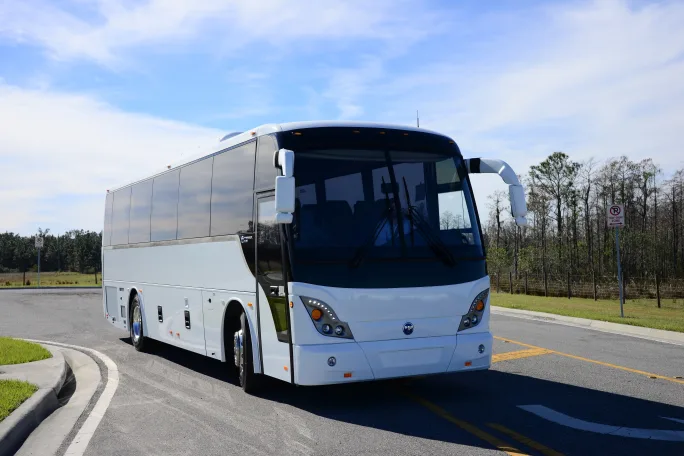
Despite hopes for relief, the commercial auto insurance market is unlikely to ease in the near term.
Temsa
Improving Insurability…Will the Market Stabilize?
For smaller fleets and new entrants, improving insurability requires both operational discipline and the right external relationships.
“Operators must be strategic in choosing their business allies, starting with their insurance broker,” O’Shea said. “A broker specializing in passenger transportation understands exactly what underwriters value and how to present the company’s safety commitment in the strongest light.”
Equally important is selecting an insurance carrier with deep expertise in passenger transportation claims and a demonstrated long-term commitment to the industry.
“Together, the right broker and carrier form a powerful alliance that helps operators manage risk, control costs, and build resilience in a challenging insurance market,” he said.
Despite hopes for relief, the commercial auto insurance market is unlikely to ease in the near term.
“The market is expected to remain challenging,” O’Shea said. “Claim costs continue to climb at an unprecedented rate, surpassing levels seen at any point in history.”
While operators cannot control jury behavior or litigation financing trends, they can control their culture, discipline, and commitment to risk prevention.
“The most effective defense is a relentless focus on safety — taking every possible step to ensure the business runs with accountability and loss prevention at its core,” O’Shea said. “Companies that do that will thrive through whatever comes at them. The passenger transportation industry is resilient and creative.”
In today’s environment, insurance is no longer simply a cost of doing business. It reflects operational integrity.
And increasingly, safety is the strongest policy an operator can carry.
Quick Answers
Insurance premiums remain elevated due to increased claims costs and heightened underwriting scrutiny, driven by various legal, medical, and cultural factors affecting the commercial insurance landscape.
*Summarized by AI
More Motorcoach

METRO Opens Submissions for 2026 Motorcoach Awards
Nominations are now being accepted for METRO Magazine’s Operator of the Year and Innovative Operator of the Year awards.
Read More →
Biz Briefs: Alstom Lands Canadian Contract, LYT to Supply California TSP, and More
In METRO's latest installment, we take a look at recent news from Complete Coach Works, Beep, FlixBus, and more partnerships making headlines across the transportation sector.
Read More →
Biz Briefs: RIPTA Unveils New Frontrunners, Clevland RTA Adds New Siemens, and More
In METRO's latest installment, we take a look at recent news from Siemens, Prevost, Dodge, and more partnerships making headlines across the transportation sector.
Read More →
People Movement: Holly Arnold Joins Transdev and More
In this edition, we also cover recent appointments and announcements at Pace, CamTran, MCI, and more, showcasing the individuals helping to shape the future of transportation.
Read More →
ABA Report: Motorcoach Travel Generates $161.6B Economic Impact
The 2025 analysis finds motorcoach travel supported nearly 900,000 jobs and generated $28 billion in federal, state, and local taxes.
Read More →
CharterUP’s Armir Harris on Technology, AI, and the Future of Group Mobility
In a recent episode of METROspectives, CharterUP Founder/CEO Armir Harris discussed the company’s evolution from an online charter bus marketplace into a technology platform supporting public- and private-sector mobility and much more.
Read More →
People Movement: ABC Names John Walsh as Chief Commercial Officer
In this edition, METRO also covers recent appointments and announcements at the DART, STV, and more, showcasing the individuals helping to shape the future of transportation.
Read More →
From Surviving to Thriving: Building Stronger Transportation Organizations
Bus Business Consultants founder Brian Dickson shares lessons on leadership, organizational health, and creating options for long-term success in a changing transportation industry.
Read More →
Biz Briefs: Luminator Marks Milestone and More
From manufacturers and suppliers to transit agencies and motorcoach operators, these updates offer a snapshot of the projects, partnerships and business moves driving the industry forward.
Read More →
ABAF Study Reveals Growing Insurance Crisis for Motorcoach Operators
Preliminary findings show 98% of operators faced premium increases over the past five years, while shrinking insurer participation is putting added pressure on businesses and customers.
Read More →