




Consultant Q&A: AECOM’s Librera Discusses Mobility, Global Trends
How Unified Payment Systems Work
The fare payment business has changed over the last few years, and the biggest change has come in the form of unifying the systems. The process comes with its benefits and challenges, but cities across the nation are recognizing the importance.
May 25, 2023

Cubic sees that agencies shift to more outcome-based procurements where they describe what they want to achieve.
Photo: Cubic Transportation Systems
5 min to read
The COVID-19 pandemic caused a shift in the fare payment business, leading to more contactless operations. Now, with the help of Cubic Transportation Systems, the transit industry is seeing unified payment systems.
Cubic delivers integrated systems for transportation and traffic management. The company provides tools for travelers to choose the way to travel and pay for their journeys while enabling agencies to manage demand across the entire transportation network in real time.
The company has been making waves across the industry by connecting broader regions with regional systems to help riders.
What is a Unified Payment System?
A starting point is talking about what's meant by unified payment systems.
“It is bringing together across a broader regional area where passengers are traveling, whether that's a greater metro area like New York, Chicago, or Los Angeles, or bringing together regional systems like our latest Umo launch in Milwaukee where some of the counties surrounding the city give passengers the benefit of seamless travel,” said Boris Karsch, COO of Cubic’s Umo Platform.
Cubic delivers unified payment systems by bringing multiple transit services together under a single payment solution.
“Technology is shifting, in particular with the advances in telecommunications, enabling buses, and other parts of the transit system to be reliably connected to cloud services,” Karsch said. “This makes it easier to also integrate other services that an agency may have.”
The company has a mobile app, Cubic Mobile for Travelers, that provides mobile ticketing and multimodal trip planning.
In June 2020, Cubic expanded its partnership with Moovit to further co-develop mobile experiences that enable travelers to “look, book, and pay” for multimodal journeys.
Benefits and Challenges of Unifying Payment Systems
Karsch explained the benefits and the challenges of unifying payment systems.
Traditionally, agencies had to buy software licenses from a system integrator like Cubic to customize and configure that solution and then have it hosted either on their infrastructure or in cloud infrastructure.
“Over the last five to six years, Cubic and other parties in the market have also introduced the ability for agencies to consume fare collection technology under a software-as-a-service model as an alternative,” said Karsch. “Rather than buying a system, they can subscribe to a common back office that's shared by multiple agencies with all the data separated, and each agency has their ability to implement their own specific business rules, branding, etc.”
While there's a lot of innovation going on, there's also a lot of change as a consequence of startup companies getting purchased by different solution providers with different delivery track records.
Cubic sees that agencies shift to more outcome-based procurements where they describe what they want to achieve.
“We tend to encourage agencies to change how they procure to enable more vendors to respond to the RFP, so they get a greater choice of solutions they can evaluate,” Karsch explained.
How Cubic Helps Agencies with Payment Systems
Traditionally, Cubic has operated in large cities. Now, the company, through its software service solution product line, Umo, has made the same expertise available to agencies of all sizes.
Umo Mobility is a multimodal platform that connects public and private mobility systems to optimize public transportation operations.
Cubic now has more than 40 agencies in implementation and more than 30 agencies in production under a software service and subscription model.
In February, Milwaukee County Transit System (MCTS) announced it had chosen the Umo Mobility Platform as its new fare collection system following a competitive process that began last May.
Cubic then announced in June its Umo Mobility platform is beginning a pilot in Temuco, Chile — the first Umo implementation outside North America.
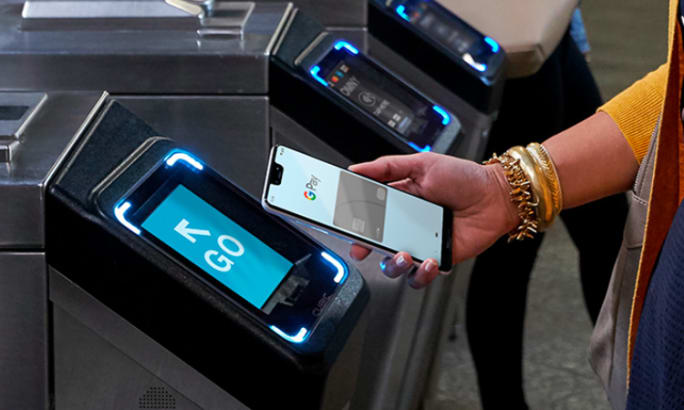
One of the big changes in payment systems since the COVID-19 pandemic is moving away from cash.
Photo: Cubic Transportation Systems
COVID-19’s Impact on Payment Systems
One of the big changes in payment systems since the COVID-19 pandemic is moving away from cash, whether that's enabled by a physical card, mobile phone, or a contactless credit card, and removing physical interactions between passengers and agency staff as much as possible.
For example, TransLink announced in January that its customers can now pay for transit using Interac Debit on every bus and at every fare gate throughout Metro Vancouver.
This made TransLink the first transit agency in Canada to fully integrate contactless Interac Debit payments systemwide.
As part of TransLink’s Customer Experience Action Plan, TransLink, Interac, Moneris, and Cubic upgraded more than 5,000 Compass Readers throughout TransLink’s system to make transit payments more convenient.
“We need to accelerate through electronic fare collection options,” said Karsch. “The ability to allow more passengers to pay electronically has other benefits for agencies like significantly faster boardings, which help with on-time performance and overall service delivery.”
The second impact of the COVID-19 pandemic is the shape of the economic environment that's driving agencies toward modernizing payment collection solutions.
“We are also seeing a big shift, and that's where things like the on-demand services come into play,” said Karsch. “Agencies are looking to integrate how they deliver services that are more convenient for passengers, but also operationally more efficient for agencies.”
Evolution of Mobility-as-a-Service
In 2021, Cubic revealed that transportation leaders believe Mobility on Demand (MOD) and mobility-as-a-service (MaaS) are the ultimate forward-thinking solutions.
The study, “2021 MaaS Survey,” featured responses from 135 global transportation industry stakeholders, members of associations and alliances, agency executives, and mobility technology providers.
More than half of the respondents highlighted MaaS or MOD solutions should be considered from a global perspective and that interoperability should be simplified to allow the integration of different stakeholders and promote roaming for end users.
It's been a journey for the industry and a learning curve of what works and what doesn't work for MaaS since then.
“A few years back, there was a view that mobility-as-a-service means private parties coming in to aggregate and bundle together public and private transportation services under a consumer-facing subscription model,” Karsch explained. “I think they learned that it's a difficult business model to make work.”
MaaS has shifted to how to incorporate an overall mobility network and additional services, whether it’s micromobility services, rideshare services, and then specifically in the U.S. market, investing in on-demand services.
According to the 2022 Market Research report, size is projected to reach $40.1B by 2030 from an estimated $3.3 billion in 2021.
Karsch explained the growth of the MaaS market is influenced by factors such as increasing smart city initiatives and the growing adoption of on-demand mobility services.
“What is seen as the most successful part of mobility-as-a-service has been integrating, particularly from a trip planning point of view, the discovery of those additional mobility options to passengers, and then the ability to plan and book those additional services,” he said.
Subscribe to Our Newsletter
More New Mobility

From Hardware to Digital Partner: Luminator Charts Its Next Chapter
CEO Magnus Friberg discusses Luminator’s shift toward becoming a digital partner, the growing importance of software and interoperability, and how AI can help agencies improve operations and passenger experience.
Read More →
Biz Briefs: Alstom Lands Canadian Contract, LYT to Supply California TSP, and More
In METRO's latest installment, we take a look at recent news from Complete Coach Works, Beep, FlixBus, and more partnerships making headlines across the transportation sector.
Read More →
CharterUP’s Armir Harris on Technology, AI, and the Future of Group Mobility
In a recent episode of METROspectives, CharterUP Founder/CEO Armir Harris discussed the company’s evolution from an online charter bus marketplace into a technology platform supporting public- and private-sector mobility and much more.
Read More →
Jacksonville’s NAVI Project Charts a New Course for Autonomous Public Transportation
Through its NAVI program, JTA is showing how autonomous vehicles, intelligent infrastructure, and coordinated operations can work together to deliver everyday public transportation.
Read More →
Biz Briefs: Luminator Marks Milestone and More
From manufacturers and suppliers to transit agencies and motorcoach operators, these updates offer a snapshot of the projects, partnerships and business moves driving the industry forward.
Read More →
New Tricks for Old Bureaucracies: Joshua Schank on Making Transit Innovation Stick
Former LA Metro Chief Innovation Officer Joshua Schank discusses why good ideas aren't enough, how transit agencies can overcome resistance to change, and why today's challenges demand more innovation.
Read More →
How DART's GoPass Is Redefining Regional Mobility
Serving 14 transit agencies, GoPass simplifies multimodal travel by allowing riders to plan, pay for, and manage an entire trip through one app.
Read More →
Biz Briefs: OCTA Taps Clean Energy for Hydrogen Station, Stadler to Supply Via Rail Vehicles, and More
From manufacturers and suppliers to transit agencies and motorcoach operators, these updates offer a snapshot of the projects, partnerships and business moves driving the industry forward.
Read More →CharterUP Expands Into New Mobility and Autonomous Transportation
Vice President of New Mobility Stephen Joos discusses how CharterUP is leveraging its nationwide transportation network, technology platform, and autonomous vehicle partnerships to expand into workforce mobility, campus shuttles, and transit solutions.
Read More →
METRO Magazine Announces 2026 Innovative Solutions Awards Winners
Projects Recognized for Advancing Mobility Through Technology, Accessibility, Workforce Innovation, and Operational Excellence
Read More →