



Related: Statewide Procurement: Simplifying Zero-Emission Bus Purchasing
Key Considerations for Your Fleet Procurement Process
From identifying and engaging key stakeholders to choosing the right partners, here are seven steps to consider before your next big purchase.
by Ray Melleady
September 6, 2021
The process of fleet specification and procurement will result in one of the most critical and long-lasting decisions in a managers’ career.
Photo: Getty Images
8 min to read
Fleet procurement comes with a set of challenges many of which are unique to public-sector spending. The money that public transit systems spend belongs, in large part, to the taxpayers and the lead in any purchase process is accountable to them as well as other internal and external stakeholders.
Moreover, the process of fleet specification and procurement will result in one of the most critical and long-lasting decisions in a managers’ career. Quite often, the economic and service-related impacts will be felt decades after buses or railcars have been delivered and the bills have been processed. Managers should understand this and do everything in their power to optimize the process for the best possible long-term results.
The process begins with the establishment of procurement parity within the agency. The CEO will generally assign responsibility for fleet procurement and should consider the need to align who has authority to decide in a procurement process with who is ultimately responsible for maintenance of the asset.
Usually this will be the most senior operations manager, a lead engineer, or the director of maintenance, but the authority is never one dimensional. For medium-to-large properties, the Finance Department will need to be involved with funding, and Procurement and Legal with regulatory requirements (attached to funding sources).
The following is a list of key suggestions to consider in administering a major fleet procurement:
1. Identify and engage key stakeholders – establish parity
In any public fleet procurement process the list of stakeholders is long and it includes riders, bus operators, technicians, and taxpayers, among others. The lead in any procurement process should recognize accountability to each of these groups. Your role is to both shape the agenda and ultimately make the final decision. Stakeholder engagement is never a mechanism to abdicate responsibility, but rather a process to gain input on critical areas that impact specific groups. If done effectively, key participants are more likely to own and embrace the outcome.
Stakeholders to engage in the process include customers (riders), the ADA community, operators, and technicians. And for newer technologies, this group could be expanded to include utility providers and infrastructure partners.
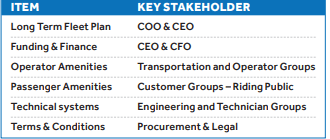
By definition, procurement parity means to align responsibility with authority in the selection and award process. That is to say, the authority in a fleet procurement decision process should rest, or at a minimum involve, the people who live with the outcome of that decision over the life of the investment. Examples include:
2. Look forward before looking back
Fleet planning should always start with a strong vision of what the future state of a bus or rail fleet operation will be at some distant point in the future. What does the customer and employee of the future look like, and what can we do to attract these groups to our organization or services? Begin with what you want not what you have, and don’t restrict yourself to current fiscal realities. In my experience, there is more money in search of vision than vision in search of money. Create the vision and plan backward.
Ensure that your fixed infrastructure planning is aligned with your fleet plans. This is especially true if you are looking to procure new propulsion technology (electric or hydrogen) or if you are looking at larger capacity buses (articulated or double-decker fleets).
Verify that you have planned and budgeted to operate and maintain the capital that you are intending to purchase. Never expand a fleet at the expense state of good repair obligations.
3. Look back after looking forward
Asset management includes far more than asset procurement. Make sure your property has completed an asset management inventory, condition assessment, and fleet plan prior to starting the procurement process. Learn from critical mistakes made in past procurements and apply lessons-learned to the current process and technical specifications. Be aware of the agency's goals and ensure that your process is in lockstep with this direction.
4. Pay me now or pay me later
All too often, agencies purchase assets when funds are available, which creates major difficulties from an operating perspective. Despite the unpredictable nature of funding for capital, bus procurement should never be an event. Fleets should be planned and purchased using a deliberate and balanced approach that is based on expected lifecycles, with adjustments for service changes (growth/contraction).
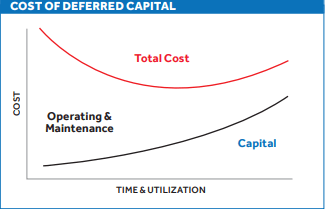
For example, a standard heavy-duty transit bus in the U.S. is defined as a 12-year asset, in Canada it will often be an 18-year asset, and some properties will define expected-life using their own operating characteristics. Whatever your number is, recognize there are benefits to buying one-twelfth of a 12-year fleet annually (or one-eighteenth of an 18-year fleet). Remember that fleets have an economic, service, and technological lifecycle. A deferred investment in capital will generally be accompanied by an unplanned and unwelcomed increase in operating expenses. (see table below)
When funding is tight, look for financing options. Debt financing can be an effective tool if it does not outlive the asset. In fact, financing options on long-term assets, like commuter rail and light rail, produce intergenerational equity, meaning the asset is paid over its useful life and by its active tax base and benefactors.
5. Know what you don’t know
As noted previously, the impact of this process, and ultimate outcome, will be felt for many years, and often, beyond your time. Understand what you don’t know and leverage industry resources, including peer properties and multiple OEMs to help develop a specification that is truly aligned with desired outcomes. Some properties may choose to hire consultants to handle technical specifications or the entire procurement process. This may be more expensive, or when viewed within the context of total process management, save money over the life of the vehicle.
6. Develop the right specification
When developing a technical specification there are many things to consider — total cost of ownership, fleet continuity, etc. A well-written specification will be open to competitive bids, capitalize operating dollars, improve efficiencies, and increase planned maintenance activities. Do not build the bus. Define your operating environment and your required performance characteristics and allow the bus builders to leverage their expertise to meet your specification. For every dollar in capital, a property will spend between $4 and $7 in operating expenses over the life of the vehicle. These amounts vary widely because lower price doesn’t always mean best long-term value. Choose wisely.
Transit properties can lower the cost of procurement by partnering for success using a strategic buying process. The goal is to lower interaction and supplier cost, which results in a reduced overall purchase price. This begins with a clearly worded performance-based specification that adheres to the requirements associated with your funding source.
As an example, FTA-funded procurements require specifications with components open to competition with few exceptions. Writers can name a preferred product but should also stipulate any approved equals to minimize the need for clarification and to provide clarity for the OEM bid teams. A preferred industry practice is to provide an appendix with products known to have met the specifications listed.
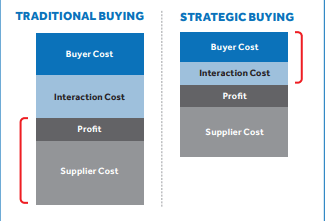
Partner to manage risk and to reduce cost. Fleet procurements quite often require multi-year contracts that need to allow for cost increases over the term of the contract. There are several producer price indexes used to stipulate a price change over the term of the fleet contract.
As an example, WPU 1413 is a common producer price index to re-price a traditional bus from the initial build date. Quite often properties will add stipulations that transfer risk but also add cost to the supplier (and buyer) in this process. Multi-year fixed price contracts or stipulating a producer price index but then capping the maximum increase permitted per year are both examples of risk transfer in traditional buying that add cost and price to the fleet procurement process. Transferring risk is often a tool for budget predictability, but it generally results in higher initial and overall pricing to the buyer.
Another area for consideration is performance bonding and liquidated damage clauses. Performance bonding should be used when there are eligible proposers with an uncertain financial standing. Many of us have witnessed the challenges associated with a large contract award to a bus or railcar manufacturer that outlived the life of the manufacturer. The operating costs and creativity associated maintaining rolling stock that was provided from a defunct OEM can be staggering. For my NJTRANSIT alumni, we all remember the Eagle contract award and its long-term impact to service operations. Bonding can be used as a mechanism to price financial uncertainty into the overall cost from the proposer, which provides an indication of financial stability.
Liquidated damages are often used to penalize an OEM for not adhering to contract manufacturing schedules. This is a valid financial tool to align delivery of railcars and buses with a project timeline but should be reasonably connected to the financial loss associated with that project.
7. Choose the right partner
The evaluation of proposals or bids must be thorough and objective. Once a selection is made, be prepared to meet with winners and losers to review the scoring (or pricing if a bid) and final decision. Develop a partnership with the selected provider and look for ways to minimize risk and maximize value for both parties over the term of the procurement process.
In equipment maintenance, the most rigid adherence to good process does not necessarily ensure a good outcome. The assets must be specified and procured properly, using a well-developed and widely supported fleet plan. The customers and employees of the future are counting on your approach.
Subscribe to Our Newsletter
More Management

METRO Opens Submissions for 2026 Motorcoach Awards
Nominations are now being accepted for METRO Magazine’s Operator of the Year and Innovative Operator of the Year awards.
Read More →
New York MTA Advances Final Contract for Second Avenue Subway Expansion
Contract Four is the largest in the Second Avenue Subway Phase 2 project and includes construction of station infrastructure, tracks, and signals for the subway expansion, MTA officials said. Work on Contract Four will begin in 2027.
Read More →
Transit Agencies Highlight Safety Gains at National Summit
Leaders from 15 major transit systems shared crime-reduction results and safety initiatives while discussing the role of continued federal support.
Read More →

NITA Names New Leadership, Expands Reduced-Fare Program at First Board Meeting
The new regional transit authority appointed its first board chair and interim executive director while extending reduced fares across CTA, Metra, and Pace for eligible riders.
Read More →
Beyond the Checklist: A Structured Approach to Transit Maintenance
Reliability-Centered Maintenance helps transit agencies move beyond routine checklists to focus limited resources on the assets and failures that have the greatest impact on safety, reliability, and service.
Read More →
APTA 2026 Nominating Committee Selects Leadership Slate, Names Chair and Vice Chair Nominees
Leadership changes will help shape the association’s priorities and its representation of the transportation industry during the 2026–2027 term.
Read More →
DART Launches Major Security, Fare Enforcement Initiative
The 90-day demonstration will deploy coordinated security teams at five light rail stations while testing controlled access and gathering data to guide future investments.
Read More →
Sponsored•September 9, 2026
Advancing Fare Collection Through Technology and Innovation
Learn about delivering 1300 gates at 91 stations while managing fare evasion. Explore the large scale deployment, solution customization and real-world results that affect the region. Prepare for deployment in your region now.
Read More →
Game Day in Motion: Moving Millions During the 2026 World Cup
Between packed transit stations and team motorcoaches, see how agencies and operators across North America tackled the transportation demands of the 2026 FIFA World Cup.
Read More →
Surface Transportation Extension Averts Shutdown, Leaves Transit Funding Gap
The stopgap keeps federal transportation programs moving, but missing advance funding could complicate the transit and rail projects agencies are planning next.
Read More →