



Layoffs, service cuts plague transit agencies
Several transit agencies throughout the country are facing budget shortfalls, forcing them to reduce costs through various means.

Several transit agencies throughout the country are facing budget shortfalls, forcing them to reduce costs through various means. A survey done by the American Public Transportation Association (APTA) showed that the economic downturn has produced substantial negative impacts to the transit industry. Fare revenues dropped, government funding decreased and reduced dedicated tax revenues resulted in rising operating deficits. The Metropolitan Atlanta Rapid Transit Authority (MARTA) recently announced the elimination of 100 positions in an effort to reduce costs. MARTA General Manager Nathaniel P. Ford Sr. eliminated 10 senior-level positions, including his chief of staff and two deputy general managers, one for operations and the other for administration. In a press release, Ford said, “These realignments are extremely painful, but necessary to streamline our organization and reduce overall costs.” While 38 of those 100 positions were vacant, MARTA spokeswoman Steen Miles said about 67 of 4,800 employees were actually laid off. “EAP counseling is being provided for staff members who are remaining and those staff members who are departing. None of the positions that were eliminated or impacted were representative employees,” Miles said. “No union people or front-line police, bus operators, train operators, none of those people were [laid off].” Miles emphasized that the agency’s re-organization would impact its service minimally. The elimination of positions is expected to save MARTA about $6.5 million. “I think the elimination of these positions was necessary at this time and you do what is necessary at a given time with the information and resources that you have,” Miles said. “Our objective is to recommend a budget which maintains expenses and the use of reserves at levels adopted in the FY 2003 operating budget without raising fares or cutting service,” Ford said. “We simply cannot achieve that objective without sacrifice. Ridership and sales tax revenues are way below FY ’03 projections. These conditions continue to be a challenging variable in the development of the FY ’04 operating budget, hence a reduction in force is necessary to assure the authority’s delivery of services in a sound fiscal manner.” The Santa Clara Valley (Calif.) Transportation Authority (VTA) has already cut service and is in the midst of talks about more service cutbacks. The agency chose reduction in service over elimination of positions because, over the past couple of years, more than 150,000 jobs were lost in Silicon Valley, said VTA’s Public Information Officer Dina Braun. VTA’s Board of Directors approved in February a 9% service reduction, eliminating about 200 positions, and in 2002, the agency laid off about 10% (550 positions, not all of them filled) of its workforce and raised fares 15%. “For about seven consecutive quarters, [there was] a downturn in our funding for our operations — which is 80% from local sales taxes and the other 20% comes from fare box and other miscellaneous revenues — and sales tax revenues started to go down, and that means our revenue started to go down,” Braun said. The agency had to immediately figure out what could be done to keep service on the streets and retain jobs. FY 2002-03’s budget shortfall for the VTA was about $73.7 million and is estimated this year at $72.1 million. Due to downturns in revenue for the past seven quarters, the agency lost about 33% of its revenue. The VTA formed an ad hoc committee to help approach this with short- and long-term strategies, like finding new revenue streams to maintain and improve transportation services in Santa Clara. The agency has also put together a two-year budget instead of an annual one. “We’re looking at broadening some sales tax, a gas tax, a payroll tax, going to the voters and asking them if we can use one of our existing measures that kicks in 2006, if we can use those funds for operating,” Braun said. “Another one is we’re going back to the public in June about more service cuts. This is where its going to be hard because we’re proposing a 21% service cut.” The New York City Transit Authority is scheduled to slash 381 jobs during the next two years through attrition as part of a budget-cutting plan. The Alameda-Contra Costa Transit District in California previously eliminated 130 positions and cut service. Officials have said the agency is going to be facing that again with more service cuts and layoffs.
More Management

People Movement: Connectpoint Expands Leadership Team, Stadler Names New Group CEO, and More
In this edition, we also spotlight recent personnel moves at Burns, UZURV, and more, highlighting the people taking on new roles across the transportation industry.
Read More →
More Than a Summer Job: Building the Next Generation of Transit Talent
The Delaware River Port Authority and PATCO have transformed their internship program into a hands-on professional development experience that introduces students to the breadth of transportation careers — and creates a pipeline for future employees.
Read More →
LA Metro Board Awards 220 Battery-Electric Bus Contract to ENC
The contract, which is the largest base award of battery-electric buses by a U.S. transit agency, will be built in Southern California, sustaining good jobs as LA prepares to welcome the world in 2028
Read More →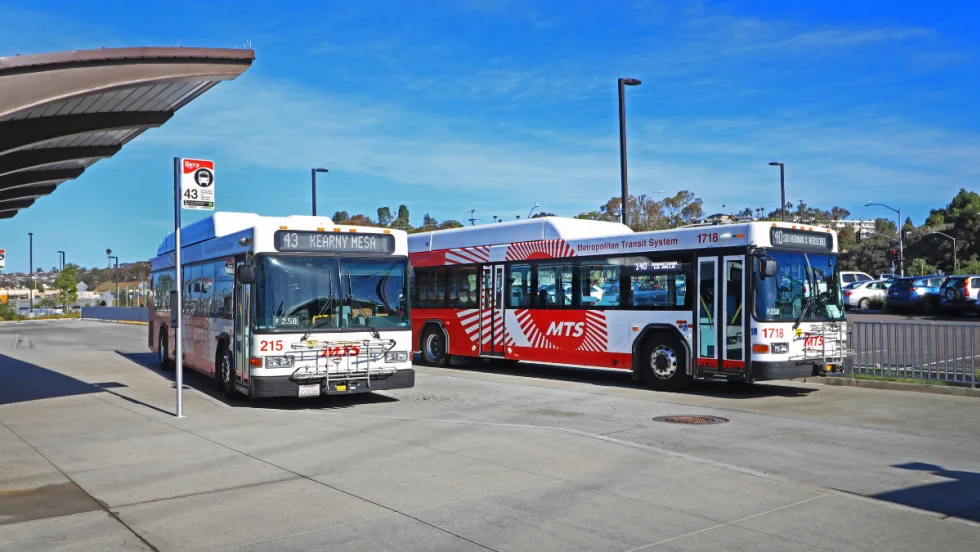
What’s Behind San Diego MTS’s Award-Winning Transit Strategy
Named one of APTA’s 2026 Outstanding Public Transportation Systems with 50 million or more annual passenger trips, California’s San Diego Metropolitan Transit System points to gains in ridership, safety, technology, and reliability as foundations of its success.
Read More →
Public Transit Conference Returning to GFX in 2027, Call for Papers Now Open
The Call for Papers is now open, allowing transit agency professionals and industry experts to help shape the PTC educational program by submitting session ideas for consideration.
Read More →
Indian River Transit’s Community-Focused Approach Earns National Recognition
Named APTA’s 2026 Outstanding Public Transportation System in its size category, Florida’s Indian River County transit system continues to grow ridership through fare-free service and a focus on evolving community needs.
Read More →
ENC Lands MATA Contract and More in Biz Briefs
In this edition of Biz Briefs, we spotlight the latest developments shaping the future of mobility.
Read More →
From Surviving to Thriving: Building Stronger Transportation Organizations
Bus Business Consultants founder Brian Dickson shares lessons on leadership, organizational health, and creating options for long-term success in a changing transportation industry.
Read More →
Everett Transit, Community Transit Outline Consolidation Agreement
The proposed agreement calls for a 50% increase in bus service in Everett, a new microtransit zone, continued paratransit service, and the transfer of Everett Transit operations to Community Transit.
Read More →
Strada360’s Steve Lassey on Turning Transit Data Into Better Decisions
From breaking down data silos to preparing for AI, Strada360 CEO Steve Lassey discusses how transit agencies can use technology to improve operations, customer information, and long-term decision-making.
Read More →