



Light Rail Line Links Salt Lake City with Airport
The Airport TRAX, which has six stations, is now on full schedule, with trains from downtown to the airport running every 15 minutes on weekdays and every 20 minutes on weekends. It travels at speeds up to 60 miles per hour.
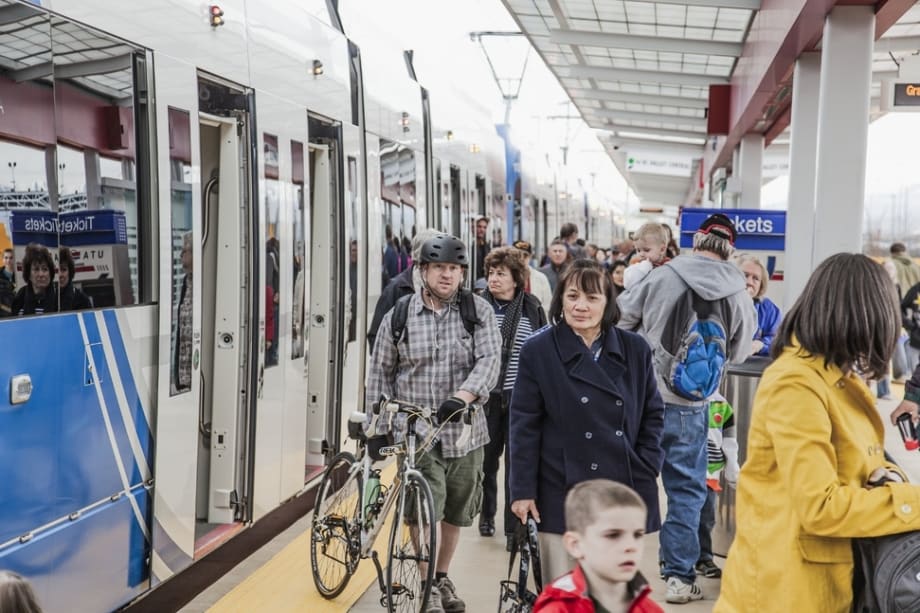
The Airport TRAX, which has six stations, is now on full schedule, with trains from downtown to the airport running every 15 minutes on weekdays.
The Airport TRAX, which has six stations, is now on full schedule, with trains from downtown to the airport running every 15 minutes on weekdays.
Kevin Cox knew that the Airport TRAX light rail would make an impact on travel between downtown Salt Lake City and Salt Lake City International Airport. But, he had no idea it would be such an immediate hit.
One day after the April 13 grand opening, Cox volunteered at a downtown station, helping to orient passengers to the new six-mile line connecting the airport with the downtown.
“Already, I saw a lot of people using the train to travel to the airport,” Cox says. “Overwhelmingly, when I talked to people about the new line, they were very excited about it.”
It was a satisfying moment for Cox, Parsons Brinckerhoff’s project manager for the Airport TRAX project, which is part of the Utah Transit Authority’s (UTA) FrontLines 2015 program that includes five rail projects. Parsons Brinckerhoff serves as program manager to UTA for the FrontLines program.
The Airport TRAX, which has six stations, is now on full schedule, with trains from downtown to the airport running every 15 minutes on weekdays (5:30 a.m.- 11:30 p.m.) and every 20 minutes on weekends. It travels at speeds up to 60 miles per hour.
Airport TRAX, known as the Green Line, also gives people beyond Salt Lake City convenient transportation to the airport, connecting with TRAX light rail lines, as well as the FrontRunner commuter rail lines. So now, residents from as far away as Ogden to the north or Provo to the south can travel directly to the airport on rail transit.
‘A Complete Street’
One of the most striking features of the Airport TRAX Line is the North Temple Street corridor, half of the overall project length. Originally owned by Utah Department of Transportation, ownership of this three-mile stretch of land was turned over to Salt Lake City, which then turned that corridor into “a complete street” shared by light rail, vehicles, bikes and pedestrians.
“It was originally just a street for vehicle traffic. No landscaping, just cars and trucks,” Cox says. “The city went out of its way to turn it into something unique and sustainable.
It is kinder and friendly…an approachable corridor,” Cox says. “The city invested a lot to liven this area up and add color, to make it a place you would want to visit. I think relative to what it used to look like, the transformation has been amazing.”
Making the Green Line Green
One unusual aspect is the creation of a “grass track.” It follows a European model with a test bed of grass growing in between a 400-foot stretch of track. UTA will examine maintenance and safety issues surrounding this test bed to determine whether it would be viable to expand it or if it should be discontinued.
Sustainability was an important consideration from the start of the project, and Cox said all agreements with UTA and Salt Lake City required elements that took the environment into account every step of the way.
That led to the inclusion of elements like solar panels on the tops of four of the six station canopies, which were funded by a grant from Rocky Mountain Power. An idling policy was created that required shutdown of all construction equipment when unused after three minutes to five minutes. Recycled materials were used on projects whenever possible.
Alliance Agreement
Another innovative aspect of this project was the “alliance” agreement among all parties involved in development and construction of the rail line.
“There was a sense of ‘share the pain, share the gain,’ so that when we beat a goal, everyone shared in the benefit,” Cox says. There was also some risk in this type of approach, since the flip side was that losses would also be divided. But, the unity in purpose ultimately benefitted all involved.”
More Management

METRO Opens Submissions for 2026 Motorcoach Awards
Nominations are now being accepted for METRO Magazine’s Operator of the Year and Innovative Operator of the Year awards.
Read More →
New York MTA Advances Final Contract for Second Avenue Subway Expansion
Contract Four is the largest in the Second Avenue Subway Phase 2 project and includes construction of station infrastructure, tracks, and signals for the subway expansion, MTA officials said. Work on Contract Four will begin in 2027.
Read More →
Transit Agencies Highlight Safety Gains at National Summit
Leaders from 15 major transit systems shared crime-reduction results and safety initiatives while discussing the role of continued federal support.
Read More →

NITA Names New Leadership, Expands Reduced-Fare Program at First Board Meeting
The new regional transit authority appointed its first board chair and interim executive director while extending reduced fares across CTA, Metra, and Pace for eligible riders.
Read More →
Beyond the Checklist: A Structured Approach to Transit Maintenance
Reliability-Centered Maintenance helps transit agencies move beyond routine checklists to focus limited resources on the assets and failures that have the greatest impact on safety, reliability, and service.
Read More →
APTA 2026 Nominating Committee Selects Leadership Slate, Names Chair and Vice Chair Nominees
Leadership changes will help shape the association’s priorities and its representation of the transportation industry during the 2026–2027 term.
Read More →
DART Launches Major Security, Fare Enforcement Initiative
The 90-day demonstration will deploy coordinated security teams at five light rail stations while testing controlled access and gathering data to guide future investments.
Read More →
Advancing Fare Collection Through Technology and Innovation
Learn about delivering 1300 gates at 91 stations while managing fare evasion. Explore the large scale deployment, solution customization and real-world results that affect the region. Prepare for deployment in your region now.
Read More →
Game Day in Motion: Moving Millions During the 2026 World Cup
Between packed transit stations and team motorcoaches, see how agencies and operators across North America tackled the transportation demands of the 2026 FIFA World Cup.
Read More →
Surface Transportation Extension Averts Shutdown, Leaves Transit Funding Gap
The stopgap keeps federal transportation programs moving, but missing advance funding could complicate the transit and rail projects agencies are planning next.
Read More →