March Networks Unveils New Capabilities, Focuses on Future of Video Surveillance
METRO Executive Editor Alex Roman recently spoke to Net Payne, chief sales and marketing officer at March Networks, about the new platform, the importance of surveillance in transit, and how AI will continue to play a role in the industry’s future.
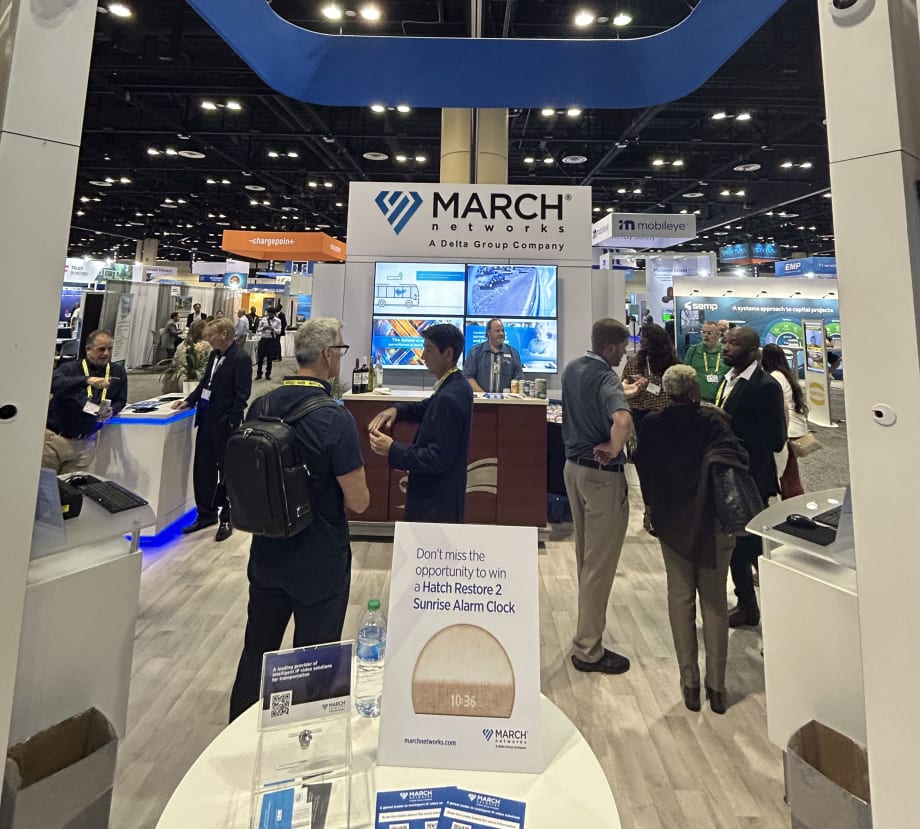
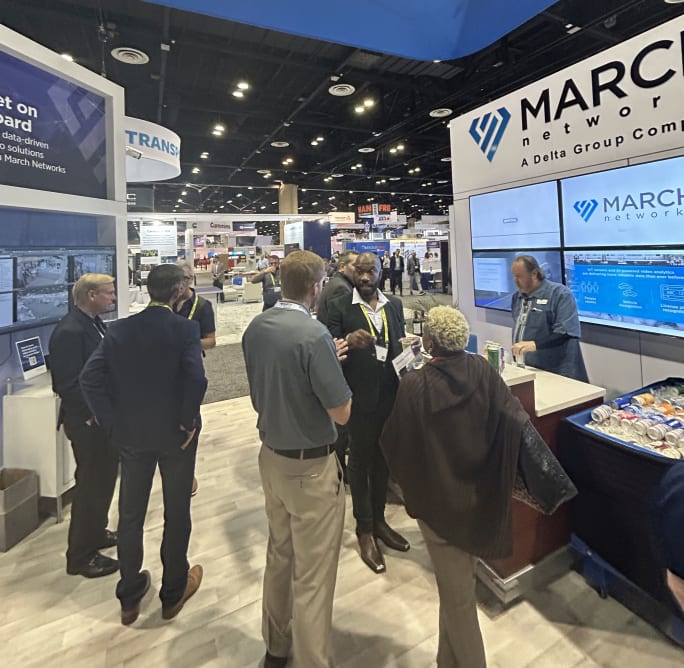
March Networks recently unveiled the new RideSafe XT IP NVR recording platform at APTA's EXPO in Orlando, Fla.
Photo: March Networks
7 min to read
March Networks recently unveiled the new RideSafe XT IP NVR recording platform. RideSafe XT delivers a first-of-its-kind Sleep Mode capability enabled by artificial intelligence (AI) to help transit agencies eliminate damage and risk when buses are out of service.
METRO Executive Editor Alex Roman recently spoke to Net Payne, chief sales and marketing officer at March Networks, about the new platform, the importance of surveillance in transit, and how AI will continue to play a role in the industry’s future.
Ad Loading...
Can you talk a bit about March Networks’ big announcement, which was unveiled at 2023’s APTA EXPO?
We announced the release of the RideSafe XT IP network video recorder (NVR), which is our next generation NVR for the transit market. It has an AI-based processor from Nvidia that runs the NVR. This chip enables the NVR itself to do AI, instead of that coming from cameras or in the cloud, which is a big advantage when you are deploying multiple cameras and have limited bandwidth.
One innovative piece of functionality, we think, is that RideSafe XT leverages AI to address what we believe transit agencies really need, which is what we call Sleep Mode. What Sleep Mode does is help solve the problem of when you have damage or vandalism that happens to your buses when they are on the lot, or wherever you are parking your vehicles overnight.
Historically, there has always been a challenge when you power down the bus because there’s no more video surveillance, right? The sort of half-step taken to solve that is deploying a motion detector on the bus your surveillance system, which when triggered spins up the NVR, but that process can take a few minutes to begin recording video and by that time, the damage can already be done and the vandal already gone without anything being captured on video.
What Sleep Mode is for us is a combination of how we can be smarter with power usage, while also using AI that triggers only when there is an issue. Because there are features like people detection, car detection, and facial detection built in, when there are things happening in the background, like blowing trees, AI analytics can more effectively eliminate false alarms. Because of that, you can run it on multiple cameras, instead of just one motion sensor that spins on one camera. More importantly, transit agencies can program the system themselves to do what they want to do. So, if an agency wants one camera on all four sides of a bus, they can configure the system to do that and record it all directly to an SD card that is located in the NVR itself.
Net Payne, chief sales and marketing officer at March Networks.
Photo: March Networks
And this capability was added based on feedback from your customers?
After speaking to one customer recently, I found out that not all of those bus depots necessarily have external video surveillance systems. Sometimes, they have somebody just drive around the lot to do a visual of the buses, which is not a cost-effective solution. A majority of our customers are tier one agencies who have large fleets spread across several lots and they often have to deal with vandalism and vagrancy. With the motion sensor setups, we have heard that by the time the system spins up, the person is already off the bus or the damage is done.
Ad Loading...
Transit agencies, especially the larger ones, spend $500 a bus or so for motion sensors. Spread over hundreds of buses, our system can save those agencies thousands of dollars. But the bigger reality here is with our Sleep Mode system transit agencies will have the evidence they need to prosecute offenders — many of whom are repeat offenders when you get into those getting onto the buses to write graffiti or otherwise vandalize the bus.
AI is a great buzzword right now, not only in transit, but everywhere you seem to look. How do you see AI fitting into public transit?
AI is an incredibly broad term, which most people are probably familiar with through ChatGPT, which deals with natural language, right? AI in the video surveillance space provides enhanced processing capabilities and the ability to train algorithms to make video analytics much better than they were before.
So when we discuss AI in the video space, there are two things. One is analytics, which have existed for a while, but are now much better because they are no longer creating false alarms. In fact, they are allowing us to look for specific things. For example, we have one customer in the Northeast that wanted to be able to detect when a horse drawn buggy comes into a park. Now, that’s a random example, but it proves the point that AI can be trained to detect certain data sets and then perform those tasks. So for us, it’s about what you can do with video analytics that are of a better quality, which in turn provides a real-use case for customers.
There is another opportunity with AI that we believe can be very useful in low-bandwidth environments and that is image-based analytics. So rather than running AI-analytics on a whole video stream, you are evaluating a single image in isolation. Our product has a functionality called Operations Audit, which allows us to take a single image from multiple cameras and put it into one pane of glass at the time interval you like. What that does is it allows us to take those single images, ingest them, and run analytics. So, if there is something specific you are looking for, theoretically the system will be able to start to learn how to predict what you are going to see before it happens.
Now, I think you will hear a lot more marketing hype around that prior to being widely adopted in transit because that is a few steps down the road. But it is really about how do you start to make predictive business intelligence around AI based on what is happening in the background and not on the video stream. It can be on an image or your data. So, as you ingest fare systems, for example, and correlate that video to a transaction, you can do that and start to apply an AI algorithm in the background that is looking for various things that have to do with the transaction, not necessarily the video.
Ad Loading...
AI in the video surveillance space provides enhanced processing capabilities and the ability to train algorithms to make video analytics much better than they were before.
Photo: March Networks
Where does March Networks go from here? Are there other capabilities that will be coming down the pike?
For us, as a company and for U.S. transit, specifically, Cloud Managed video is the future. Now, cloud is another buzzword, and if I asked my customers what cloud video means to them, they would probably all have different answers. The reality is cloud video is very core to what we have always done, but it has always been managed by us in our own data centers. We are already managing thousands of buses in the cloud, so our customers don’t have to worry about it. And, we have a second functionality, which is to monitor the health of all their cameras and NVRs across their fleets through a cloud portal. Those are just two elements, though.
The reality is cloud storage is really what many people have in mind when they think of the cloud, but it is an inherently more challenging technological solution. Because there is a lot of video being recorded, it gets quite expensive when you are trying to store all of that footage. We believe it is all about creating redundancy of the most important video, so we have a cloud storage solution where it can automatically be scheduled for a set of cameras being fed into an NVR to save footage that is captured when there is movement at night or an alarm is triggered.
Imagine in our scenario, then, that we are able to retain video for long-term evidence in a cloud storage solution automatically. All you have to do is set it up once and it will take all that video and retain it long term. So, I think while public transit has been a bit slower than the rest of the video surveillance market to adopt cloud-managed video, that is absolutely where the industry is headed. It may start small, but it will begin to grow, especially in the tier one transit space. As that happens, then you will start to see players like March Networks have contracts where we are sometimes doing just cloud-managed video and other times putting redundant storage in the cloud. It will ultimately be up to the individual transit agencies.
CEO Magnus Friberg discusses Luminator’s shift toward becoming a digital partner, the growing importance of software and interoperability, and how AI can help agencies improve operations and passenger experience.
Reliability-Centered Maintenance helps transit agencies move beyond routine checklists to focus limited resources on the assets and failures that have the greatest impact on safety, reliability, and service.
More than 1,500 buses now feature upgraded technology designed to improve arrival predictions and provide free Wi-Fi, with deployment expected to reach nearly 2,000 buses by the end of 2026.
John Hroncich discusses BAE Systems’ modular and scalable approach, lessons learned from decades of real-world operations, and how agencies can identify electrification strategies that fit their fleets.
In METRO's latest installment, we take a look at recent news from Complete Coach Works, Beep, FlixBus, and more partnerships making headlines across the transportation sector.
What if transit leaders could ask any operational question and get a trusted answer in seconds? Conversational AI is transforming how agencies use their data.
More than $191 million in federal funding will help three transit agencies replace aging rail vehicles and support a new autonomous shuttle service in Chattanooga.
LA Metro’s Obed Mejia discusses technician training, evolving maintenance technology, fleet replacement, and strategies for getting the most out of today’s transit fleets.
In METRO's latest installment, we take a look at recent news from Siemens, Prevost, Dodge, and more partnerships making headlines across the transportation sector.
Pedestrian microsimulation is helping rail planners identify bottlenecks, test station designs, and prepare complex transit hubs for growing passenger volumes.