In METRO’s report from last year, we predicted the climb back to industry health would be challenging and 2023 proved this out. Our COVID hangover seems to be continuing, with 2023 hopefully being the turning point for industry deliveries to begin its upswing back to normal levels.
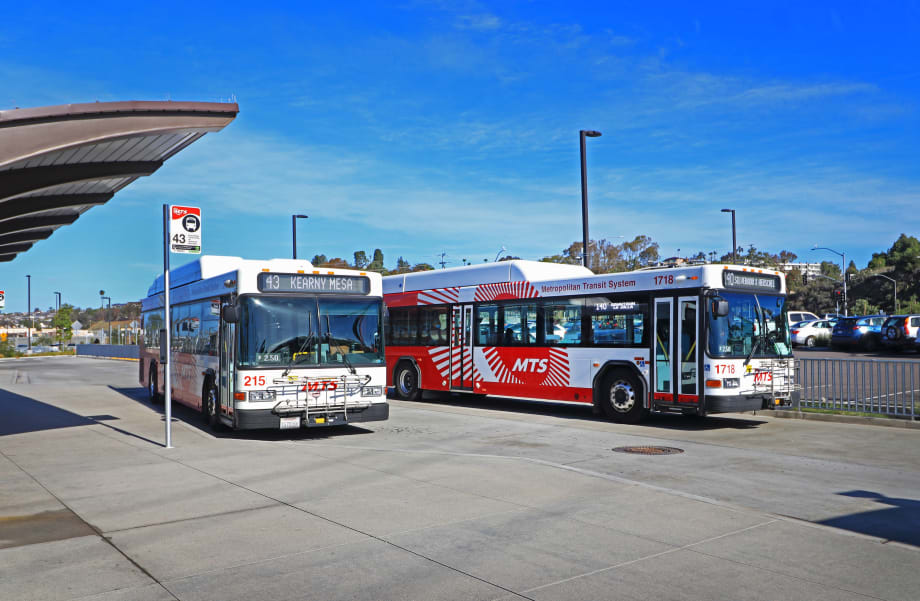
Photo: San Diego MTS
7 min to read
As North America’s major heavy-duty bus OEMs were continuing to recover from post-COVID supply chain and hyper-inflation effects, a few were forced into bankruptcy, restructure, or retrench, causing a perfect storm of events that made 2023 one of the most turbulent years in recent memory in the North American transit bus supply sector.
Despite the turbulence, North American transit bus deliveries were up 7% in 2023 compared to 2022, according to numbers submitted by large transit bus OEMs.
Ad Loading...
How We Got Here
The culmination of many influences contributed to the situation that occurred in 2023. Bus OEMs continued to face headwinds with global supply chain shortages and their ability to run their assembly operations efficiently and on schedule as component part supply to their production lines lacked consistency throughout the year.
Further, the more specialized nature of zero-emission bus components created additional supply chain headwinds for bus OEMs.
The most significant influences, though, was the economic reality of funding manufacturing overheads and production facilities built for much higher volumes and the transitioning to increased demand for electric buses. Due to the increased cost of zero-emission vehicles versus traditional diesel buses, the amount of working capital needed to support electric bus production is now almost twice as much for OEMs to finance. These factors were discovered by the APTA Bus Manufacturing Task Force, which was convened in late 2023 to address the serious situation the industry found itself in. More on that in a bit.
For the larger OEMs, assuming they build 100% electric buses, the amount of working capital necessary to operate this zero-emission transition can be in excess of $1 billion. With transit agency payments for new buses not occurring until after final acceptance and delivery, OEMs are left to finance this significant increase in working capital. For some OEMs in 2023 it proved overwhelming.
2023’s OEM Turbulence
Last year saw significant developments with bus OEMs.
Ad Loading...
Proterra was forced into bankruptcy and sold off their various divisions with Phoenix Motors being the acquirer of Proterra’s bus assembly operations — but not its in-house electric component business, which went to Volvo.
Meanwhile, at APTA’s TRANSform Conference & EXPO in October, New Flyer discussed experiencing cash flow issues in early to mid-2023 forcing them to enter complex financial restructuring, and more recently, Nova Bus elected once again to exit the US transit bus market and become a solely Canadian bus supplier, repeating a similar approach they undertook 15 years prior.
Finally, ENC and their parent REV Group decided to shut down their bus assembly operations citing COVID supply chain effects and the difficulty of sourcing and financing electric bus components, while BYD rebranded as RIDE.
The result of all of this is the market now has essentially two major players in the heavy-duty bus market: GILLIG and New Flyer.
Despite this supply side churn, GILLIG once again has proven its resiliency to weather these debilitating market effects as its unique business model and nimble product and assembly processes allowed it to march along in 2023, increasing deliveries close to pre-COVID levels.
Ad Loading...
The federal government and the Biden Administration took notice of this downturn in the supply side of the transit bus market. With record funding levels for zero-emission buses through the IIJA, federal officials became perplexed as to how the supply side of the business could be in such disarray.
With almost a perfect storm of challenges facing the industry, the process by which transit buses are procured and paid for rose to the surface.
In Q4 of 2023, the industry convened a blue-ribbon group of OEMs, suppliers, and transit agencies to identify the issues and how to best introduce improvements. This was the APTA Bus Manufacturing Task Force chaired by Dorval Carter of the Chicago Transit Authority.
Technical customization, lack of progress payments, bonding costs, and other contractual penalties came into focus by this group, which in turn focused on a need to find solutions quickly to return the industry to a healthier balance.
The Task Force together with the Federal Transit Administration released some near-term solutions with an FTA “Dear Colleague” letter being released in February 2024. The challenge remains as to whether transit agency staff will adopt these improvements, however, initial indications have been positive.
Ad Loading...
Despite all these issues, new bus procurements, especially for zero-emission propulsion, continue to be bullish with major OEM orderbooks and backlogs at all-time highs. This is clearly positive, however, with reduced industry capacity and OEM retrenchment, wait times for new bus deliveries are now reportedly stretching out from 18 to 24 months in some cases.
The major heavy-duty OEMs showed increases in their deliveries in 2023 and they were the major drivers to the 7%-unit increase, despite the reduction in deliveries with three other OEMs who exited or retrenched in 2023.
Photo: GILLIG
Overall Transit Market Assessment
Turning attention to the industry delivery numbers for 2023, overall transit bus deliveries increased by 298 units from 4,051 units in 2022 to 4,349 units in 2023, or a 7% year-over-year increase. However, this is still far short of industry “normal volumes.
Additional findings include:
Pre-pandemic deliveries in 2019 were 6,320 units, and 2023 is the first year since COVID that deliveries have increased. Each year from 2020 to 2022, deliveries decreased from the 2019 pre-COVID market high. Notwithstanding, the market is still only at 68% of pre-pandemic levels.
The major heavy-duty OEMs showed increases in their deliveries in 2023 and they were the major drivers to the 7%-unit increase, despite the reduction in deliveries with three other OEMs who exited or retrenched in 2023.
It is expected that 2024 should see improvement in overall industry deliveries as major OEMs work down their orderbooks, as their production rates increase with a clearing of the decks of post-COVID supply chain issues, and a cooling of hyperinflation.
In METRO’s report from last year, we predicted the climb back to industry health would be challenging and 2023 proved this out. Our COVID hangover seems to be continuing, with 2023 hopefully being the turning point for industry deliveries to begin its upswing back to normal levels.
Ad Loading...
Units By Size
2023
2022
2023 vs 2022 (Units)
2023 vs 2022 (%)
30 Feet and Under
214
302
(88)
-29%
35 to 40 Feet
3,662
3,287
375
11%
45 Feet
128
229
(101)
-44%
60 Feet
345
233
112
48%
Total
4,349
4,051
298
7%
Source: METRO Magazine, based on numbers reported by participating suppliers. Some numbers projected
Assessment from a Transit Vehicle Length Perspective
A closer look at 2023’s transit bus deliveries by transit length show:
Overall, 35- to 40-foot units made up the lion’s share of deliveries, with a total of 3,662 units delivered in 2023.
30-foot and under units experienced another consecutive year of decline of 88 units, or 29%, from 302 units in 2022 to 214 units in 2023.
35- to 40-foot units increased by 375 units, or 11% year-over-year, turning the tide on the decreases seen in 2022 vs 2021. 2023 deliveries were 3,662 units compared with 3,287 units in 2022.
45-foot units experienced a similar and significant decline exhibited in 2022 with deliveries down 101 units, or 44%, from 229 units in 2022 to 128 units in 2023.
60-foot units showed a marked uptick in 2023 reversing 2022 declines. Deliveries were up 112 units, or 48%, from 233 units in 2022 to 345 units in 2023. The most interesting development in 2023 is that now only one bus OEM supplies the U.S. market with 60-foot units with Nova Bus’s exit.
Propulsion Catalog
2023
2022
2023 vs 2022 (Units)
2023 vs 2022 (%)
Diesel
1,973
2,204
(231)
-10%
Hybrid
916
521
395
75%
Natural Gas
850
780
70
9%
Electric
579
504
75
15%
Fuel-Cell Electric
31
42
(11)
-26%
Total
4,349
4,051
298
7%
Source: METRO Magazine, based on numbers reporting by participating suppliers. Some numbers are projected
Assessment from a Propulsion Segmentation Perspective
Although orderbooks are flush with zero-emission orders, industry deliveries are still predominated by the more traditional propulsion technologies.
Ad Loading...
A look at the transit bus deliveries by propulsion, shows:
Diesel was still the predominant propulsion technology in 2023 with 1,973 units delivered, representing a decline of 231 units, or -10%, from 2,204 units in 2022.
Hybrid propulsion proved itself in 2023 with a major increase to 916 units from 521 units in 2022, or a 395 unit and 75% increase year-over-year.
Natural gas, or NGV propulsion, had an increase from 780 units in 2022 to 850 units in 2023. This 70-unit increase resulted in an approximate 9% year-over-year bump for NGV.
Electric buses were 579 units in 2023 vs 504 units in 2022, representing a 75 unit increase or 15%.
Ad Loading...
Fuel-cell buses were with 31 units in 2023 vs 42 units in 2022, representing an 11-unit decrease, or -26%.
As we move forward in 2024, we forecast a continued decrease in diesel propulsion technology in favor of primarily electric buses, as OEMs work through their backlog, while CNG and hybrid deliveries are forecasted to remain reasonably favorable in the overall market mix.
Further, we trust that the significant OEM challenges that occurred in 2023 will not repeat themselves as the market continues its march back to normal levels in 2024 and beyond.
The agency is seeking manufacturers for 650 new CNG buses to replace aging vehicles, improve reliability, and advance its broader fleet modernization strategy.
John Hroncich discusses BAE Systems’ modular and scalable approach, lessons learned from decades of real-world operations, and how agencies can identify electrification strategies that fit their fleets.
LA Metro’s Obed Mejia discusses technician training, evolving maintenance technology, fleet replacement, and strategies for getting the most out of today’s transit fleets.
In METRO's latest installment, we take a look at recent news from Siemens, Prevost, Dodge, and more partnerships making headlines across the transportation sector.
In this edition, we also cover recent appointments and announcements at Pace, CamTran, MCI, and more, showcasing the individuals helping to shape the future of transportation.
Transit leaders and policymakers examine how standardized bus designs, streamlined procurement, and predictable funding could help agencies stretch budgets and deliver better service.
As chair of APTA’s Business Members Board of Governors, Ray Melleady explains how more than 850 business members are partnering with transit agencies to advance funding, innovation, and industry-wide collaboration.
Bus Business Consultants founder Brian Dickson shares lessons on leadership, organizational health, and creating options for long-term success in a changing transportation industry.
The award-winning partnership combines AI-powered detection with human oversight to improve bus reliability, accessibility, and enforcement efficiency.