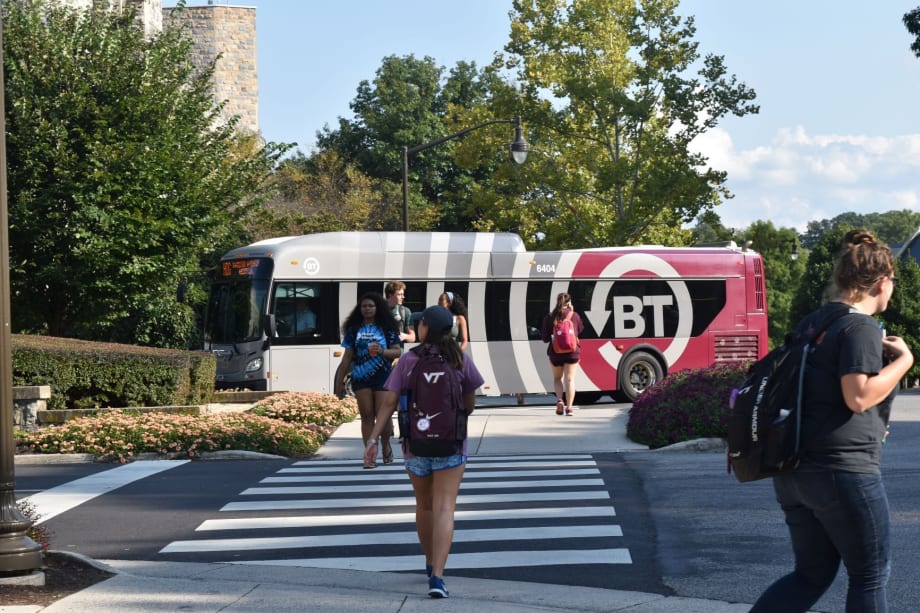
The agency earned APTA’s award in the small urban transit system category characterized by annual ridership of four million or less
by METRO Staff
October 15, 2019
Va.-based Blacksburg Transit operates 18 fixed routes and two demand-response services.
Blacksburg Transit
2 min to read
Va.-based Blacksburg Transit operates 18 fixed routes and two demand-response services.
Blacksburg Transit
Va.-based Blacksburg Transit (BT), which earned APTA’s award in the small urban transit system category characterized by annual ridership of four million or less, was singled out for their successful delivery of service to Virginia Tech, Blacksburg, and Christiansburg based on its performance in various quantitative and qualitative criteria.
“We’ve had unprecedented ridership growth of 22 percent over the last three years when most systems in our industry are facing declines,” said Tom Fox, BT director. “Many of the actions we took in the last three years helped drive this increase, including expansion of hours and routes, the addition of service on Sundays during the summer, and streamlining routes to eliminate the need for most “alternate” routes during off-peak service.”
Ad Loading...
The tactical challenges of the ridership growth manifested primarily in three areas: buses, not enough; manpower, not enough; and customer expectations, sometimes too much. “At the end of 2015, we only had five articulated buses and 94 operators,” Fox said. “By the end of 2018, we had 11 articulated buses and 123 operators.”
Initiatives that helped bolster this effort included the purchase of articulated buses, installation of new bus wash equipment to reduce vehicle wash time and improving maintenance-related performance measures to increase miles between road calls resulting in 9,950 miles for fixed-route and 23,601 for paratransit in 2018.
Additionally, Blacksburg Transit increased revenue service hours by 22% over the three-year period, with staff using Big Data to determine where new service should be deployed. This type of strategic decision-making and operational efficiencies resulted in the agency being able to maintain, and in some cases improve performance as expansion occurred. Passengers-per-revenue hour, varied from 42.9 to 43.8 over the period that revenue hours increased by 22%; and on-time performance averaged close to 90% for fixed-route and 85% for paratransit in 2018, according to agency data.
“Teamwork has contributed to our ability to handle our overall success in increasing ridership and the delivery of efficient/effective service the community has come to expect,” Fox said. “Rather than working in the traditional narrow “silos of power” that can characterize an organization, at BT we have formed cross functional teams that can work together to reach the goal of serving the community with effective and efficient service while expanding ridership and services.”
Wharton named Business Member of the Year
Jeffrey Wharton, director, alternative delivery systems, at SYSTRA was named APTA’s 2019 Outstanding Public Transportation Business Member. This is awarded to the American Public Transportation Association (APTA) public transportation business member who has had a remarkable influence on the public transportation industry. Currently, Wharton develops design-build partnerships throughout the U.S. for SYSTRA, as well as serves on several APTA committees. Previously, he served as president of a manufacturer of specialty transit equipment for the international transit electrification industry. Prior to that, he held executive management roles for a nationwide construction firm that specializes in mass transit and energy.
The agency is seeking manufacturers for 650 new CNG buses to replace aging vehicles, improve reliability, and advance its broader fleet modernization strategy.
John Hroncich discusses BAE Systems’ modular and scalable approach, lessons learned from decades of real-world operations, and how agencies can identify electrification strategies that fit their fleets.
LA Metro’s Obed Mejia discusses technician training, evolving maintenance technology, fleet replacement, and strategies for getting the most out of today’s transit fleets.
In METRO's latest installment, we take a look at recent news from Siemens, Prevost, Dodge, and more partnerships making headlines across the transportation sector.
In this edition, we also cover recent appointments and announcements at Pace, CamTran, MCI, and more, showcasing the individuals helping to shape the future of transportation.
Transit leaders and policymakers examine how standardized bus designs, streamlined procurement, and predictable funding could help agencies stretch budgets and deliver better service.
As chair of APTA’s Business Members Board of Governors, Ray Melleady explains how more than 850 business members are partnering with transit agencies to advance funding, innovation, and industry-wide collaboration.
Bus Business Consultants founder Brian Dickson shares lessons on leadership, organizational health, and creating options for long-term success in a changing transportation industry.
The award-winning partnership combines AI-powered detection with human oversight to improve bus reliability, accessibility, and enforcement efficiency.