



San Joaquin RTD Making Strides in Revitalizing Transit
With its newly launched BRT service and the opening of its downtown transit center, the Stockon, Calif.-based agency is seeing some long-term goals realized.
The city of Stockton, Calif., cited as one of the top U.S. cities undergoing substantial growth, is in the midst of a revitalization effort. With its progressive vehicle program, which brought hybrid technology to the region, the San Joaquin Regional Transit District (RTD) is playing a vital part in this new era.
In addition to a newly built ballpark, events center and developed waterfront, the city now boasts a new $14 million downtown transit center, unveiled by RTD in late December. “What we’ve done is important for revitalization, but definitely important for transportation in the community,” says Donna Kelsay, RTD general manager/CEO.
The transit center occupies an entire city block in downtown Stockton and serves as the primary hub for an average of more than 5,000 daily passengers.
Prior to having the downtown transit center, passengers were relegated to waiting on the street corner without any shelter from the elements. “People who were previously discouraged from taking public transit now know they have a safe, comfortable place to wait for their bus,” says Kelsay.
Downtown revitalization
To preserve a sense of the city’s past, the facility incorporates the facades of three historic buildings, while the interior is decorated with furnishings and historical photographs of the transportation system.
The center’s passenger boarding area includes two canopy-covered boarding platforms and four bus lanes with five bus cutouts per lane. This component opened for service in March 2006 and was dedicated to Jerald L. Hughes, general manager for RTD from 1990 to 2001. Hughes developed the concept for the transit center before he passed away suddenly from an aneurysm.
The new facility also houses a customer service center, where patrons can purchase bus passes or obtain photo IDs; an operator breakroom with a TV and private restroom; and a satellite office for the agency’s contracted Stockton police officers.
Other features include a meeting space for the agency’s board of directors and approximately 2,100 square feet of retail space, which the agency leased to a local ice cream parlor and cafe. In addition, RTD’s administrative and management staff has moved into the transit center, freeing up much-needed space for operations and maintenance staff in the existing facility.
‘Hopper’ ADA service lauded
While the transit center has enhanced all services, the agency is still seeing the benefits of a deviated fixed-route service introduced in 2002. Branded as the Hopper, this service replaced the agency’s costly and underutilized dial-a-ride. “We reallocated our existing resources — vehicles and operators — to create a countywide, systematic fixed-route system that deviates for ADA passengers,” Kelsay says. “It was met with a lot of skepticism because people were used to calling us and getting a ride, but it wasn’t an economical way to work.”
Despite initial resistance to the service by the community and the San Joaquin Council of Governments (SJCOG), the agency was awarded the SJCOG’s Annual Regional Excellence Award for its Hopper service. Since its inception, countywide ridership has gone up — 86% in its first three years — while the cost per passenger has dipped. Traditional dial-a-ride service had cost the agency $52 per trip, while the new deviated fixed-route is only $19 per trip.
Other services offered by RTD include commuter services that run to Sacramento and the Bay Area, intercity service and a recently launched BRT service for the Stockton metropolitan area.
BRT system launched
Metro Express, as the BRT service is called, transports passengers between the downtown transit center and north Stockton via its Route 40 corridor. Launched in late January, Metro Express is the first phase of RTD’s BRT program, developed in conjunction with the city of Stockton through a CMAQ (Congestion Mitigation and Air Quality) grant and local matching funds.
The service, which employs a traffic-signal priority system, runs 40-foot low-floor GILLIG diesel-electric hybrid buses. These vehicles are equipped with GM/Allison hybrid-drive systems, which use an efficient parallel technology and Cummins ISB engines for power generation. Vehicle features include front-door wheelchair ramps and wider front and rear doors for quicker passenger entry and exit. There are four vehicles in service, with an additional two spares rounding out the BRT fleet, and more on order.
Newly branded stations and other amenities were installed along the corridor, including shelters, benches and fare vending machines that enable fare payment prior to boarding to reduce passenger dwell times. Service stops include the central library, local university and college, and the malls, with 15-minute frequencies during weekday peak hours and 30-minute frequencies on weeknights, weekends and holidays.
The cost of the BRT system, including the hybrid vehicles, fare vending machines, traffic signal control systems, shelters, engineering, construction and marketing costs, was just over $5.2 million. About $4 million of that total came to RTD through a competitive CMAQ grant.
The agency applied for and was awarded another grant to build an extension of the BRT system. This second phase will run from the transit center to the local airport and to the county hospital. “With this extension, we will really be serving our largest origin and destination points,” Kelsay says.
With the inception of Metro Express, the agency revamped all of its schedules and services so that everything feeds into the BRT service. RTD also modified routes to better serve local schools. This led the city’s school district to purchase bus passes rather than provide their own bus service for students. “We are able to be more responsive to the needs of our community now and provide service to areas not previously served,” Kelsay says.
While services were revamped to accommodate the new BRT service, the entire system underwent a makeover of sorts over the past six years. The agency began by replacing outdated bus stop signs, some of which still listed the system’s previous incarnation — Stockton Metropolitan Transit. The marketing team created a new system logo and changed the color scheme of all of the services to a “jazzier” wine and black theme. “There was no consistent logo, and people in our community didn’t know that all of our services were connected,” Kelsay says. “We’ve worked really hard to identify ourselves. I know the community is paying attention and that they have a much higher opinion of transit.”
Task teams offer key input
When the agency was looking to purchase vehicles for its BRT service, it looked to its employees for assistance. This unique collaborative effort, which they coined as “equipment task teams,” were first used for a previous hybrid vehicle procurement. “We invited our operators, bus cleaners, mechanics and safety and training staff to participate and develop specifications for our buses,” says Kelsay. “Our operators gave us feedback on where to place the fare equipment on our other hybrid vehicles and they gave us design ideas regarding the windshields to improve the visibility and comfort for our drivers.” Other ideas provided by the team included adjusting seating configurations to prevent the accumulation of trash in hard-to-reach places, as well as replacing ridged flooring material, which made gum removal challenging for bus cleaners.
“I’ve learned that everybody has a different perspective, and if we combine those perspectives we are going to get a better product,” Kelsay says. As a result, she says that other agencies are using RTD’s bus specifications.
Besides the equipment task team, the agency formed other teams, including a service development team, which provides input on planning routes and where to place shelters or benches. “The task team concept is a part of the agency’s culture change to get employees more involved,” she says. It enables the agency to get away from “working in a vacuum.”
Hybrid usage since 2001
While it seems RTD is jumping on the current trend of going green, it was actually one of the early adopters of hybrid vehicle technology — using hybrids since 2001. “We are in a non-attainment area in San Joaquin County, so air quality is important to us,” Kelsay says. “We complied in advance of deadlines for things like the use of ultra low sulfur diesel fuel and equipping our vehicles with particulate traps.”
In 2003, the agency tested a GILLIG Phantom bus before putting its first two diesel-electric hybrid buses into service in 2004. In 2006, SJRTD rolled out its first eight hybrid buses received from a $78 million consortium contract, one of the largest group purchases to date. The agency runs hybrid vehicles, which it purchased with a $19 million CMAQ grant, on its intercity routes and BRT service, and expects hybrid vehicles will comprise about one-third of its fleet by mid-year.
More Management
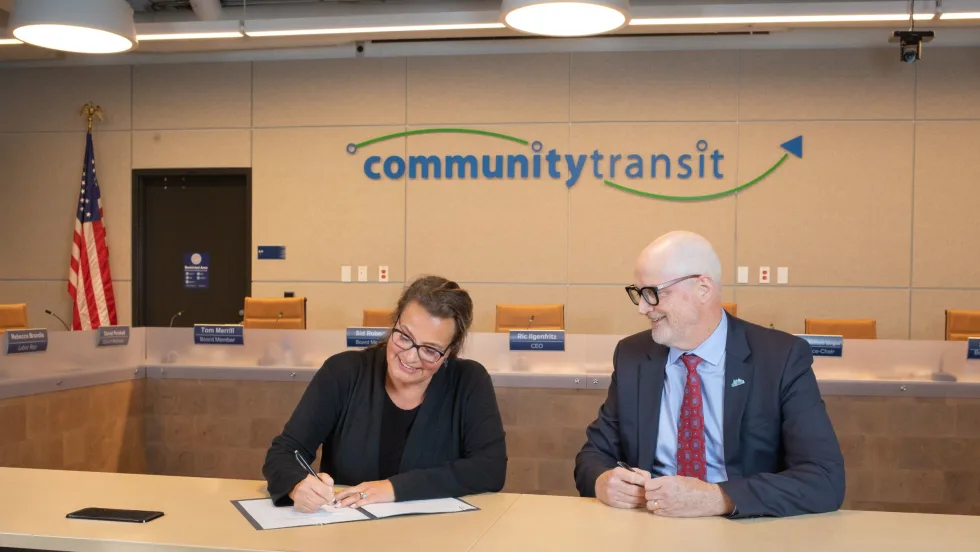
Everett Transit, Community Transit Approve Consolidation of Services
The agreement will bring Everett Transit into Community Transit’s network in April 2027, with plans to increase bus service by 50% by 2031 and expand regional connections.
Read More →
NITA Proposes $5B Operating Budget, $9.7B Capital Program for 2027
The proposed budget includes funding for expanded transit service, safety initiatives, fleet upgrades, and infrastructure improvements across CTA, Metra, and Pace.
Read More →
Financing, Fleet Replacement Requires a More Strategic Approach
Executives from ABC Companies and MCI discuss how rising costs, changing market conditions, and post-pandemic challenges are prompting motorcoach operators to rethink financing strategies, fleet replacement cycles, and long-term planning.
Read More →
Bringing Austin’s First Light Rail System to Life
Austin Transit Partnership CEO Greg Canally discusses the city's nearly 10-mile light rail project, its collaborative approach to project delivery, the importance of community engagement, and the milestones ahead as construction approaches in 2027.
Read More →
ETA CEO John Maglio on Transit Technology, Innovation, and Building Agency Trust
ETA founder and CEO John Maglio explores the evolution of transit technology, the importance of reliable systems, and how stronger partnerships can help agencies improve operations and the passenger experience.
Read More →
Metra Draft Plan Outlines Costs, Service Improvements for Regional Rail
The Systemwide Network Plan identifies infrastructure needs and potential investments to expand all-day, bidirectional rail service across the Chicago region.
Read More →
New Orleans RTA Names Augustine III as New CEO
In this edition, we also spotlight recent personnel moves at HDR, PATH, STV, and more, highlighting the people taking on new roles across the transportation industry.
Read More →
How Transit Agencies Are Using Free Rides to Improve Voting Access
Transit agencies are using fare-free service, trip-planning tools, and targeted rides to improve voting access. See what other agencies can learn from these efforts.
Read More →
Caltrain’s Electrification Drives a New Era of Ridership Growth
The railroad’s shift to electric service has brought more frequent trains, stronger customer satisfaction, and increased ridership, earning it APTA’s Outstanding Public Transportation System award.
Read More →
Chicago, Charlotte Transit Agencies Expand Rider Support Programs
CTA launched crisis intervention teams as CATS prepares to deploy fare ambassadors, expanding customer assistance and security efforts across both systems.
Read More →