



Seattle's Floating Bridge is High-Tech Light Rail Link
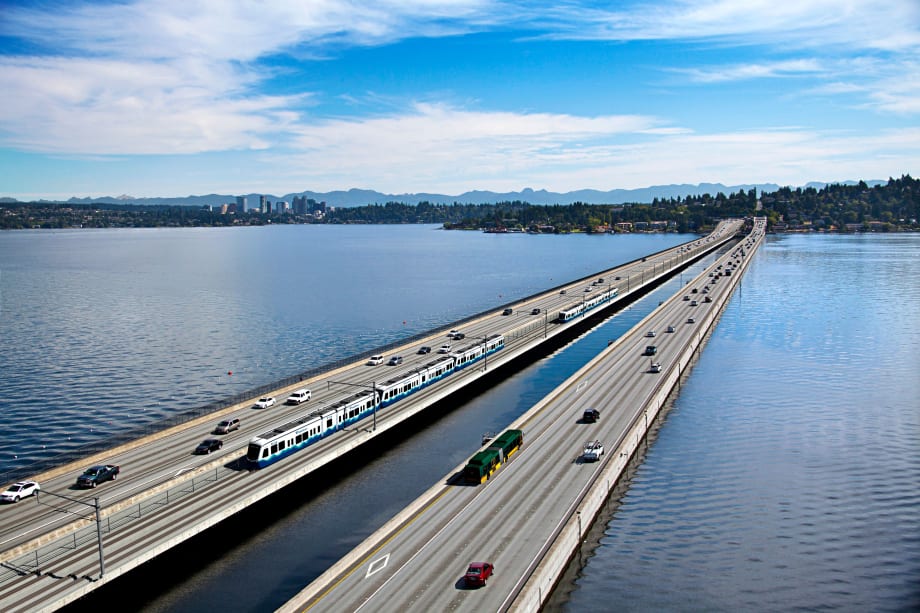
The I-90 Track Bridge is part of the East Link project, a 14-mile extension of Sound Transit’s Link light rail system from downtown Seattle to Redmond scheduled to begin revenue service in 2023.
Sound Transit

Sound Transit
The Homer M. Hadley Memorial Bridge boasts the title of the world’s fifth-longest floating bridge. But in a few years, the bridge across Lake Washington in Seattle will claim another title: the world’s first floating bridge that accommodates a light rail line. The center lanes of the bridge had originally been intended for high-capacity transit use — a goal that will soon be realized.
Design work on a project, known as the Interstate 90 (I-90) Track Bridge, was completed in January 2017. Construction is now underway to install double track on the middle roadway of the 1.1-mile-long bridge that currently carries I-90 across Lake Washington between Seattle and Mercer Island.
The I-90 Track Bridge is part of the East Link project, a 14-mile extension of Sound Transit’s Link light rail system from downtown Seattle to Redmond that is scheduled to begin revenue service in 2023.
While rubber-tired vehicle traffic is unaffected by floating bridge expansion joint movement, transit track requires more support and continuity for safety and passenger comfort, as well as track integrity. So, the challenge for the design team was to create flexible steel underpinning and supports that would adjust to the floating bridge movements, while keeping the track in proper alignment and profile.
“Building light rail across a floating bridge had never been done before,” says John Harrison, project manager for WSP USA. “An innovative engineering solution was required to compensate for the floating span yaw, pitch, roll, and surge, while supporting train operation up to 55 miles per hour — the maximum speed allowed for light rail transit revenue service operation — across the moveable joints at each end of the I-90 floating bridge.”
On behalf of Sound Transit, WSP and its sub-consultants are providing design services during construction under its East Link contract. Kiewit-Hoffman, a joint venture that includes Kiewit Corp. and Hoffman Construction, is providing the fabrication and installation of eight production track bridges for the project.
WSP has been involved with the project since 2011, when Sound Transit contracted a team led by the firm to identify, develop, analyze, and evaluate conceptual designs of a track bridge system that would meet its light rail service performance objectives.
“Sound Transit asked the WSP team to solve unique technical challenges,” says John Sleavin, project manager for Sound Transit. “The agency needed demonstration and proof of the feasibility of building and installing track bridges and operating trains safely and comfortably over the moveable joints of the I-90 bridge before proceeding with the rest of the project.”

CESuRa works through the interaction of curved and rotating track supports, which automatically adjust for multi-directional movements of the supporting bridge deck through the kinematics of the system.
WSP USA
Innovative Invention
During the design phase, the firm conceived of and validated a new “track bridge” technology, which will enable light rail vehicles to transition from the fixed to the floating sections of the I-90 bridge.
A novel concept to make the project work, known as the Curved Element Supported Rail (CESuRa) configuration, was devised by Andy Foan, who at the time was the chief engineer of Balfour Beatty Rail Ltd. in the U.K.
“The CESuRa concept was very innovative and became the cornerstone of a proven track bridge system that was tested and demonstrated to meet all technical requirements,” says Tom Cooper, lead structural designer for WSP. “No other feasible solution was found to accommodate all expected floating bridge movements as well as the CESuRa concept.”
The system works through the interaction of curved and rotating track supports, which automatically adjust for multi-directional movements of the supporting bridge deck through the kinematics of the system without the use of springs or dampers. This approach addressed yaw, pitch, and roll movements and will provide a smooth alignment and profile under all movement combinations. Conventional sliding rail joints accommodate longitudinal rail movement.
The main elements of the system include two longitudinal box girders, called “wings” — 17 transverse bearer bars supported on the wings by uni-directional friction pendulum bearings — and running and guard rails, which rest on the bearer bars. The bearer bars are secured to the rails by means of an elastic fastening system and to the guard rails by pinned connections.
The bearings on each wing are mounted in a horizontal curved pattern, called the “yoke” — thus, the bearer bars vary in length, with the longest bars at the ends of the wings. The wings are supported from below on the bridge spans and move vertically with the transition span in response to changes in the water level.
However, the wings also undergo rigid body rotation about their longitudinal axes.
As the wings rotate, the bearer bars move vertically through various distances, and the rails bend in both the vertical and horizontal planes as required to accommodate the bridge joint movements. By suitable choice of the horizontal curve on which the bearings lie, and the location of the supports for the wings, the vertical curvature of the rails can be made to provide a smooth curved progression from the transition span to the fixed and floating spans, while the rails are fully supported along the length of the CESuRa track bridge. The project team modeled, analyzed, and tested the design to ensure that the rail stresses resulting from this bending are within tolerances.
“Development of a unique and elegant design required the collaboration of a team consisting of track engineers, special track work fabricators, structural engineers, and research specialists working with construction experts, to take the project from concept through installation,” Cooper explains.
Throughout the design process, WSP collaborated with more than 30 contractors and vendors, including Balfour Beatty Rail Ltd., the University of Washington, SC Solutions, Balfour Beatty Rail Inc., Transportation Technology Center Inc., Jesse Engineering, and Earthquake Protection Systems, and with the engineering and maintenance teams from Sound Transit, the Washington State Department of Transportation (owners of the existing I-90 floating bridge), and the Federal Highway Administration.

The I-90 Track Bridge is part of the East Link project, a 14-mile extension of Sound Transit’s Link light rail system from downtown Seattle to Redmond, Wash.
Sound Transit
Visualizing the Possibilities
The design team was thrilled with the opportunity to create a first-of-its-kind structural system, but was faced with the challenge of visualizing and modeling the multi-dimensional continuous movements of the underlying floating bridge. So, the design team needed to develop computer models that could represent any combination of movements and weather conditions — from normal environmental occurrences to extreme 100-year events — which such a track system might experience.
“The structural system of a floating bridge track system is subject to as many as six dynamic movements of the bridge deck at the existing expansion joints, due to changing lake elevations, vehicle traffic loading, wind, waves and, in extreme conditions, the potential of broken anchor cables, of which these were addressed in the design,” Harrison says.
To that end, WSP developed a visualization tool used that could analyze and help evaluate two alternative concepts being considered for the I-90 Track Bridge. Using 3Ds Max software, the design team created a model using engineering dimensions that accurately replicated the actual bridge movements and helped the design team and Sound Transit identify the best solution.
Throughout the design process, WSP mitigated risk by verifying theoretical calculations and track bridge performance parameters through modeling and physical testing. By using the results of finite element analysis modeling and testing, the team could conduct risk management analysis, computer modeling and analysis, component testing, full-scale prototype testing, and design refinement.
“These models illustrated the kinematics of two alternative concepts and showed how the track bridges would be supported by and attached to the existing structures,” Harrison says. “The visualization tool was helpful in evaluating the design and in communicating how the different concepts work.” Ultimately, the CESuRa concept was selected as the best solution.
Popular Design
Even before construction began, the I-90 Track Bridge project has been earning accolades for its design and innovation. Most recently, the project was honored by Popular Science magazine with its 2017 Best of What’s New award in the engineering category. The project also earned the 2013 ACEC Washington Best in State Silver Award in the future value to the engineering profession category.
While the project is set to make a significant impact on commuting from the East Side of Lake Washington, it has already made quite an impression on Harrison, who found its allure strong enough to pull him out of retirement.
“I retired briefly in 2014-15, but returned to work to see the project through completion,” he explains. “I consider this the crowning achievement of my 48-year rail engineering and project management career.”
More Rail

FTA Advances $164M Broward County Commuter Rail Project
The proposed 10.5-mile commuter rail extension would connect Fort Lauderdale and Aventura, expanding passenger rail options in South Florida.
Read More →
New York MTA Launches Historic $1.9B Signal, Track Modernization Project
Funded in part by congestion pricing revenue, the project will replace nearly century-old signals along the A and C lines in Brooklyn and Queens.
Read More →
LA Metro Breaks Ground on East San Fernando Valley Light Rail Project
The 6.7-mile line will add 11 stations along Van Nuys Boulevard, expand access to jobs and regional transit connections, and support Metro’s broader efforts to improve mobility as rail ridership grows.
Read More →
CSA Group Releases Climate Resilience Standard for Transit, Passenger Rail
Developed with support from the Standards Council of Canada, CSA D700 guides assessing climate-related risks and planning adaptation measures for transit and passenger rail systems.
Read More →
LA Metro September Ridership Climbs 3.9%, Led by Rail Growth
The agency recorded more than 27.2 million boardings, with rail ridership increasing 12.4% year over year and the D Line posting the largest gains.
Read More →
First Full MetroLink Rail Expansion Completed in 20 Years with $192M Airport Project
The project links two St. Louis-area airports by light rail while adding roadway and bike trail connections to improve regional access and mobility.
Read More →
Utilimarc Launches SmartReplace to Optimize Fleet Replacement Decisions
AI-powered SmartReplace helps fleets prioritize vehicle replacements, model budget scenarios, and build more defensible long-term strategies.
Read More →
Scenes from APTA TRANSform & EXPO 2026
Transit leaders, manufacturers, and industry professionals gathered in Chicago to explore new technologies, share ideas, and discuss the future of public transportation.
Read More →
USDOT Awards $416 Million for Florida Rail Crossing Safety Upgrades, New Brightline Station
The projects aim to reduce risks for motorists and pedestrians at rail crossings while expanding passenger rail access along Florida’s Space Coast.
Read More →
OCTA Declares Emergency to Protect Rail Corridor From Coastal Erosion
The California agency is accelerating shoreline protection and plans to place approximately 690,000 cubic yards of sand along the San Clemente coast to protect a key passenger and freight rail link.
Read More →