



'Small Starts' in Position to Overtake Larger Counterparts
With a surplus of expensive projects competing for a fixed amount of New Starts funding, fiscal pressures will favor small projects.

As Congress puts its finishing touches on the long-overdue reauthorization of TEA 21 this summer, the New Starts portion of the program remained in doubt, even in early July, on a key provision affecting eligibility of bus rapid transit (BRT) projects.
Taking a step back and looking more macroscopically, however, it is quite clear that projects with a lower price tag — so-called “small starts” — will likely do better in the current fiscal climate.
The majority of the projects in the New Starts program’s “pipeline” are rail projects. According to this year’s annual report of the program, half are for light rail (new systems and extensions to existing ones), with almost all of the remainder for commuter rail and only three for BRT.
This mix is expected to shift to much smaller projects, particularly when those for New York City are excluded. For example, according to at least one newspaper account, as many as 150 projects in the U.S. are looking at bus rapid transit (BRT) as the mode of choice. Congress has estimated that at least 50 cities have already chosen BRT, with these projects in varying stages of development.
The newest New Starts
In February, the Federal Transit Administration (FTA) as part of its annual New Starts report and FY 2006 budget proposal recommended to Congress more than $1.5 billion in funding for up to 26 new or expanding major transit projects. The budget announced that multi-year “full funding grant agreements” (FFGA) were being honored for 16 existing and four new transit projects — the new ones for Charlotte, N.C.; Pittsburgh; New York City; and Phoenix.
In addition, this year’s annual report allowed rail extensions in San Diego, Dallas and Denver; a big-ticket but long-awaited heavy rail connection in New York City; and commuter rail projects in Washington County, Ore., and Salt Lake City to go into final design, which makes them eligible for FFGAs if their progress continues as envisioned this year.
There is little doubt, except from the hard-core transit luddites, that virtually all of these projects have as much or more economic and transportation merit as any New Start ever funded, which makes the funding competition even worse.
“When completed, these projects are expected to carry over 273 million riders each year, while saving over 128 million hours in travel time and reducing vehicle-related pollution in many of our nation’s most congested cities,” Transportation Secretary Norman Mineta said in a statement at the time of these announcements.
Take the 19.6-mile light rail start-up in Phoenix, which was approved for an FFGA last January. The system will connect commuters from the Spectrum Mall to several of the area’s major business districts, Sky Harbor Airport and professional sports venues.
This year’s largest project recommended for a FFGA is the Queens Connector, an extension of New York’s Long Island Rail Road that will ease commutes into and out of Manhattan and Queens. Other recommended FFGAs include a 9.6-mile light rail line in Charlotte and a 1.5-mile extension of Pittsburgh’s light rail system from downtown to the North Shore area. Six additional projects will be considered for funding contingent upon further progress during the final design stage and providing that they will meet the FTA’s now-even-more-rigorous New Starts evaluation criteria and other requirements.
The evaluation gauntlet
Cities that seek major federal transit investment dollars must face excruciating competition for them. In part to deal with that reality, the rules got tougher again earlier this year. Even at record levels of spending expected in the pending reauthorization bill, the DOT’s own calculations put the gap between the total assistance being sought in the New Starts pipeline, a process of federal approvals that most projects must go through in order to receive New Starts Program assistance, and what will be available at $19 billion over the next decade.
“The Federal Transit Administration ensures that American taxpayers are getting the most for their money by conducting rigorous reviews of transit projects and making funding recommendations based on sound risk analysis,” explained FTA Administrator Jennifer Dorn in defense of her agency’s review process.
During the past three years, the FTA has made two significant changes to the New Starts project evaluation and management process, which have focused on improving the cost-effectiveness of the projects proposed for New Starts program funding.
First, the agency has required sponsoring project agencies to take out costs that do not “contribute” to the project’s actual economic and transportation benefits. Second, the FTA has changed travel forecasting procedures that agency officials contend more accurately portray user benefits.
It is not as if the process was a cakewalk before. To be eligible for New Starts funding, proposed projects must complete the appropriate steps in the planning and project development process, as described in Sections 5303-5306 and Section 5309 of 49 U.S.C., and receive a positive project rating. These ratings, ranging from Highly Recommended to Recommended to Not Recommended, are intended to reflect the overall merits of each project.
Even after the evaluation, favorable ratings do not automatically mean a funding recommendation will be given. In other words, even if the FTA agrees with a project’s merits, an FFGA will only be given if other project readiness requirements have been met (more about this later) and if funding is available — which, as noted above, is less and less likely.
Generally now, FTA officials admit that they will not recommend a project for an FFGA if the share of New Starts funding being applied for is greater than 60% of the project cost. Given the competition, that share will drop. Indeed, according to FTA data, the average federal share of all capital expenditures in the industry, including formula grant assistance and other programs that are not covered in this article, has now dropped to around 40%.
Of the $1.5 billion in New Starts funding recommended in the Bush Administration’s budget for FY 2006, which the House Appropriations Committee has approved at about the same level, roughly half contains funding for the 17 projects with existing FFGAs. Most of the remainder will be for the FFGAs expected to be issued before the end of September 2006.
Even after all this, a process that takes years — sometimes more than a decade — the FTA is not done. Before submitting a proposed FFGA to Congress, agency officials apply strict tests for readiness and technical capacity, and they double-check to ensure that no outstanding project issues remain, including a final check of the local financial commitment. In addition, the FTA requires an independent third-party risk assessment, which also must include completion of a thorough project risk management plan that must evaluate and plan for such issues as outstanding property acquisition risks, construction material prices, contract management and substructure risks. The FTA’s New Starts risk management program has been expanded to include final design and preliminary engineering.
The process also encourages value engineering, which typically involves yet another consultant to retool a project for the least possible cost. Although it saves both the local funding sources and the FTA money, it is another hurdle that consumes time and some money on its own, and those who have gone through it advise that this time and cost must be built into the timeline and budget early on, ideally during alternatives analysis.
Ready for ‘small starts’
Just when you might think that the process seems clearer, it is expected to get murkier and change again after reauthorization finally reaches President Bush’s desk, and even FTA officials responsible for implementing the statute can’t say how it will change. Under current law, projects that are requesting less than $25 million in New Starts funds are exempt from the rating process by law. These have been referred to as “small starts.”
Under the reauthorization, the exemption will remain the same, but the process will become easier for projects that require less than $75 million from the New Starts program. However, it is not clear even today how the law will change for these projects, because these are some of the details being worked out in the House-Senate conference, which was meeting as this issue went to press.
Changes for BRT ahead?
One contentious issue is how BRT projects will be treated under the changes. The House version of the bill retained the “fixed guideway” requirement of previous law, which means that an eligible BRT project has to run in its own right-of-way or a highway carpool lane for at least half its route length. The Senate bill is silent on this requirement, however. (A new white paper on the “small starts” provision of the new legislation when finally enacted will be written by Cliff Henke and will be available on METRO’s website this fall.)
What is clear now is that whether BRT or one of the rail-based modes, lower-cost projects will fare better in the new environment, even if the regulatory burdens remained the same. The funding competition is too great for it to be otherwise.
As for how each mode will fare under the New Starts or the “small starts” provisions, each has its advantages and disadvantages, as ever. In other words, the corridor’s needs and the people each project is expected to serve should ultimately do the talking.
Cliff Henke is a former editor for METRO.
More Management
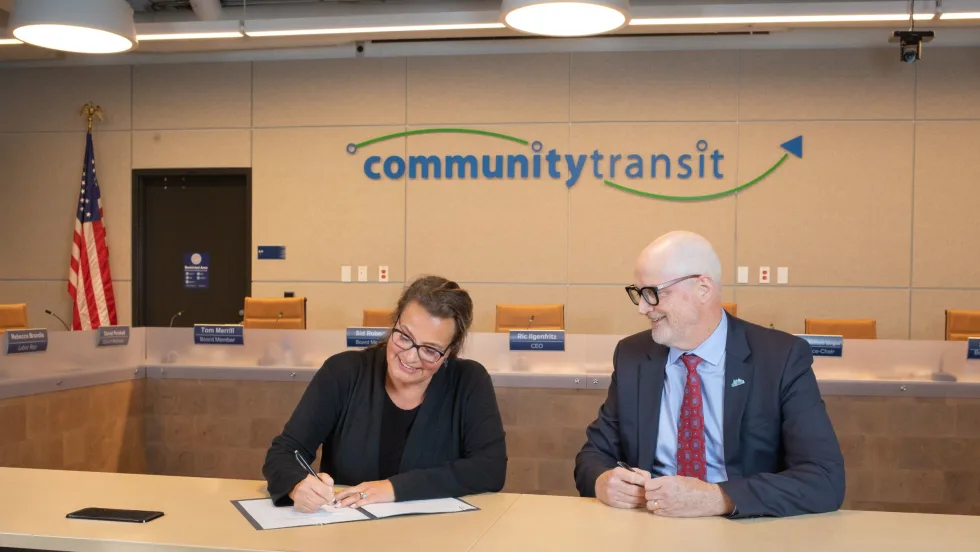
Everett Transit, Community Transit Approve Consolidation of Services
The agreement will bring Everett Transit into Community Transit’s network in April 2027, with plans to increase bus service by 50% by 2031 and expand regional connections.
Read More →
NITA Proposes $5B Operating Budget, $9.7B Capital Program for 2027
The proposed budget includes funding for expanded transit service, safety initiatives, fleet upgrades, and infrastructure improvements across CTA, Metra, and Pace.
Read More →
Financing, Fleet Replacement Requires a More Strategic Approach
Executives from ABC Companies and MCI discuss how rising costs, changing market conditions, and post-pandemic challenges are prompting motorcoach operators to rethink financing strategies, fleet replacement cycles, and long-term planning.
Read More →
Bringing Austin’s First Light Rail System to Life
Austin Transit Partnership CEO Greg Canally discusses the city's nearly 10-mile light rail project, its collaborative approach to project delivery, the importance of community engagement, and the milestones ahead as construction approaches in 2027.
Read More →
ETA CEO John Maglio on Transit Technology, Innovation, and Building Agency Trust
ETA founder and CEO John Maglio explores the evolution of transit technology, the importance of reliable systems, and how stronger partnerships can help agencies improve operations and the passenger experience.
Read More →
Metra Draft Plan Outlines Costs, Service Improvements for Regional Rail
The Systemwide Network Plan identifies infrastructure needs and potential investments to expand all-day, bidirectional rail service across the Chicago region.
Read More →
New Orleans RTA Names Augustine III as New CEO
In this edition, we also spotlight recent personnel moves at HDR, PATH, STV, and more, highlighting the people taking on new roles across the transportation industry.
Read More →
How Transit Agencies Are Using Free Rides to Improve Voting Access
Transit agencies are using fare-free service, trip-planning tools, and targeted rides to improve voting access. See what other agencies can learn from these efforts.
Read More →
Caltrain’s Electrification Drives a New Era of Ridership Growth
The railroad’s shift to electric service has brought more frequent trains, stronger customer satisfaction, and increased ridership, earning it APTA’s Outstanding Public Transportation System award.
Read More →
Chicago, Charlotte Transit Agencies Expand Rider Support Programs
CTA launched crisis intervention teams as CATS prepares to deploy fare ambassadors, expanding customer assistance and security efforts across both systems.
Read More →