



Sustainability, Innovation Focus of CUTRIC's Virtual Conference
Originally, the conference was to be held in Winnipeg, Manitoba with an expected audience of some 200 transit operators, manufacturers, experts, and academics.

The Canadian Urban Transit Research & Innovation Consortium (CUTRIC) held its “Second Annual Low-Carbon Smart Mobility Technology Conference” June 17 to 19, with a difference. Originally, the conference was to be held in Winnipeg, Manitoba with an expected audience of some 200 transit operators, manufacturers, experts, and academics. As it turned out, over 400 people from across North America, and the world, connected digitally to listen to keynotes and panel discussions on electrification of fleets, autonomous vehicles, the evolution of charging, hydrogen fuel cells, and big data, to name a few.
A testament to the evolution of conferences and communications perhaps, thanks to all those webinars and Zoom chats we’ve become accustomed to over the past few months.
The vision, in Canada at least, is to have some 5,000 electric buses on the road by the year 2025. The coronavirus has put a bit of dent in that dream but transit systems throughout the country are convinced that most buses, and heavy-duty transport vehicles, will be someday be powered by electric drive systems, whether that be battery-electric buses (BEB) or fuel-cell electric buses (FCEB).
This means more than just converting fleets from diesel fuels to electric components and installing a few chargers. This represents a wholesale change for the transit and transportation industries. To make the leap to “electrification,” transit systems (both within municipal boundaries and between cities) and the long-haul sector must look at new vehicles, a total new approach to garages and maintenance facilities, a closer examination of routes and length of trips possible on a single charge, a bigger use of digital data collected onboard, and, perhaps even, looking at autonomous vehicles to complement existing services.
CUTRIC promotes innovative technology and commercialization projects that advance mobility and transportation technologies across Canada. It also helps transit agencies across Canada and the U.S. determine how their battery-electric buses, hydrogen fuel-cell electric buses, and autonomous smart vehicles will operate in real-time on their roads and in service.
Josipa Petrunic, president and CEO of CUTRIC, opened the webcast conference with a thought-provoking speech, “Gender, Race, and Mobility in a Climate Change World.” As cities and countries around the world declare climate emergencies and commit to targets on carbon emissions, transit agencies must recognize that they have a responsibility to address these social issues as well as contribute, in a significant way, toward the climate change goals set out by governments. “According to Statistics Canada,” Petrunic noted, “more women, racialized communities and low-income earners take transit. Transit is about giving access to people.”
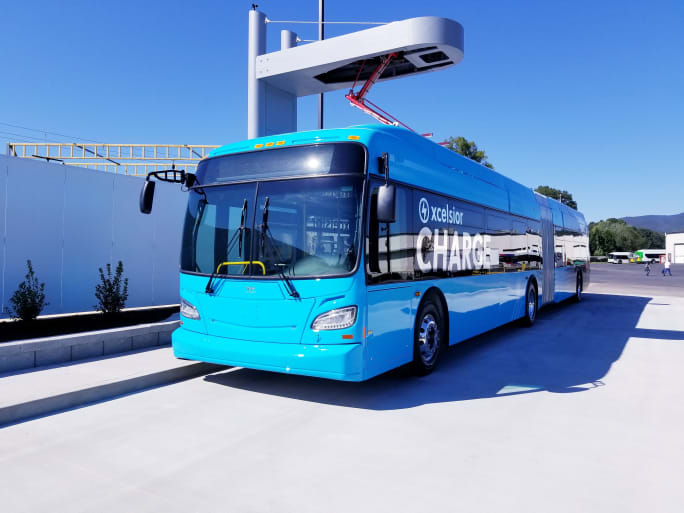
The vision, in Canada at least, is to have some 5,000 electric buses on the road by the year 2025.
New Flyer
The future of transit
But not the whole conference was as issue laden. There were virtual “Happy Hours” and networking opportunities and chances to connect with other attendees through a well thought out system of one-on-one chats, texts, and online Q & A sessions.
Frank Muhlon, global head of EV-Infrastructure for ABB Group, explained his company’s approach to charging infrastructure for light and heavy-duty vehicles. “The economies of scale play much more on the car side (of charging) than the bus side,” Muhlon observed, “so it’s important to examine cabinets that are robust for all climate and environments. You can connect through small depot boxes — up from the bus or down (Pantograph) from the infrastructure.”
Muhlon added that with a normal charge time of five to six hours, a series of buses could be linked and charged in sequence if a large enough charging system were installed, reducing cost and operator time.
Ballard Power Systems’ Chief Commercial Officer Rob Campbell suggested that that hydrogen fuel-cell technology presents the lowest-cost solution for zero emission transit needs.
Nicolas Pocard, director of marketing for Ballard, admitted that perhaps Ballard entered the field a bit too early, when components such as the power-train and batteries had not yet developed enough to complement the fuel-cell technology that the company was pioneering. “What we’ve seen in the past five years is an acceleration of the electric drive-train industrialization,” explained Pocard. “So now, we have a number of components which now enable us to create a robust, cost-effective fuel-cell electric drive train.” He went on to mention that this has renewed the interest in fuel cells driven by the push toward zero-emission vehicles.
Collaboration was in the air as a panel of Lauren Skiver CEO of SunLine Transit; Cliff Thorne of Orange County Transit Authority (OCTA); and Doran Barnes CEO of Foothill Transit, all from California, spoke on the benefits and advantages of working together, learning from each other, and adopting best practices to avoid pitfalls and mistakes.
SunLine Transit is an early adopter of a hydrogen fuel fleet (pre-2006), with hydrogen derived from a 200 kg./day Steam Methane Reformer (SMR), and is well experienced with its mixed propulsion, mixed provider fleet. OCTA is responsible for road, bus, and rail transit in the 34 towns within the county. OCTA recently debuted America’s largest transit-operated hydrogen fuelling station (starting with 10 FCEB buses) to support the planned conversion of its fleet of 500 from compressed natural gas (CNG) buses to FCEB buses by 2040. Foothill Transit introduced CNG buses in 2002 and transitioned to electric buses in 2010 with fast-charge systems, with plans to add FCEB buses soon.
Listeners to the “Autonomous Shuttle Pilot Experiences” panel heard about trial runs in Montreal, Calgary, and from Transdev, which operates in 17 countries around the world.
Primael-Marie Sodonon, from the City of Montreal, explained that its six-week trial with Autonomous Vehicles (AV) had mixed results in part because the trial ended early, but enough data was gathered to promote encouraging next steps. Andrew Sedor, business development coordinator, transportation strategy, City of Calgary, noted that the coordination between the traditional transit fleet and the AV trial needs to be planned in advance and that AV’s are useful for facilitating access to a city center or tourist attraction. Veronika Siranosian of AECOM Ventures suggested that AV’s can be used to address accessibility and equity and for routes that are less used, but they must meet expectations of safety. Pierre Zivec, VP, performance, for Transdev, noted that AV’s are used every day in several countries but not as widely in North America.
CUTRIC’s Petrunic separately noted, “You can platoon buses so that you have the driver at the start in a bus then three or four buses that are driverless follow that driver in a connected trolley car scenario. It’s called assisted driver support.”
The “Smart” in Smart Mobility was covered through several panel discussions. Speaking about AV’s, those vehicles don’t just go on “auto-pilot.” LIDAR, RADAR, and cameras are all essential for driverless vehicles. A panel discussed “The State of Automated Vehicle Technologies Today & The Challenges Looming.” An additional panel on “Big Data” examined the fact that transit systems have become more digitized. What can they do with all that data? Can transit agencies deliver more services with fewer resources? Agencies can now start to track vehicles, chargers, energy storage devices, and fueling systems, real-time.
CUTRIC, in addition to hosting conferences and workshops, prepares research papers and offers demonstrations of various technologies with its member partners. For more information about CUTRIC visit https://cutric-crituc.org.
Lawson Hunter is a freelance writer based in Canada having written business, technology and environmental articles for several national, international, and trade publications.
More New Mobility

From Hardware to Digital Partner: Luminator Charts Its Next Chapter
CEO Magnus Friberg discusses Luminator’s shift toward becoming a digital partner, the growing importance of software and interoperability, and how AI can help agencies improve operations and passenger experience.
Read More →
Biz Briefs: Alstom Lands Canadian Contract, LYT to Supply California TSP, and More
In METRO's latest installment, we take a look at recent news from Complete Coach Works, Beep, FlixBus, and more partnerships making headlines across the transportation sector.
Read More →
CharterUP’s Armir Harris on Technology, AI, and the Future of Group Mobility
In a recent episode of METROspectives, CharterUP Founder/CEO Armir Harris discussed the company’s evolution from an online charter bus marketplace into a technology platform supporting public- and private-sector mobility and much more.
Read More →
Jacksonville’s NAVI Project Charts a New Course for Autonomous Public Transportation
Through its NAVI program, JTA is showing how autonomous vehicles, intelligent infrastructure, and coordinated operations can work together to deliver everyday public transportation.
Read More →
Biz Briefs: Luminator Marks Milestone and More
From manufacturers and suppliers to transit agencies and motorcoach operators, these updates offer a snapshot of the projects, partnerships and business moves driving the industry forward.
Read More →
New Tricks for Old Bureaucracies: Joshua Schank on Making Transit Innovation Stick
Former LA Metro Chief Innovation Officer Joshua Schank discusses why good ideas aren't enough, how transit agencies can overcome resistance to change, and why today's challenges demand more innovation.
Read More →
How DART's GoPass Is Redefining Regional Mobility
Serving 14 transit agencies, GoPass simplifies multimodal travel by allowing riders to plan, pay for, and manage an entire trip through one app.
Read More →
Biz Briefs: OCTA Taps Clean Energy for Hydrogen Station, Stadler to Supply Via Rail Vehicles, and More
From manufacturers and suppliers to transit agencies and motorcoach operators, these updates offer a snapshot of the projects, partnerships and business moves driving the industry forward.
Read More →CharterUP Expands Into New Mobility and Autonomous Transportation
Vice President of New Mobility Stephen Joos discusses how CharterUP is leveraging its nationwide transportation network, technology platform, and autonomous vehicle partnerships to expand into workforce mobility, campus shuttles, and transit solutions.
Read More →
METRO Magazine Announces 2026 Innovative Solutions Awards Winners
Projects Recognized for Advancing Mobility Through Technology, Accessibility, Workforce Innovation, and Operational Excellence
Read More →