



The COMET's Andoh talks COVID-19 response
METRO’s Managing Editor Alex Roman recently spoke to The COMET’s Executive Director/CEO John Andoh for a new podcast called METROspectives.
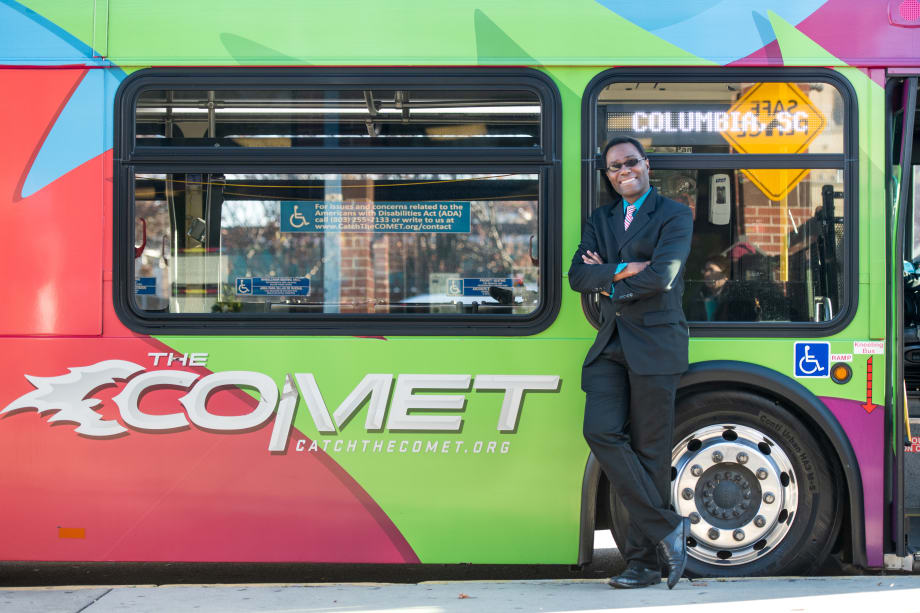
John Andoh has helped lead The COMET during the pandemic and
has aggressively addressed keeping passengers and operators safe, including distributing masks to operators that match the agency’s colorful logo scheme.
Sean Rayford
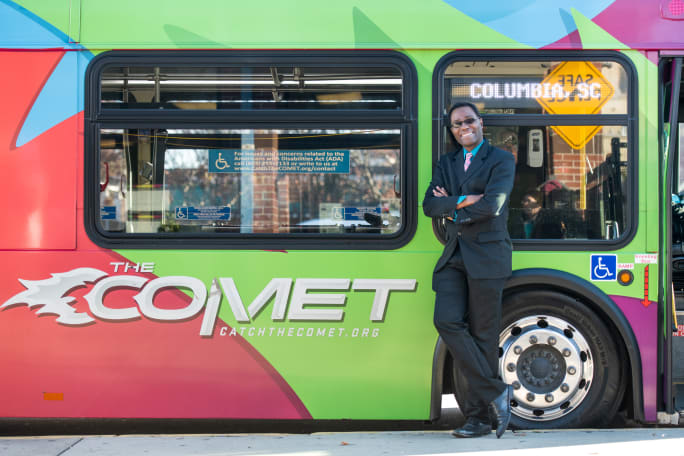
John Andoh has helped lead The COMET during the pandemic and
has aggressively addressed keeping passengers and operators safe, including distributing masks to operators that match the agency’s colorful logo scheme. Sean Rayford
The COMET, officially the Central Midlands Regional Transit Authority (CMRTA), operates mass transportation in Richland and Lexington counties in the Columbia metropolitan area of South Carolina. Like most transit agencies, The COMET is providing essential transportation throughout the region while dealing with the COVID-19 pandemic.
METRO’s Managing Editor Alex Roman recently spoke to The COMET’s Executive Director/CEO John Andoh for a new podcast called METROspectives. During the conversation, Andoh discusses how the agency is dealing with the pandemic, what it is like to manage his workforce during this time, and what transit in his region might look like in the future.
Can you talk about the status of The COMET’s service right now and what you are doing to keep riders and operators safe?
We are running a Sunday schedule right now. And, for the areas that lose fixed-route service because we are on a Sunday schedule, we created an on-demand service, so those riders can still have access to our system. We are fare free, doing rear-door boarding, and aggressively disinfecting the fleet daily. We have a full utility staff and have also contracted a detailing firm that sanitizes all the buses daily, so we can ensure that we are keeping people safe. We are also cleaning the buses at our downtown transit center during the middle of the day, as well as cleaning our bus stops, including our bus shelters, bus benches, and wall panels.
The agency has been looking at ways to supplement fixed route for some time, how has that planning had an impact on your ability to change things on the fly?
We were able to implement programs that helped those that need nighttime service before. But now, since Lyft and Uber Pool are not available, they are only doing single rides to keep with social distancing. We are also looking at how we can expand the partnerships with those TNCs to help us with essential worker travel when we start getting into capacity issues, because we have cut the capacity of our vehicles in half. We are trying to get creative in how we still provide essential transportation without also breaking our bank, of course.
How have those existing relationships helped continue finding new ways to move people?
The development has been great. I can say our ridership is not what it used to be before COVID-19, but we have people still using those programs, especially the partnerships which provide access to the grocery store.
What it is like to manage a workforce during this time?
It is completely surreal, to be honest, but it is ever changing. We must keep paying attention to the governor’s executive orders, as well as our local jurisdictions, since the city and county may sometimes do things differently than what the governor wants to do, or our President, right? So, we are trying to be flexible to change the operation at a moment’s notice, and make sure the customers are aware of what we are doing in advance so that they can plan accordingly. And, we are working to be flexible with our operations contractor, and their personnel, to ensure that when services must change at a moment’s notice, they are ready to do so. This definitely has taught us that we need to ensure that, when we do our safety and emergency planning, we just can’t focus on the traditional emergencies like hurricanes, tornadoes, and earthquakes. Now, we also must plan for biological issues or things like this pandemic that is going on right now. This ensures that we are prepared and able to quickly respond if this ever happens again.
As far as being in touch with your operations team and people you would see on a day-to-day basis, how has that worked out for you?
Microsoft Teams has been great for us. We have been able to have our weekly meetings with the contractor to discuss issues and conduct our staff meetings on Microsoft Teams. I have given folks the flexibility, to work from home or in the office, or any combination of both, since we are viewed as essential. Many of our operations team is still coming in, at least on an every other day basis. At this point, I would say four of us are still coming into the office, generally, but even when we are here, we are maintaining social distance and conducting meetings via Microsoft Teams. We are not necessarily engaging with each other, just so that we can ensure people are being safe. Also, anyone that’s getting sick or has the potential of being sick, we’re advising them to not come to the office, or in the case of our contractor, come to work and operate our buses, so we don’t expose anyone else or have the potential to expose anybody.

John Andoh
Photo by Michael Dantzler
And, how are you dealing with your frontline workers during this time?
Every week on social media, we are highlighting different transit workers to talk about them and thank them for their service and encouraging our customers to do the same, since they are working through this unique period. If it were not for our frontline workers, people in our region would not be able to get where they need to go, so we want to make sure that they feel valued. We are also ensuring that they have the necessary protections in place. As I mentioned before, we are fare free and doing rear boarding so that the operator and the passengers are separated. Our contractors are also supplying personal protective equipment, and we have even designed masks that match with The COMET’s colorful paint schemes that we are distributing to our staff. We have also worked with our local government to supply hand sanitizers on our vehicles for our customers and the operations staff. We are just trying to provide any equipment our operators need to feel safe.
And what kind of feedback are you getting from those frontline workers?
You know, during this moment, they understand the importance of what they are doing. We have not had any significant concerns from the workforce because we have been proactive in advance to keep them safe and not waiting until the last minute to make changes. For instance, we have been detailing our buses and cleaning at our transit centers for some time. We have also had hand sanitizers on all our buses since 2017, but we have been more aggressive with these steps since we have known about the outbreak.
How do you think this pandemic will impact The COMET moving forward?
Our board has formed a COVID-19 committee, where we meet once a week and talk about emerging issues and trends. Part of that discussion is what the new future public transit will be because the status quo is not going to be the norm for the future. So, we are discussing things like if we resumed fare collection, how are we going to separate the driver and the passenger? Are we going to have to ensure that our buses and passenger amenities are continuously cleaned? How do we address social distancing, or some form of social distancing in the future, because obviously, crowding conditions on buses is probably not going to be the norm in the future. Lastly, what does that cost look like to the transit agency if we must add more frequency to prevent having standees on buses? Clearly, we must rethink the size of buses we use as well.
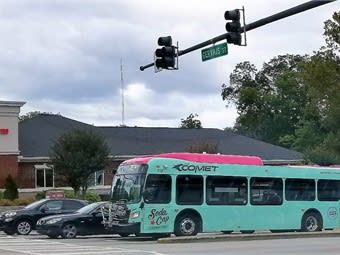
The COMET has worked with its local government to supply hand sanitizers on vehicles for customers and the operations staff.
Do you foresee having to have a larger fleet to deal with demand in the future?
You know, that is a good question. It is going to be interesting to see what happens when all this is over, and if people continue to use transit, how they plan to use it. We are getting ready to undertake a comprehensive operational analysis, so the timing is appropriate. Recognizing all that has happened over the last few months will help us design the transit system of the future.
Lastly, how is the agency using the funds it received from the CARES Act and do you feel it is enough to help get you through this time?
In our case, it will be sufficient since what we’re going to do is use the CARES Act funding to cover our operational costs that we pay our contractor, and any additional costs over and beyond what we typically pay to take care of COVID-19. So that, in essence, will allow us to defer our local sales tax revenue that we use to fund transit operations for a full year, which will basically buy us an additional year past our sunset date of when we stop collecting sales tax revenues for operations and change our fiscal sustainability plan a little bit.
More Management

METRO Opens Submissions for 2026 Motorcoach Awards
Nominations are now being accepted for METRO Magazine’s Operator of the Year and Innovative Operator of the Year awards.
Read More →
New York MTA Advances Final Contract for Second Avenue Subway Expansion
Contract Four is the largest in the Second Avenue Subway Phase 2 project and includes construction of station infrastructure, tracks, and signals for the subway expansion, MTA officials said. Work on Contract Four will begin in 2027.
Read More →
Transit Agencies Highlight Safety Gains at National Summit
Leaders from 15 major transit systems shared crime-reduction results and safety initiatives while discussing the role of continued federal support.
Read More →

NITA Names New Leadership, Expands Reduced-Fare Program at First Board Meeting
The new regional transit authority appointed its first board chair and interim executive director while extending reduced fares across CTA, Metra, and Pace for eligible riders.
Read More →
Beyond the Checklist: A Structured Approach to Transit Maintenance
Reliability-Centered Maintenance helps transit agencies move beyond routine checklists to focus limited resources on the assets and failures that have the greatest impact on safety, reliability, and service.
Read More →
APTA 2026 Nominating Committee Selects Leadership Slate, Names Chair and Vice Chair Nominees
Leadership changes will help shape the association’s priorities and its representation of the transportation industry during the 2026–2027 term.
Read More →
DART Launches Major Security, Fare Enforcement Initiative
The 90-day demonstration will deploy coordinated security teams at five light rail stations while testing controlled access and gathering data to guide future investments.
Read More →
Advancing Fare Collection Through Technology and Innovation
Learn about delivering 1300 gates at 91 stations while managing fare evasion. Explore the large scale deployment, solution customization and real-world results that affect the region. Prepare for deployment in your region now.
Read More →
Game Day in Motion: Moving Millions During the 2026 World Cup
Between packed transit stations and team motorcoaches, see how agencies and operators across North America tackled the transportation demands of the 2026 FIFA World Cup.
Read More →
Surface Transportation Extension Averts Shutdown, Leaves Transit Funding Gap
The stopgap keeps federal transportation programs moving, but missing advance funding could complicate the transit and rail projects agencies are planning next.
Read More →