



Intelligent transportation systems and the urban parking crunch
Virtually all city drivers have suffered through the miserable experience of circling downtown blocks repeatedly in search of parking. Yet there is reason for hope. The Intelligent Transportation Systems industry has been developing smart parking systems that can mitigate the problem by providing drivers, businesses, and metropolitan authorities the information they need to reduce wasted time, energy and money.

Smart parking is rapidly emerging as a popular term for applying new technology to an old problem: the urban parking crunch. Virtually all city drivers have suffered through the truly miserable experience of circling downtown blocks over and over in search of an open spot.
The necessary evil of “cruising” for parking comes with unnecessarily high costs, as experts such as UCLA Professor Donald Shoup have pointed out. After completing a one-year study in Los Angeles, Shoup found that “the search for curb parking in this 15-block district created about 950,000 excess vehicle miles of travel — equivalent to 38 trips around the earth or four trips to the moon.” This translates to 47,000 gallons of wasted gasoline, a pricey sum these days, and 73 tons of excess carbon dioxide.
Yet there is reason for hope. The Intelligent Transportation Systems (ITS) industry has been developing smart parking systems that can alleviate many of these costs by providing drivers, businesses, and metropolitan authorities the information they need to reduce wasted time, energy and money. Smartphone apps like Streetline’s Parker offer drivers the information they need to find a parking space within an easily walkable distance from their destination, providing details on street and garage parking, as well as payment options.
A number of automakers have also been developing their own smart parking systems. Volkswagen, BMW, and Audi all recently announced plans to incorporate parking information and services into their vehicles.
For example, Audi is working with Inrix-powered ParkMe to supply vehicle owners with the locations of nearby parking garages. Although Audi’s Audi connect system is under development, similar offerings will ultimately provide an electronic bridge between parking garages and increasingly connected vehicles, allowing drivers in the near future to reserve parking spots prior to arrival and pay for them cash-free.
Smart parking systems also provide city administrators with extremely useful data on consumer demand, which they can use to adjust meter rates, often in real-time, to price the parking supply accordingly. Shoup’s The High Cost of Free Parking is a must-read on this topic. Smart parking technologies also allow parking enforcement officers to be dispatched more efficiently to target egregious offenders, rather than punishing shoppers who get stuck in a long checkout line as Zia Yusuf, president/CEO of Streetline Inc., points out in this New York Times article. After all, one of the primary goals of smart parking is to make downtowns more inviting and convenient to visit.
Cities like San Carlos and San Mateo, both in the San Francisco Bay area, feature smart parking systems brought to consumers through a partnership between Streetline, Cisco Systems and city government. Such public-private partnerships are the key to expanding smart parking into larger municipalities like San Francisco and Los Angeles, both of which are undergoing projects to address high levels of urban traffic congestion.
Currently in its pilot phase, San Francisco’s SFpark project provides drivers with real-time information on the occupancy of over 19,000 city-owned parking spots. Drivers can use rate, location and time limit information to select their preferred spot, while on the back end, the city can modify parking rates, and thus, demand patterns to optimize occupancy.
The City of Los Angeles has a similar project — LA Express Park — which, like SFpark, is a partnership between the city, the U.S. Department of Transportation, and software/telematics companies, all of whom have an interest in alleviating downtown congestion through improved parking.
Mitigating urban congestion is a complex task that requires coordination between many public and private stakeholders. As the industry association representing the largest cross-section of the transportation technology community, ITS America recently held two smart parking conferences in New Jersey and Berkeley, which brought together leading business executives, policy and decision makers, and researchers to discuss ways to better utilize technology to improve parking services.
We also just held a Complete Streets Symposium in Chicago to begin addressing the broader role of technology in improving urban mobility for pedestrians and cyclists, not just drivers. Urban congestion is a problem that affects all city residents and it requires a holistic solution that draws ideas from all who use the city streets.
The smart parking movement is no longer on the horizon; it’s already here. And the sooner cities begin investing in smart parking solutions, the better for commuters, residents, businesses and visitors alike.
At ITS America we are excited to be part of the conversation and we invite you to join us in helping move innovation forward. Find out how you can get involved online at www.itsa.org.
About the author: Scott F. Belcher was appointed President and CEO of the Intelligent Transportation Society of America in September 2007 after a successful legal and nonprofit management career including more than 20 years of private and public sector experience in Washington, DC. He holds a Juris Doctor from the University of Virginia, a Master of Public Policy from Georgetown University, and a Bachelor of Arts from the University of Redlands.
More Blog Posts
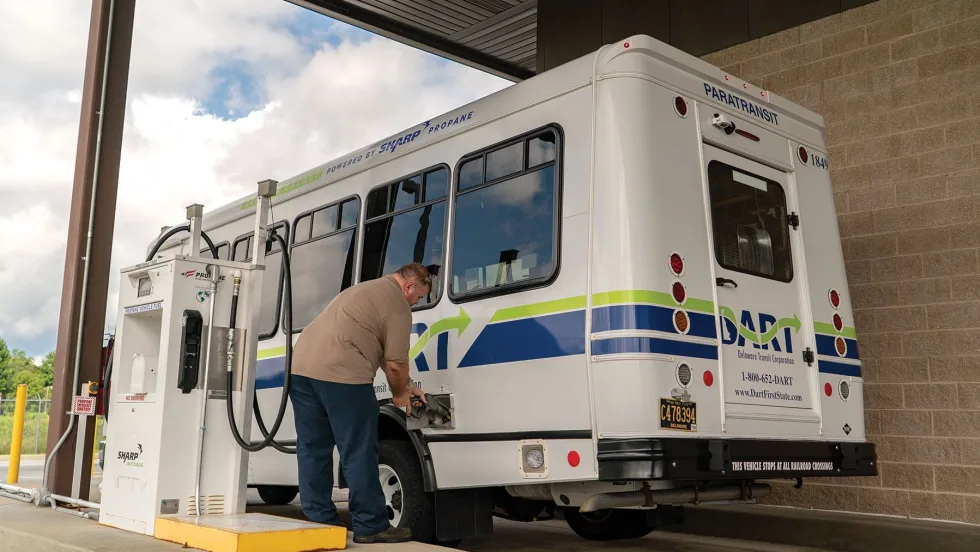
Building a Winning FTA Grant Proposal: Why Propane Autogas is the Pragmatic Choice for Fleet Resilience
With $610 million available through the FY 2026 Buses and Bus Facilities Competitive Program and the Low or No Emission Grant Program, agencies must build a compelling case before the September 21 deadline that balances environmental compliance with operational feasibility.
Read More →
Velo-city Conference 2026: Latest Trends in Cycling as Part of Urban Mobility
The global cycling conference highlighted how cities are integrating bicycles into multimodal transportation networks, expanding cycle tourism and reshaping urban mobility.
Read More →
Kindness Isn’t Soft...It’s Strategic.
Mike Bismeyer — often known as “The Kindness Guy” — has spent more than 17 years in public transit and mobility, serving in industry leadership roles, speaking across North America, and advocating for stronger workplace cultures. But his message doesn’t come from theory. It comes from lived experience.
Read More →
Inside ITF 2026: Transport Reacts to A Challenging World
Transport leaders from around the world gathered in Leipzig, Germany, for the 2026 International Transport Forum to discuss resilience, climate impacts, supply chains and the future of sustainable mobility.
Read More →
Every Ride Tells a Story — But You’re Not Just Selling the Ride
You’re selling the moment, the meaning, and the emotion behind it.
Read More →
How Digital Signage is Reshaping the Traveler Experience at Transportation Hubs
What was once a landscape of static signs has evolved into a responsive, immersive environment powered by real-time visual communication.
Read More →
Latest Trends in Urban Mobility from Polis Conference 2025
Polis comprises cities and regions, as well as corporate partners, from across Europe, promoting the development and implementation of sustainable mobility. This year’s event had over a thousand attendees across various policy forums and an exhibition.
Read More →
Why Transit Leaders Require Better Tools for Operational Clarity In Today’s Tech-Fragmented Environment
Across North America and beyond, transit agency officials are contending with a perfect storm of operational headaches and strategic challenges that hamper daily service and long-term progress.
Read More →
The Powerless Brokers: Why California Can’t Build Transit
It is no secret that transit in the U.S. is slow and expensive to build.
Read More →
Why Transport Sustainability Should Focus on People Instead of Cars
Simply incentivizing electrification is not enough to make a meaningful impact; we must shift our focus toward prioritizing public transportation and infrastructure.
Read More →