



The Powerless Brokers: Why California Can’t Build Transit
It is no secret that transit in the U.S. is slow and expensive to build.

Currently, many local governments employ different engineering and design standards, resulting in a lack of uniformity.
Photo: METRO
- The article examines the challenges California faces in building efficient transit systems.
- It highlights the high costs and slow pace of transit development in the state.
- The content explores structural and operational obstacles that hinder transit progress.
*Summarized by AI
It is no secret that transit in the U.S. is slow and expensive to build.
Yet, transit is an integral part of urban success. It helps people get around with less traffic and less greenhouse gas emissions.
There are many causes for this situation. Station sizes are larger than America’s international peers. Contracting rules designed to ensure fair dealing are outdated and difficult to administer.
In California, the situation is worse than in most places. Our projects take longer and cost more. The decade of difficulty (and counting) surrounding high-speed rail is just one prominent example.
While there are many reasons for our transit malaise, one factor is often overlooked: the public agencies tasked with building transit are not allowed to do so.
Even after elected officials and transit authorities approve projects, transit authorities do not have the power to construct them.
Before public agencies can build, they must seek third-party permits from local governments, special districts, state agencies, and public and private utilities. These third-party permits are a significant and often unnecessary barrier to building the transit we need to meet our goals for mobility and the climate.
How it Started
Decades ago, unelected master builders like Robert Moses, also known as “The Power Broker,” famously abused power without democratic oversight.
Moses built considerable public infrastructure in New York, much of which is still in use today, including the Cross Bronx Expressway and the Queens-Midtown Tunnel. Though notably, he refused to build transit in favor of sprawling roadways.
History has been critical of Moses-style planning, which often plowed through neighborhoods and steamrolled opposition.
As a result, in recent decades, many laws and procedures have been adopted to prevent the abuses of Moses-style planning.
Unfortunately, those same reforms created their own challenges, adding new hurdles and veto points. These are intended to serve as guardrails, but they limit state capacity to complete transit projects quickly and cost-effectively, if at all.
The guardrails erected to prevent Moses-style abuses of power have rendered many transit agencies powerless. This has been the core observation of modern thinkers, such as Derek Thompson and Ezra Klein, in their New York Times bestseller, “Abundance.” They argue that if we want to attain more of the public goods we claim to want, we need to reexamine the self-imposed policy barriers that stand in our way.
To scale those barriers, Circulate San Diego published the report “The Powerless Brokers: Why California Can’t Build Transit” in August 2025.
The report focuses on third-party permitting challenges that are arbitrary, excessive, and avoidable. It included several case studies from across California that show how transit authorities are often frustrated by third-party permitting challenges.
The challenges documented in California are common for transit authorities throughout the U.S. The report also provided recommendations for reform.

Even for segments of the rail line that are fully approved and funded, the CHSRA must also obtain numerous permits from local cities, counties, irrigation districts, and other entities.
Photo: CHSRA
Challenge: California High-Speed Rail
The California High-Speed Rail project is famously late and over budget, mainly due to the decade-long process of conducting environmental reviews and securing rights-of-way through eminent domain. Yes, these are substantial challenges, but they are just the tip of the iceberg.
Even for segments of the rail line that are fully approved and funded, the California High-Speed Rail Authority (CHSRA) must also obtain numerous permits from local cities, counties, irrigation districts, and other entities. This creates an unfortunate dynamic in which local governments have an incentive to delay the project to extract their own benefits. For too many, the temptation for a shakedown was too great.
For example, to secure permission to build in the City of Wasco, the CHSRA was required to absorb $26 million in increased costs and incur a five-year delay across 37 construction change orders. While some of these needed changes were made in good faith, many were not.
The Wasco Tribune quoted the city manager vividly summing up the leverage Wasco had over the situation: “If they plan on building from Bakersfield to Los Angeles, the HSR will have to come up with additional monies.”
When passing through the County of Madera, the CHSRA faced similar challenges. Negotiations with the county included realignments of five overpasses, the use of more expensive boring techniques, and more. The combined changes added more than $30 million.
The inspector general for California High-Speed Rail considers third-party permitting to be a “top risk” for the agency. They also noted a core source of this problem was an imbalance in the negotiations. As they explained, the rail authority “lacks leverage to help ensure that third-parties do not themselves needlessly delay negotiations.”
The imbalance in negotiations is exacerbated when permitting authorities are indifferent, or even opposed, to the transit project.
Many local elected officials in California's Central Valley are not enthusiastic about public expenditures to address public transit, or even antagonistic to it. Altogether, they often have little incentive to make it easy. Holding high-speed rail hostage may feel to them more like protecting their communities than bureaucratic delay.
Challenge: LA Metro’s Purple Line
Even for transit projects supported by local governments, transit agencies face permitting barriers.
The Purple Line, currently under construction by the Los Angeles Metropolitan Transportation Authority (LA Metro), had strong support from the City of Los Angeles and its mayor. The LA Metro board of directors even has a plurality of members appointed by the mayor. Despite all of the political support, LA Metro faced myriad challenges.
Many engineering plans were returned by the Department of Public Works and the Department of Water and Power for redesign. Construction times were limited to avoid disruptions to neighbors.
The project faced numerous change orders, exhausting its contingency budget three years before completion and requiring an additional $200 million to cover the shortfall.
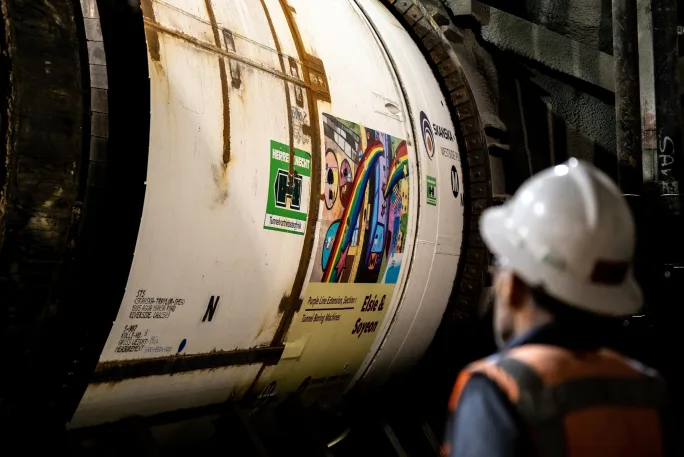
The Purple Line, currently under construction by the LA Metro, had strong support from the City of Los Angeles and its mayor.
Photo: LA Metro
What Works
Fortunately, we do not have to live like this. If we want to see more transit infrastructure constructed, we can empower transit authorities to build it.
Instead of subjecting every transit agency permit to the whims and shakedowns of local governments, we can reallocate at least some responsibility to the transit authorities themselves.
“The Powerless Brokers” report outlined policy reforms that could improve things. The most impactful change would be to grant at least some transit authorities the power to self-permit.
While that might be the most politically difficult change, it would be the most direct way to see more transit.
That expanded power could be limited to central transit authorities or to projects with a substantial statewide benefit, such as high-speed rail.
One could imagine granting more authority to a large and sophisticated agency, such as LA Metro, than to a small agency like the Antelope Valley Transit Authority.
More moderate reforms are also possible. Shot clocks could require third-party permitting entities to make decisions within a specified time frame or automatically grant permits. That would still leave the ultimate decisions with local governments, but limit their ability to delay.
Shot clocks are not new. They already apply to permitting for broadband infrastructure.
Federal regulations require local governments to issue permits for private sector broadband infrastructure within a prescribed timeline. The purpose of those laws is to ensure we have a functional national broadband network — and anyone reading this piece on their phone knows we have succeeded in expanding broadband.
We should expect the same for our public transit network. Public sector transit authorities should be allowed to use the same permitting rules as private-sector broadband companies.
State standards could be created for the permit applications themselves.
Currently, many local governments employ different engineering and design standards, resulting in a lack of uniformity. Transit projects are sometimes required to design different segments to comply with the diverse rules of various local governments.
A uniform standard across California, or even within a large multi-jurisdictional transit agency, would smooth things along. Individual jurisdictions could still retain the final authority to approve or deny permits, but they would be required to consider them in accordance with a common standard.
There is also a role for state departments of transportation, such as Caltrans in California. Transit projects often need to cross into the Caltrans right-of-way, which requires its approval. The California Legislature recently adopted Senate Bill 960, which requires Caltrans to establish statewide standards for considering encroachment permits. Caltrans will also be subject to a shot clock, ensuring its staff considers permits promptly.
Currently, Caltrans is preparing a package of policy documents to implement Senate Bill 960. Caltrans can lead by example by adopting policies that provide clear guidance for transit authorities and an easy path to permit approvals.
Like many state-level Departments of Transportation, Caltrans is more than just a builder and operator of transportation infrastructure. It is also an influential player in the transportation sector.
Caltrans alums are leaders in other public agencies and private infrastructure firms. Cities routinely implement the Caltrans Highway Design Manual, meaning Caltrans helps set the standard for public works throughout the state.
Billions of dollars are allocated to transit each year, and we expect transit authorities to build the projects for which they are funded. Our current processes make that difficult, and sometimes impossible. If we want to see more transit, we must empower transit authorities to build and expand their services.
Quick Answers
Building transit systems in the U.S. is challenging due to complex regulatory frameworks, high costs, and lengthy approval processes.
*Summarized by AI
More Blog Posts

Five Years Later: What’s Changed at Greyhound
Five years after Flix acquired it, Greyhound reflects on fleet modernization, operational improvements, employee empowerment, and a renewed focus on customer experience.
Read More →
Building a Winning FTA Grant Proposal: Why Propane Autogas is the Pragmatic Choice for Fleet Resilience
With $610 million available through the FY 2026 Buses and Bus Facilities Competitive Program and the Low or No Emission Grant Program, agencies must build a compelling case before the September 21 deadline that balances environmental compliance with operational feasibility.
Read More →
Velo-city Conference 2026: Latest Trends in Cycling as Part of Urban Mobility
The global cycling conference highlighted how cities are integrating bicycles into multimodal transportation networks, expanding cycle tourism and reshaping urban mobility.
Read More →
Kindness Isn’t Soft...It’s Strategic.
Mike Bismeyer — often known as “The Kindness Guy” — has spent more than 17 years in public transit and mobility, serving in industry leadership roles, speaking across North America, and advocating for stronger workplace cultures. But his message doesn’t come from theory. It comes from lived experience.
Read More →
Inside ITF 2026: Transport Reacts to A Challenging World
Transport leaders from around the world gathered in Leipzig, Germany, for the 2026 International Transport Forum to discuss resilience, climate impacts, supply chains and the future of sustainable mobility.
Read More →
Every Ride Tells a Story — But You’re Not Just Selling the Ride
You’re selling the moment, the meaning, and the emotion behind it.
Read More →
How Digital Signage is Reshaping the Traveler Experience at Transportation Hubs
What was once a landscape of static signs has evolved into a responsive, immersive environment powered by real-time visual communication.
Read More →
Latest Trends in Urban Mobility from Polis Conference 2025
Polis comprises cities and regions, as well as corporate partners, from across Europe, promoting the development and implementation of sustainable mobility. This year’s event had over a thousand attendees across various policy forums and an exhibition.
Read More →
Why Transit Leaders Require Better Tools for Operational Clarity In Today’s Tech-Fragmented Environment
Across North America and beyond, transit agency officials are contending with a perfect storm of operational headaches and strategic challenges that hamper daily service and long-term progress.
Read More →
Why Transport Sustainability Should Focus on People Instead of Cars
Simply incentivizing electrification is not enough to make a meaningful impact; we must shift our focus toward prioritizing public transportation and infrastructure.
Read More →