




RELATED: Mobile surveillance systems eye safety, accountability
Safeguarding Surveillance Data So You Don’t Fall Short of the Law
The continuous growth in use of video surveillance means new challenges for data storage, and as the role of CCTV grows increasingly important, it’s critical to manage and protect in the correct way.
October 14, 2018
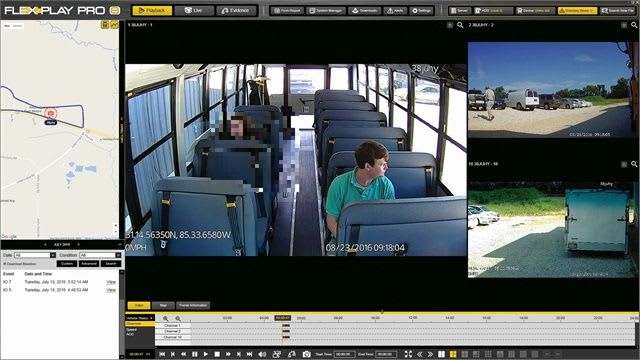
Many organizations require higher-resolution video to ensure compliance with insurance providers, maximize loss recovery and strengthen criminal cases in court, for example. Photo: AngelTrax
3 min to read
Many organizations require higher-resolution video to ensure compliance with insurance providers, maximize loss recovery and strengthen criminal cases in court, for example. Photo: AngelTrax
Video surveillance has evolved massively since CCTV was invented in 1942. The continuous growth in use of video surveillance, however, also means new challenges for data storage, and as the role of CCTV grows increasingly important, it’s critical to manage and protect in the correct way.
It’s especially imperative to consider data storage and security, ensuring it complies with local and international laws and regulations. For digital evidence, it’s important to be able to offer seamless scalability to accommodate rapid growth, along with a comprehensive suite of data security features that meet strict requirements for file integrity, privacy, chain of custody, and compliance.
Key Data Storage Issues: Capacity, Retention, and Chain of Custody
In terms of capacity, video and digital images are exceptionally heavy users of storage space and the guidelines around managing evidentiary data are key to it being recognized as a valid source by the criminal justice system.
Many organizations require higher-resolution video to ensure compliance with insurance providers, maximize loss recovery, and strengthen criminal cases in court, for example. It is therefore essential that data is stored in a solution that is scalable and cost-effective, allowing them to add capacity as needed, since running out of storage space is not an option.
Storage solutions that incorporate policy-based rules for data retention can help police departments to significantly boost their storage efficiency by automatically keeping all surveillance videos only for their legally mandated retention period. Similarly, a solution that can enable a digital chain of custody, including an audit trail, will help prove that any digital evidence is correct and has not been deleted or altered in any way and who accessed that information.
By implementing high quality storage solutions, the owner of the surveillance data — whether that’s local government or a business with its own CCTV — can be sure that it can be utilized as evidence. And when it comes to catching and prosecuting criminals, it’s better to be safe than sorry.
The Solution
The best solution to all these issues is implementing a storage solution that enables organizations to meet regulatory demands while ensuring data does not become corrupted or — worse yet — deleted before its time.
Surveillance videos require Chain of Custody and immutability tools to keep them admissible as evidence in legal proceedings. Using a storage solution that guarantees the integrity of archived data through the use of file serialization, file fingerprinting, audit trails, self-auditing, and self-healing capabilities is ideal for this situation. Because secure archive is designed to work transparently with existing applications, no APIs are needed to deliver these benefits for the physical security network.
To ensure optimum storage for high-value surveillance, solutions should encompass file integrity, data availability, secure time, file redundancy, data verification, and no-backup-needed options.
Gary Watson co-founded Nexsan in 1999 and is currently the company’s CTO, a role he’s served in for more than 12 years.
Topics:video surveillance
Subscribe to Our Newsletter
More Blog Posts

Velo-city Conference 2026: Latest Trends in Cycling as Part of Urban Mobility
The global cycling conference highlighted how cities are integrating bicycles into multimodal transportation networks, expanding cycle tourism and reshaping urban mobility.
Read More →
Kindness Isn’t Soft...It’s Strategic.
Mike Bismeyer — often known as “The Kindness Guy” — has spent more than 17 years in public transit and mobility, serving in industry leadership roles, speaking across North America, and advocating for stronger workplace cultures. But his message doesn’t come from theory. It comes from lived experience.
Read More →
Inside ITF 2026: Transport Reacts to A Challenging World
Transport leaders from around the world gathered in Leipzig, Germany, for the 2026 International Transport Forum to discuss resilience, climate impacts, supply chains and the future of sustainable mobility.
Read More →
Every Ride Tells a Story — But You’re Not Just Selling the Ride
You’re selling the moment, the meaning, and the emotion behind it.
Read More →
How Digital Signage is Reshaping the Traveler Experience at Transportation Hubs
What was once a landscape of static signs has evolved into a responsive, immersive environment powered by real-time visual communication.
Read More →
Latest Trends in Urban Mobility from Polis Conference 2025
Polis comprises cities and regions, as well as corporate partners, from across Europe, promoting the development and implementation of sustainable mobility. This year’s event had over a thousand attendees across various policy forums and an exhibition.
Read More →
Why Transit Leaders Require Better Tools for Operational Clarity In Today’s Tech-Fragmented Environment
Across North America and beyond, transit agency officials are contending with a perfect storm of operational headaches and strategic challenges that hamper daily service and long-term progress.
Read More →
The Powerless Brokers: Why California Can’t Build Transit
It is no secret that transit in the U.S. is slow and expensive to build.
Read More →
Why Transport Sustainability Should Focus on People Instead of Cars
Simply incentivizing electrification is not enough to make a meaningful impact; we must shift our focus toward prioritizing public transportation and infrastructure.
Read More →
Transit ROI & System Efficiencies Will Drive 'Big, Beautiful' Transit Funding
For many years, the narrative surrounding public transit improvements has been heavily weighted toward environmental gains and carbon reduction. While these are undeniably crucial long-term benefits, the immediate focus of this new funding environment is firmly on demonstrable system efficiencies and a clear return on investment.
Read More →