MDS 2.0 is a game changer in the micromobility industry, providing cities and operators with the ability to better understand, communicate, and visualize the status of fleet vehicles in dense urban environments.
Scott Shepard・Head of Policy & Government Affairs, Drover.Ai
By addressing safety concerns in public spaces through the adoption of scalable, proven AI and CV technologies that accurately distinguish infrastructure types and in real time, both cities and operators can ensure that order can be restored.
Credit:
Bird
4 min to read
Article originally published in Zag Daily
Drover is a proud member of the Open Mobility Foundation (OMF), a non-profit open-source foundation that brings together cities, mobility companies, and software vendors to collaboratively develop open-source tools to manage mobility.
Ad Loading...
We have worked in partnership with OMF on the development and release of the Mobility Data Specification (MDS 2.0). MDS 2.0 is a game changer in the micromobility industry, providing cities and operators with the ability to better understand, communicate, and visualize the status of fleet vehicles in dense urban environments.
Drover specifically contributed to the development of MDS 2.0 by defining three new data attributes: infrastructure type, parking status, and tip over detection. The adoption of MDS 2.0 facilitates more compliant deployments and better proactive management of micromobility by cities and regulators.
Much like we pointed out in an article in 2021, parking compliance continues to be one of the most persistent pain points cities struggle with in the deployments of free floating micromobility. Whether it be blocked sidewalks, obstructed bike lanes, or tipped-over devices, the frequency of occurrences is prevalent across all cities and creates a demand for cities to take punitive reactive action in the absence of proactive compliance.
Unfortunately, existing measures don’t always satisfy the most aggrieved stakeholders and a perceived nuisance can eventually reach a fever pitch, as seen in the recent prohibition of shared e-scooters in Paris.
While the Paris debacle remains an outlier, there is a consistent trend towards tighter regulations of e-scooter parking in public spaces.
Ad Loading...
Though various different solutions have been attempted by operators to address the e-scooter parking dilemma, some with moderate effectiveness and confusing user experiences, the issue still persists and cities are leveraging their authority to levy fines in an effort to move the needle. Operators are sadly left with a mountain of citations that make a significant dent in profitability.
Parking Compliance 2.0
Drover AI’s patented PathPilot AI & computer vision technology has already proven its effectiveness at enforcing proactive compliance with existing riding and parking regulations to help meet city expectations for micromobility behavior at scale. At the end of a ride, PathPilot shifts from sidewalk detection to parking validation, reducing friction from the user experience, and ultimately helping ensure better outcomes.
Building upon our real time parking enforcement capabilities, PathPilot’s Parking 2.0 provides an unparalleled operational experience and the ability to have insight into the end of ride outcome 100% of the time without relying on a user generated photo.
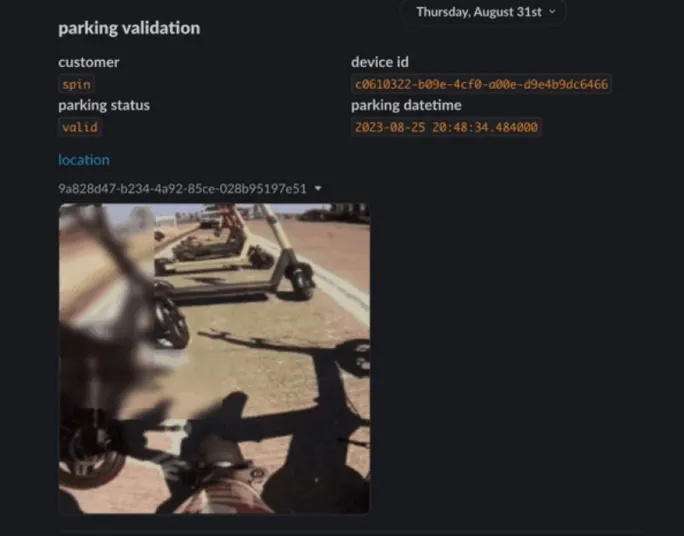
Parking 2.0 uses a short sequence of images (rather than the previous single image) and AI validation algorithms to rate each end of ride outcome and allow operators to take any necessary action. The GIF and accompanying AI score on the parking job provide detailed context on the end of ride previously unavailable from a single photo, whether taken by the rider or the vehicle. This new validation process is surfaced to operators and other customers in compliance with the latest MDS 2.0 standards via API and is also available via automated Slack alerts.
How does this help?
Ad Loading...
Operators can use this real-time feedback via API integration to inform riders of bad outcomes, nudge them toward acceptable ones, or even not allow a rider to park improperly if desired.
Operators can eventually remove the need for riders to even submit a parking photo taken with their phone, drastically improving the user experience.
Using market specific Slack channels, ops teams can be alerted to bad parking instances and use the GIF to visually confirm the need (or not) for corrective action, and address the issue before the time limit imposed by a city and avoiding a citation.
The GIFs can also serve as part of an “evidence package” that can be used to assign the citation to a specific user (or not).
Contextual confirmation and real-time data can ensure the proper use of dedicated micromobility parking infrastructure that cities invest in.
As part of MDS 2.0 adoption, cities could have access to the same real-time parking data, ensuring that all parties are working off of the same information.
Alerts are time/date stamped and include GPS location coordinates
Credit:
Drover AI
Coming to Europe
Drover looks forward to deploying our Parking 2.0 solutions to various European cities in the coming weeks. Public and private stakeholders across the shared mobility ecosystem have much to gain from upgrading and adopting MDS 2.0 as part of their operational processes.
By addressing safety concerns in public spaces through the adoption of scalable, proven AI and CV technologies that accurately distinguish infrastructure types and in real time, both cities and operators can ensure that order can be restored. Drover’s latest innovations along with our recent partnerships with Segway and Qualcomm are sure to make an impact on improved micromobility safety and public space management.
Drover AI’s Co-Founder Alex Nesic co-authored this article with Scott Shepard
With $610 million available through the FY 2026 Buses and Bus Facilities Competitive Program and the Low or No Emission Grant Program, agencies must build a compelling case before the September 21 deadline that balances environmental compliance with operational feasibility.
The global cycling conference highlighted how cities are integrating bicycles into multimodal transportation networks, expanding cycle tourism and reshaping urban mobility.
Mike Bismeyer — often known as “The Kindness Guy” — has spent more than 17 years in public transit and mobility, serving in industry leadership roles, speaking across North America, and advocating for stronger workplace cultures. But his message doesn’t come from theory. It comes from lived experience.
Transport leaders from around the world gathered in Leipzig, Germany, for the 2026 International Transport Forum to discuss resilience, climate impacts, supply chains and the future of sustainable mobility.
Polis comprises cities and regions, as well as corporate partners, from across Europe, promoting the development and implementation of sustainable mobility. This year’s event had over a thousand attendees across various policy forums and an exhibition.
Across North America and beyond, transit agency officials are contending with a perfect storm of operational headaches and strategic challenges that hamper daily service and long-term progress.
Simply incentivizing electrification is not enough to make a meaningful impact; we must shift our focus toward prioritizing public transportation and infrastructure.