



Why employers should care about the length of employees’ commutes
Employers are beginning to take notice of the psychological and physical well-being of their employees by looking for ways to combat the the toll of long work commutes.

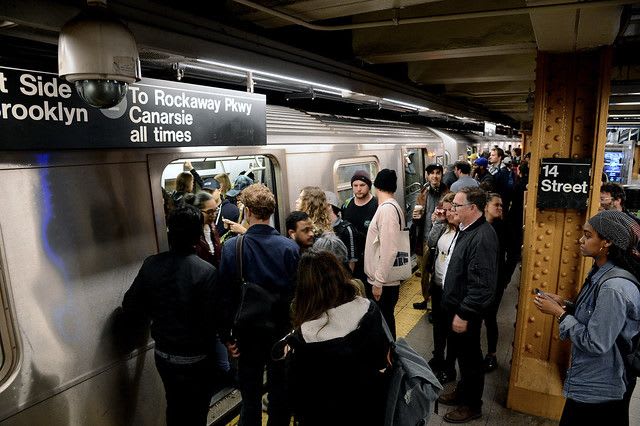
Commuting is often the single least satisfying activity out of all daily activities, according to a 2004 study.
Marc A.Hermann/MTANewYorkCityTransit

Commuting is often the single least satisfying activity out of all daily activities, according to a 2004 study.
Marc A.Hermann/MTANewYorkCityTransit
The average American has a commute of 26.9 minutes each way. Twice a day, five times a week, 52 weeks a year — that adds up to more than 9 days behind the wheel every year. And that’s just the average. More than 14 million people spend over an hour each way to work.
What else does that add up to? A huge toll on their social, psychological, and physical health. Commuting is often the single least satisfying activity out of all daily activities, according to a 2004 study.
Physically speaking, a long commute is correlated with high-blood pressure from increased stress, backaches from poor posture, and even more psychosomatic disorders with exhaustion, sleep deprivation, and dizziness topping the list. Socially, commuting takes up a lot of time that could be better spent doing literally anything else. That also includes time with family and friends, an important aspect of an individual’s overall mental health.
At the office, a long commute can make people unproductive, as they spend significant time in the morning de-stressing from their time in the car. What’s more, 23% of workers have left a job due to a bad commute — and 60% of people feel as though their company doesn’t do enough to help with it.
So how can companies help alleviate the pains of commuting? From providing employees with access to alternative mobility options, to implementing other transportation demand-management tools, there are a lot of strategies on the table.
The best way to combat the toll driving alone takes is seemingly straightforward: Don’t drive alone as your commute. But access to reliable transportation options is far from a given, so for most people it’s simply not feasible to make that change without some extra assistance.
For companies who have the ability to do so, a private shuttle can make up that first-/last-mile difference. Companies across the country, particularly in areas directly outside of a city’s central business district, have started providing shuttles to take employees to and from nearby train or metro stations. Alternatively, some companies also provide on-demand shuttles for employees who work alternative or late hours.
Once employees gain the confidence to complete their roundtrip safely via an alternative form of transportation, they feel more comfortable opting not to drive to work in the first place. If nothing else, they’ll know they can drive to a nearby metro station and commute the rest of the way there without having to be behind the wheel — lessening the burden of an hour-long commute.
Additionally, it’s time to consider the multitude of other ways people can get to work that aren’t necessarily traditional public transportation options, many of which have ways for corporate employers to easily manage accounts. Uber, Lyft, and Via, for example, all offer business accounts that allow employers to distribute funds and manage usage for employees, even going so far as to only encourage them to take shared rides like uberPOOL or Lyft Line.
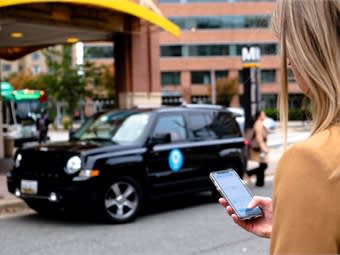
Uber, Lyft, and Via (shown), for example, all offer business accounts that allow employers to distribute funds and manage usage for employees.
Via
Offering employees a transit subsidy or a bikeshare membership can also help to bridge the first-/last-mile difference, while also encouraging a more sustainable lifestyle. These types of commutes actually increase happiness, which leads to increased productivity at work. As an employer, having happy and productive employees is key, so helping to improve the commute is essential.
Regardless of how it happens, it’s clear that something needs to be done in the way of the daily commute to keep employees as stress free as one can be on the job. Employers who are dedicated to fixing the broken commute and taking the necessary steps to alleviate this pain will not only see a happier workforce, but a more productive one as a result.
Matt Caywood is the CEO of TransitScreen.
More Blog Posts

Velo-city Conference 2026: Latest Trends in Cycling as Part of Urban Mobility
The global cycling conference highlighted how cities are integrating bicycles into multimodal transportation networks, expanding cycle tourism and reshaping urban mobility.
Read More →
Kindness Isn’t Soft...It’s Strategic.
Mike Bismeyer — often known as “The Kindness Guy” — has spent more than 17 years in public transit and mobility, serving in industry leadership roles, speaking across North America, and advocating for stronger workplace cultures. But his message doesn’t come from theory. It comes from lived experience.
Read More →
Inside ITF 2026: Transport Reacts to A Challenging World
Transport leaders from around the world gathered in Leipzig, Germany, for the 2026 International Transport Forum to discuss resilience, climate impacts, supply chains and the future of sustainable mobility.
Read More →
Every Ride Tells a Story — But You’re Not Just Selling the Ride
You’re selling the moment, the meaning, and the emotion behind it.
Read More →
How Digital Signage is Reshaping the Traveler Experience at Transportation Hubs
What was once a landscape of static signs has evolved into a responsive, immersive environment powered by real-time visual communication.
Read More →
Latest Trends in Urban Mobility from Polis Conference 2025
Polis comprises cities and regions, as well as corporate partners, from across Europe, promoting the development and implementation of sustainable mobility. This year’s event had over a thousand attendees across various policy forums and an exhibition.
Read More →
Why Transit Leaders Require Better Tools for Operational Clarity In Today’s Tech-Fragmented Environment
Across North America and beyond, transit agency officials are contending with a perfect storm of operational headaches and strategic challenges that hamper daily service and long-term progress.
Read More →
The Powerless Brokers: Why California Can’t Build Transit
It is no secret that transit in the U.S. is slow and expensive to build.
Read More →
Why Transport Sustainability Should Focus on People Instead of Cars
Simply incentivizing electrification is not enough to make a meaningful impact; we must shift our focus toward prioritizing public transportation and infrastructure.
Read More →
Transit ROI & System Efficiencies Will Drive 'Big, Beautiful' Transit Funding
For many years, the narrative surrounding public transit improvements has been heavily weighted toward environmental gains and carbon reduction. While these are undeniably crucial long-term benefits, the immediate focus of this new funding environment is firmly on demonstrable system efficiencies and a clear return on investment.
Read More →