



GILLIG unveils new 40-foot battery electric bus
The company is partnering with Cummins for electric powertrain and ChargePoint for the charging infrastructure.
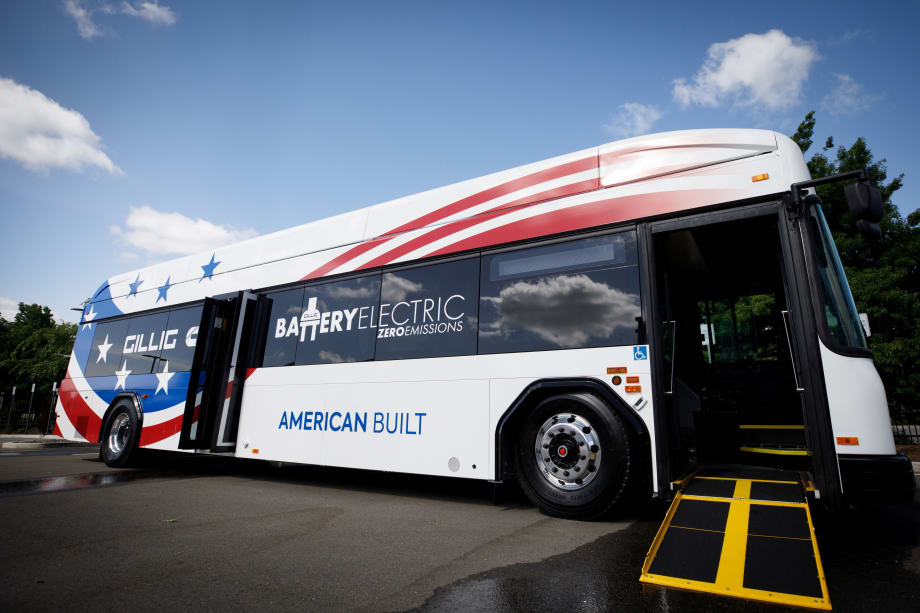
The bus will be built on the Low Floor bus platform and feature parts commonality with other GILLIG propulsion types.
Courtesy of Breslow Imaging/GILLIG
The bus will be built on the Low Floor bus platform and feature parts commonality with other GILLIG propulsion types.
Courtesy of Breslow Imaging/GILLIG
This week, GILLIG, in a partnership with Cummins, unveiled its new 40-foot battery electric buses at an event at GILLIG’s headquarters in Livermore, California.
The buses feature a direct-drive traction motor with peak torque of 3500 Nm (2,582 lbs.-ft), and utilize energy recovered from a regenerative braking system. A package of e-accessories will be powered through various convertors, with the initial bus deployment utilizing plug-in charging. GILLIG officials added that inductive and conductive charging capabilities will also be available shortly.
The bus is designed on GILLIG’s proven Low Floor bus platform, which ensures parts and training commonality with existing GILLIG fleets. Since it incorporates the Cummins electrified powertrain, the bus provides transit agencies with the advantage of accessing full local service support with hundreds of Cummins service centers throughout the country to provide the necessary training, warranty administration, and aftermarket parts for the electrified power system.
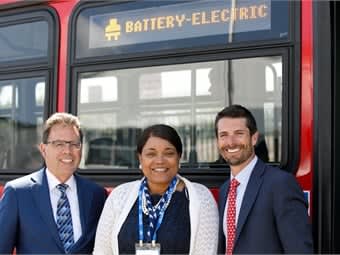
(From left to right): Joe Policarpio, VP of Sales and Marketing, GILLIG; Inez Evans, Chief Operating Officer, Santa Clara Valley Transportation Authority; and Derek Maunus, President and CEO, GILLIG, take a test ride on the Battery Electric Bus at GILLIG’s Livermore facility.
Courtesy of Breslow Imaging/GILLIG
Both GILLIG’s Joe Policarpio, VP, Sales and Marketing, and President and CEO Derek Maunus said the battery electric bus was about four years in the making. They stressed that its development reflects the company’s values to offer products only when GILLIG is able to stand behind them, while continuing to forge strong relationships with its transit agency partners.
“We’re not always first to market, because we feel it is more important to get it right before we unveil a new product,” Maunus told the crowd.
The GILLIG battery electric bus will have a battery capacity of 444 kWh, with company officials expecting a real-world range of 150 miles based on an energy usage of 2.3 kWh per mile; GILLIG noted that they could claim 210 miles at the industry-advertised 1.7 kWh per mile, but that is not a realistic transit operation energy usage. The bus is also built to SAE, UNECE, and CharIN standards.
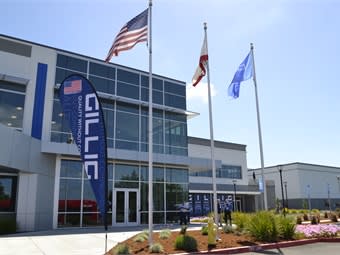
The new battery electric buses will be built at GILLIG's Livermore, California, production facility.
Alex Roman
Company officials also said that GILLIG is partnering with ChargePoint to provide the bus charging infrastructure.
GILLIG is set to begin production in May 2020, with the initial fleet of buses set to be delivered to transit agencies that have recently been awarded FTA Low-No Grants.
In the meantime, the company has several vehicles undergoing various tests, with one touring the U.S. throughout the next year and one set to soon be delivered to Santa Monica’s Big Blue Bus.
More Bus

New York MTA Plans Largest Bus Fleet Upgrade in More Than a Decade
The agency is seeking manufacturers for 650 new CNG buses to replace aging vehicles, improve reliability, and advance its broader fleet modernization strategy.
Read More →
Building a Flexible Path to Transit Electrification
John Hroncich discusses BAE Systems’ modular and scalable approach, lessons learned from decades of real-world operations, and how agencies can identify electrification strategies that fit their fleets.
Read More →
Bus Tech Talk: Keeping Transit Technicians Ahead of the Technology Curve
LA Metro’s Obed Mejia discusses technician training, evolving maintenance technology, fleet replacement, and strategies for getting the most out of today’s transit fleets.
Read More →
Biz Briefs: RIPTA Unveils New Frontrunners, Clevland RTA Adds New Siemens, and More
In METRO's latest installment, we take a look at recent news from Siemens, Prevost, Dodge, and more partnerships making headlines across the transportation sector.
Read More →
People Movement: Holly Arnold Joins Transdev and More
In this edition, we also cover recent appointments and announcements at Pace, CamTran, MCI, and more, showcasing the individuals helping to shape the future of transportation.
Read More →
The High Cost of Transit Buses: Industry Leaders Look to Procurement Reform
Transit leaders and policymakers examine how standardized bus designs, streamlined procurement, and predictable funding could help agencies stretch budgets and deliver better service.
Read More →
The Business Voice Behind Public Transportation
As chair of APTA’s Business Members Board of Governors, Ray Melleady explains how more than 850 business members are partnering with transit agencies to advance funding, innovation, and industry-wide collaboration.
Read More →
From Surviving to Thriving: Building Stronger Transportation Organizations
Bus Business Consultants founder Brian Dickson shares lessons on leadership, organizational health, and creating options for long-term success in a changing transportation industry.
Read More →
Finding the ‘Happy Medium’: Optimizing Maintenance Without Sacrificing Reliability
The key to maintenance optimization isn’t doing less work—it’s doing the right work at the right time on the right assets.
Read More →
LA Metro, City of West Hollywood, and Partners Advance Smarter Bus Lane Enforcement
The award-winning partnership combines AI-powered detection with human oversight to improve bus reliability, accessibility, and enforcement efficiency.
Read More →