



VIA's president/CEO on the revamped bus system, future of agency
Jeffrey C. Arndt manages the seventh-largest city in the U.S.
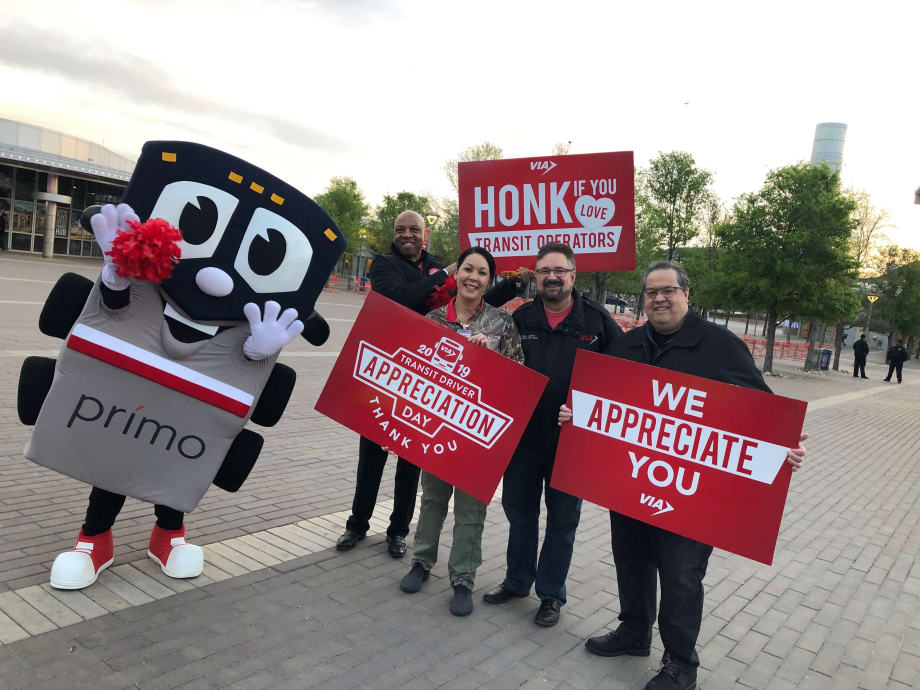
VIA President/CEO Jeffrey C. Arndt (center) celebrates Transit Driver Appreciation Day with staff, executives, and board members.
VIA
VIA President/CEO Jeffrey C. Arndt (center) celebrates Transit Driver Appreciation Day with staff, executives, and board members.
VIA
Jeffrey C. Arndt is president/CEO of VIA Metropolitan Transit, which provides transportation services to Texas' Bexar County region, including San Antonio — the seventh-largest city in the U.S. Arndt joined VIA in 2012 from Houston where he served at Houston METRO for 25 years.
METRO Managing Editor Alex Roman spoke to Arndt about VIA’s growth, its Better Bus Plan initiative, and how mobility options are changing in the region.
What are some of the challenges VIA is facing in providing services to riders?
We are like a typical Sun Belt-type city where we are experiencing growth that is continuing further and further from the urban core. Our downtown is the third-largest employment area, so we don’t have the traditional downtown that is primarily an employment center, partly because we have so many cultural destinations in the area, including The Alamo and Riverwalk. But, we do continue to see employment centers that move further and further out, and obviously, that challenges us because in many of these areas we didn’t have service, or we may not even currently have service, so it limits the ability of people who use public transit that are looking for jobs to get to and from work.
How is your Better Bus System plan attempting to solve some of these challenges?
If you were to look at VIA reimagined as a three-legged stool, Better Bus is the first leg, advanced rapid transit is the second, and the third leg is smart transit. With our current funding, the city now sends us 10 million dollars, which has allowed us to enhance the frequency of service in nine corridors with the hopes of building ridership and nine more corridors where we are establishing more convenient service. Better Bus is really the foundation. You can’t expect people to ride a service that doesn’t offer a certain level of convenience. You can expect if you’re running service every 30 minutes, your market is primarily people who don’t have other transportation available. But, if you run service every 10 minutes, you can start bringing in people who do have other options but find those 10-minute frequencies attractive.
If you look at VIA back in 2010, we had zero routes that operated with 10-minute frequencies — it was a service that was primarily coverage-based. In 2012, we introduced the first Primo line. Primo is what many other systems call BRT, because it has most of the elements that are being implemented in other cities except it does not have a dedicated Right of Way. As of September, we now have 12 high-frequency lines, so that’s a big jump in a little period of time. And, the results of this plan have been rather amazing. If you look at the routes that were done a year ago January and the routes done in May of last year, they, on average, have 20 to 25 percent increases in ridership, and the jump was almost immediate. In today’s environment, that is pretty impressive.
Tell me about your Link on-demand program.
We consider mobility to be a smart transit element. What we’re calling VIA Link is a mobility-on-demand-type operation. We found an area where we had three fixed-route buses that shuttled riders to a transfer point on our system, which only ran once an hour. Now, we’ve taken that area, designated it as ‘the zone,’ and replaced the bus system with VIA Link, which enables you to schedule a trip on an app just like an Uber or Lyft. Typically, the time for pickup is five to six minutes. It’s a shared-ride service, and about 50 percent of the trips do involve shared rides. Currently, our on-time performance is upwards of 90 percent, and on a scale of one to five, our riders rank the service a 4.7, on average.
The big deal is you book the trip and it will carry you anywhere within that zone. So, this is not a many-to-one type of service, where you’re taking many people to a station within the zone. It is instead a many-to-many service, including the ability to get to the station that is at the edge of the zone. We have a transit location called Naco Pass, which is where the bus riders tended to focus before, and now about half of Link’s passengers end up going to Naco Pass and then integrating with the rest of the system. The other half are making trips all throughout that area. And if you think about those three routes that operated once an hour, if you were trying to get from one route to another route, you had to essentially ride it into Naco Pass and then transfer back out to another area. Now, the service can take people across town, straightaway. So the travel time for the service compared to a direct drive is very comparable. The other plus is with the pricing. We calculated that if all we did was carry people that were previously riding those buses, we would save 50 percent off the cost of the operation of those bus routes. If we double the ridership compared to what was out there, we would spend about the same money.
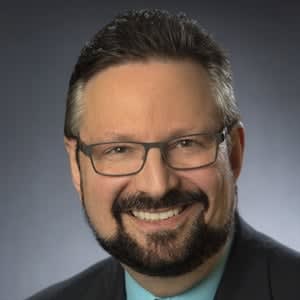
Jeffrey C. Arndt
VIA
Do you think this type of service can be easily replicated in other areas?
Absolutely. We have already identified six areas where we thought it could work and plan to introduce VIA Link to another area sometime next year. While our current VIA Link project is a one-year pilot, the other side to that is, if it is really working, we don’t have to wait until the end to come to a conclusion that we should try it elsewhere. The areas we have looked at are all similar to the line we’re operating now. The part I’m interested in trying next is implementing this program within activity centers.
Where would you like to see VIA in the next five years?
Obviously, I want us to continue down the path of Better Bus, continue with the improvements we’re making in our app, to implement and improve the technologies we offer, and continue to add more frequency. The other part, though, is we’d like to start implementing an advanced rapid transit (A.R.T.) system, which is defined as a service that operates at least fifty percent of its route in a dedicated Right of Way that gives you reliability and better speeds. We have not yet decided on the type of vehicle because we know we’re probably five to seven years away from actually accomplishing all that, but I foresee it being an electric vehicle. We have six corridors designated in our long-range plan.
We’re currently working with a private organization, called Connect San Antonio, and they have been charged with mapping out a transportation plan for the region, which is not just transit but also includes highways, roadways, linear parks, sidewalks, and micromobility lanes. They were formed by our County Judge and the Mayor of San Antonio, and their purpose was to develop a plan, take it to the community to get their input, and then develop funding scenarios so that we can build the plan out. We’re working very closely with them. The Mayor said he wants to have a funding election in November 2020 for the transportation plan, and that makes a big difference to us because without that additional funding we’re not going to be able to move A.R.T. within the desired timeframe.
Once we have a high-frequency A.R.T.- type network to serve the long-haul trips, we’ll re-orient the system to help us have a background service where the least frequent service in the peak would be 20 minutes, as opposed to 60 minutes. We’d also have a mobility-on-demand system that would serve the outlying areas, where that kind of configuration of service is effective compared to fixed-route 40-foot buses. We could also have mobility-on-demand systems in some of our activity centers as well for distribution within that area.
More Management

LIT Marks 10-Year Milestone at Annual Summit
Hosted by the COTA from September 10 to 13, the Summit carried the theme “Celebrating 10 Years of Excellence, Leadership, and Impact,” with every part of the program honoring the people, agencies, and partners who built LIT over its first decade.
Read More →
People Movement: Dan Dipert Coaches Adds Third-Generation Leader, Keolis Names New Valley Metro VP/GM, and More
In this edition, we also cover recent appointments and announcements at the Wabtec, SilverRide, HNTB, and more, showcasing the individuals helping to shape the future of transportation.
Read More →
METRO Opens Submissions for 2026 Motorcoach Awards
Nominations are now being accepted for METRO Magazine’s Operator of the Year and Innovative Operator of the Year awards.
Read More →

New York MTA Advances Final Contract for Second Avenue Subway Expansion
Contract Four is the largest in the Second Avenue Subway Phase 2 project and includes construction of station infrastructure, tracks, and signals for the subway expansion, MTA officials said. Work on Contract Four will begin in 2027.
Read More →
Transit Agencies Highlight Safety Gains at National Summit
Leaders from 15 major transit systems shared crime-reduction results and safety initiatives while discussing the role of continued federal support.
Read More →
NITA Names New Leadership, Expands Reduced-Fare Program at First Board Meeting
The new regional transit authority appointed its first board chair and interim executive director while extending reduced fares across CTA, Metra, and Pace for eligible riders.
Read More →
Beyond the Checklist: A Structured Approach to Transit Maintenance
Reliability-Centered Maintenance helps transit agencies move beyond routine checklists to focus limited resources on the assets and failures that have the greatest impact on safety, reliability, and service.
Read More →
APTA 2026 Nominating Committee Selects Leadership Slate, Names Chair and Vice Chair Nominees
Leadership changes will help shape the association’s priorities and its representation of the transportation industry during the 2026–2027 term.
Read More →
DART Launches Major Security, Fare Enforcement Initiative
The 90-day demonstration will deploy coordinated security teams at five light rail stations while testing controlled access and gathering data to guide future investments.
Read More →
Advancing Fare Collection Through Technology and Innovation
Learn about delivering 1300 gates at 91 stations while managing fare evasion. Explore the large scale deployment, solution customization and real-world results that affect the region. Prepare for deployment in your region now.
Read More →