




RELATED: NY budget includes congestion pricing to pay for transit
NY MTA solar roof initiative to generate green energy, revenue
An RFP went public on Earth Day 2019, which proposes the solar development of seven MTA properties.
April 23, 2019
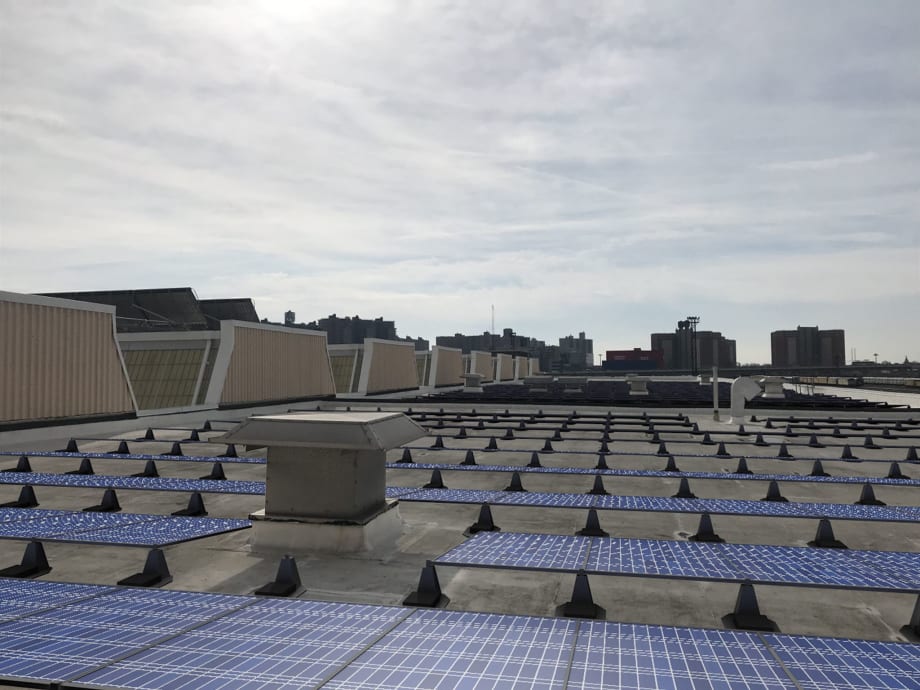
Roof of Coney Island Maintenance Facility with solar panel renderings.
MTA
2 min to read
Roof of Coney Island Maintenance Facility with solar panel renderings.
MTA
New York’s Metropolitan Transportation Authority (MTA) is launching a new initiative that will generate clean, emission free, solar electricity as well as begin to open up a new frontier of previously untapped revenue: the leasing of potentially millions of square feet of industrial roof space to companies interested in generating solar power.
Thanks to a steady fall in capital costs of solar panel and non-roof penetrating installation technologies, it is increasingly commonplace for industrial and warehouse buildings in the New York metropolitan region to place solar panels on their rooftops. This practice has also spread to buildings in public-sector portfolios, including universities and City buildings.
The MTA, the largest public transportation agency in the U.S., has identified more than 100 bus depots, train yards, repair shops, and commuter lots across all MTA agencies — totaling more than 10 million square feet of industrial roof space — which would be suitable for solar development. Fully realized, these properties present an opportunity to develop more than 100 megawatts of emission-free electricity for New Yorkers — enough to power 18,000 households. The MTA hopes to achieve a significant new revenue stream from this activity, with little to no capital investment of its own, by way of leasing the valuable real estate to companies that would use it to install solar panels and generate clean electricity to sell back to the municipal grid.
A Request for Proposals went public on Earth Day 2019. It proposes the solar development of seven MTA properties, belonging to NYC Transit, LIRR and Metro-North Railroad, generating an estimated 6.5 megawatts of emissions-free electricity for thousands of New York households. This RFP includes locations uniquely chosen to serve as a representative combination of existing roofs and parking lots.
All locations were carefully selected in partnership between the MTA Department of Environmental Sustainability and Compliance, MTA Real Estate, and the individual operating agencies. Chosen rooftops and parking lots fit the necessary requirements of having new roofs/new pavement, large quantities of unobstructed roof space, and local energy demand.
More Management

METRO Opens Submissions for 2026 Motorcoach Awards
Nominations are now being accepted for METRO Magazine’s Operator of the Year and Innovative Operator of the Year awards.
Read More →
New York MTA Advances Final Contract for Second Avenue Subway Expansion
Contract Four is the largest in the Second Avenue Subway Phase 2 project and includes construction of station infrastructure, tracks, and signals for the subway expansion, MTA officials said. Work on Contract Four will begin in 2027.
Read More →
Transit Agencies Highlight Safety Gains at National Summit
Leaders from 15 major transit systems shared crime-reduction results and safety initiatives while discussing the role of continued federal support.
Read More →

NITA Names New Leadership, Expands Reduced-Fare Program at First Board Meeting
The new regional transit authority appointed its first board chair and interim executive director while extending reduced fares across CTA, Metra, and Pace for eligible riders.
Read More →
Beyond the Checklist: A Structured Approach to Transit Maintenance
Reliability-Centered Maintenance helps transit agencies move beyond routine checklists to focus limited resources on the assets and failures that have the greatest impact on safety, reliability, and service.
Read More →
APTA 2026 Nominating Committee Selects Leadership Slate, Names Chair and Vice Chair Nominees
Leadership changes will help shape the association’s priorities and its representation of the transportation industry during the 2026–2027 term.
Read More →
DART Launches Major Security, Fare Enforcement Initiative
The 90-day demonstration will deploy coordinated security teams at five light rail stations while testing controlled access and gathering data to guide future investments.
Read More →
Sponsored•September 9, 2026
Advancing Fare Collection Through Technology and Innovation
Learn about delivering 1300 gates at 91 stations while managing fare evasion. Explore the large scale deployment, solution customization and real-world results that affect the region. Prepare for deployment in your region now.
Read More →
Game Day in Motion: Moving Millions During the 2026 World Cup
Between packed transit stations and team motorcoaches, see how agencies and operators across North America tackled the transportation demands of the 2026 FIFA World Cup.
Read More →
Surface Transportation Extension Averts Shutdown, Leaves Transit Funding Gap
The stopgap keeps federal transportation programs moving, but missing advance funding could complicate the transit and rail projects agencies are planning next.
Read More →