



Mass. Governor files $18B transportation bond bill
The authorization would be used to fund existing programs, as well as several new initiatives designed to lessen impacts from roadway congestion.

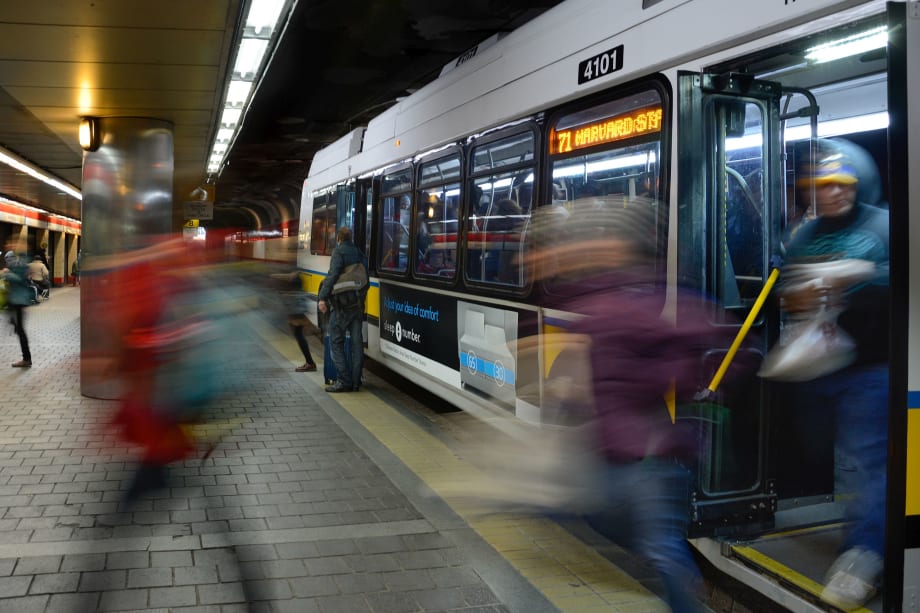
The bill reauthorizes and expands the special revenue bond Rail Enhancement Program to support $2.7 billion for MBTA investments over the next 10 years.
MBTA
The bill reauthorizes and expands the special revenue bond Rail Enhancement Program to support $2.7 billion for MBTA investments over the next 10 years.
MBTA
Gov. Charlie Baker and Lt. Gov. Karyn Polito filed a transportation bond bill seeking $18 billion in additional capital authorization to invest in building and modernizing a transportation system that meets the needs of residents, businesses, and cities and towns statewide. The authorization would be used to fund existing programs, as well as several new initiatives designed to lessen impacts from roadway congestion and ensure reliable travel throughout the Commonwealth.
Titled “An Act Authorizing and Accelerating Transportation Investment,” the proposal includes a series of initiatives from the administration to combat congestion on the Commonwealth’s roadways including establishing a tax credit to encourage telecommuting and remote working, expanding the use of designated bus lanes, and transit signal priority, as well as creating a program designed to reduce bottlenecks on local roadways.
It includes nearly $5.7 billion to continue modernizing the MBTA, $150 million to improve the pavement condition on state roads, $20 million to ensure municipalities have resources needed to continue efforts to build “Complete Streets” infrastructure to encourage the public to travel more on foot and by bicycle and $70 million for the Municipal Small Bridge Program.
The bill makes available an innovative, ongoing source of future support by authorizing up to half of the revenue generated by regional market-based compliance programs in the transportation sector, including the Transportation and Climate Initiative, which is currently under development with other Northeast and Mid-Atlantic states and the District of Columbia, to be used to support public transit capital investments that reduce greenhouse gas emissions in the transportation sector. The implementation of this initiative will lead to additional future revenues for investments in transportation infrastructure beyond those included in the bill.
The bill reauthorizes and expands the special revenue bond Rail Enhancement Program to support $2.7 billion for MBTA investments over the next 10 years beyond those funded in the five-year capital plan. This will help fund planning studies and pilots to support the reinvention of both the bus and commuter rail systems, make rail service improvements throughout the Commonwealth and invest in infrastructure power and resiliency.
It also authorizes $1.25 billion in Grant Anticipation Notes to support an expanded bridge program, the Next Generation Bridge Financing Program, ensuring that a total of approximately $4 billion will be available over the next eight years to invest in bridge preservation and reconstruction. The funding exceeds the size of the recently-completed Accelerated Bridge Program.
With the passage of the bill, MassDOT would be provided with the tools and resources to advance its goals of having 70% of non-interstate pavement in good or excellent condition. MassDOT would also be empowered to continue moving towards the goal of less than 10% of the bridge deck area of National Highway System bridges in poor condition.
More Management

METRO Opens Submissions for 2026 Motorcoach Awards
Nominations are now being accepted for METRO Magazine’s Operator of the Year and Innovative Operator of the Year awards.
Read More →
New York MTA Advances Final Contract for Second Avenue Subway Expansion
Contract Four is the largest in the Second Avenue Subway Phase 2 project and includes construction of station infrastructure, tracks, and signals for the subway expansion, MTA officials said. Work on Contract Four will begin in 2027.
Read More →
Transit Agencies Highlight Safety Gains at National Summit
Leaders from 15 major transit systems shared crime-reduction results and safety initiatives while discussing the role of continued federal support.
Read More →

NITA Names New Leadership, Expands Reduced-Fare Program at First Board Meeting
The new regional transit authority appointed its first board chair and interim executive director while extending reduced fares across CTA, Metra, and Pace for eligible riders.
Read More →
Beyond the Checklist: A Structured Approach to Transit Maintenance
Reliability-Centered Maintenance helps transit agencies move beyond routine checklists to focus limited resources on the assets and failures that have the greatest impact on safety, reliability, and service.
Read More →
APTA 2026 Nominating Committee Selects Leadership Slate, Names Chair and Vice Chair Nominees
Leadership changes will help shape the association’s priorities and its representation of the transportation industry during the 2026–2027 term.
Read More →
DART Launches Major Security, Fare Enforcement Initiative
The 90-day demonstration will deploy coordinated security teams at five light rail stations while testing controlled access and gathering data to guide future investments.
Read More →
Advancing Fare Collection Through Technology and Innovation
Learn about delivering 1300 gates at 91 stations while managing fare evasion. Explore the large scale deployment, solution customization and real-world results that affect the region. Prepare for deployment in your region now.
Read More →
Game Day in Motion: Moving Millions During the 2026 World Cup
Between packed transit stations and team motorcoaches, see how agencies and operators across North America tackled the transportation demands of the 2026 FIFA World Cup.
Read More →
Surface Transportation Extension Averts Shutdown, Leaves Transit Funding Gap
The stopgap keeps federal transportation programs moving, but missing advance funding could complicate the transit and rail projects agencies are planning next.
Read More →