



Amtrak unveils advanced tech. Siemens locomotives
Electric locomotives are being assembled in Siemens’ Sacramento, Calif., rail manufacturing plant powered by renewable energy, with parts built from its plants in Norwood, Ohio, Alpharetta, Ga., and Richland, Miss., and nearly 70 suppliers, representing more than 60 cities and 23 states.

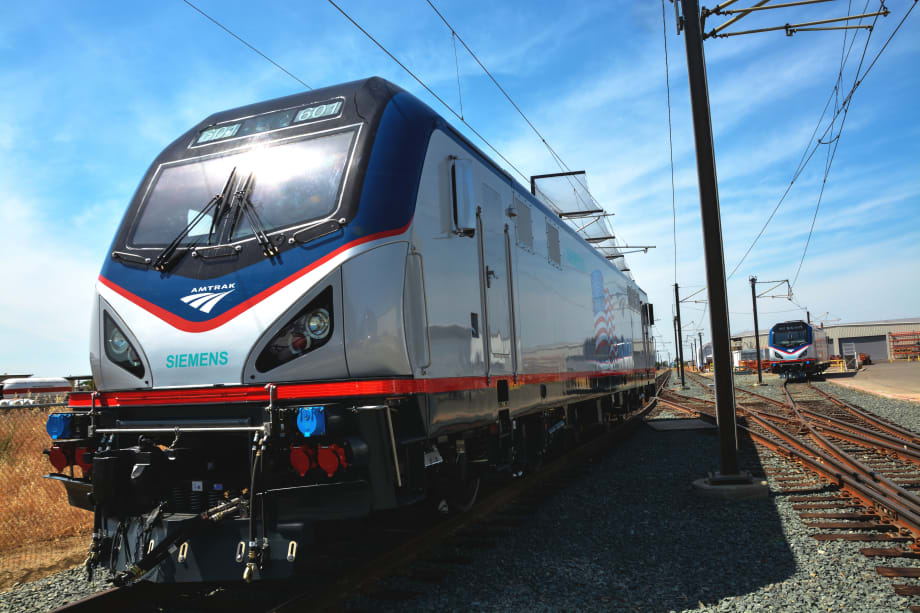
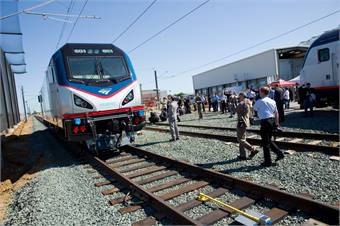
Amtrak's Siemens Sprinter locomotive. Photos courtesy Siemens.
Amtrak's Siemens Sprinter locomotive. Photos courtesy Siemens.
A new era of more reliable and energy efficient Amtrak service for
Northeast intercity rail passengers is coming down the tracks as the first of 70 advanced technology electric locomotives being built by Siemens rolled off the assembly line.
The first units of the $466 million order will be field tested this summer for entry into revenue service in the fall.
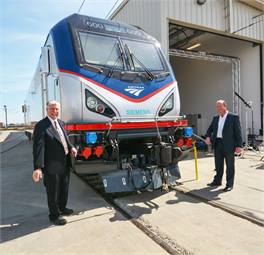
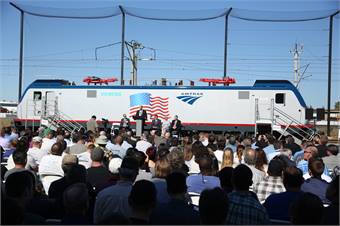
Amtrak President/CEO Michael Boardman and Siemens President Michael Cahill.
“The new Amtrak locomotives will help power the economic future of the Northeast region, provide more reliable and efficient service for passengers and support the rebirth of rail manufacturing in America,” said Amtrak President and CEO Joseph Boardman. “Built on the West Coast for service in the Northeast with suppliers from many states, businesses and workers from across the country are helping to modernize the locomotive fleet of America’s Railroad.”
Using Siemens’ innovative and proven rail technology, the Amtrak Cities Sprinter (ACS- 64) locomotives are being assembled in Siemens’ Sacramento, Calif., rail manufacturing plant powered by renewable energy, with parts built from its plants in Norwood, Ohio, Alpharetta,
Ga., and Richland, Miss., and nearly 70 suppliers, representing more than 60 cities and 23 states.
The new locomotives will operate on Northeast Regional trains at speeds up to 125 mph on the Northeast Corridor (NEC) along the Washington – New York – Boston route and on Keystone Service trains at speeds up to 110 mph on the Keystone Corridor from Philadelphia to Harrisburg, Pa. In addition, all long-distance trains operating on the NEC will be powered by the new locomotives.
“More and more Americans are parking their cars and choosing the comfort and convenience of trains, metros and streetcars as their preferred way of traveling. We’re proud of the innovations we’ve brought to passengers and commuters to expand their transportation options” said Michael Cahill, president of Siemens Rail Systems division in the U.S. “From downtown streetcar systems to regional, passenger rail lines, Siemens’ transportation solutions like the next-generation Amtrak locomotives enhance safety, boost efficiency and performance, and are built in America leveraging Siemens’ U.S. manufacturing hubs and supply chain.”
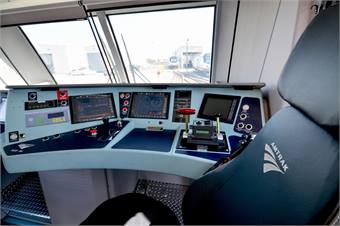
The new locomotives are designed for easier maintenance, will improve energy efficiency by using a regenerative braking system that will feed energy back into the power grid and will enhance mobility for the people, businesses and economy of the entire Northeast region. They also meet the latest federal rail safety regulations.
"We are committed to connecting people, communities and jobs. This project does all three," said Karen Hedlund, Deputy Federal Railroad Administrator. "Investing in manufacturing these 70 new locomotives are creating and preserving jobs in 60 cities across the country while meeting the growing demand for improved reliability and service along the Northeast and Keystone Corridors."
The first three locomotives will undergo a comprehensive testing program this summer, including two at a U.S. Department of Transportation facility in Pueblo, Colo., and one on the NEC. Once they are commissioned, production of the remaining units will ramp up for monthly delivery through 2016.
The new locomotives are part of a comprehensive Amtrak Fleet Strategy Plan to modernize and expand its equipment. The new units will replace electric locomotives that have between 25 and 35 years of service and average mileage of more than 3.5 million miles traveled with some approaching 4.5 million miles.
More Management

Everett Transit, Community Transit Outline Consolidation Agreement
The proposed agreement calls for a 50% increase in bus service in Everett, a new microtransit zone, continued paratransit service, and the transfer of Everett Transit operations to Community Transit.
Read More →
Strada360’s Steve Lassey on Turning Transit Data Into Better Decisions
From breaking down data silos to preparing for AI, Strada360 CEO Steve Lassey discusses how transit agencies can use technology to improve operations, customer information, and long-term decision-making.
Read More →
People Movement: Phil Washington Joins HNTB, Denver RTD Launches CEO Search, and More
In this edition, we also spotlight recent personnel moves at STV, the Eno Center for Transportation, and more, highlighting the people taking on new roles across the transportation industry.
Read More →

SEPTA Details Accelerate Vision for Transit System
The plan outlines investments in trolley modernization, new Metro and Regional Rail vehicles, accessible stations, and more frequent bus and rail service.
Read More →
FTA Ends Direct Oversight of MBTA Safety Actions
The federal agency closed its remaining special directive to the Massachusetts Department of Public Utilities following a safety review that began in 2022.
Read More →
Report: Transit Bus Manufacturing Supports 34,100 Jobs, $5.1B in GDP
The “Buses Mean Business” report examines the transit bus manufacturing industry’s economic footprint, supply chain, and rising demand for vehicle replacements.
Read More →
LIT Marks 10-Year Milestone at Annual Summit
Hosted by the COTA from September 10 to 13, the Summit carried the theme “Celebrating 10 Years of Excellence, Leadership, and Impact,” with every part of the program honoring the people, agencies, and partners who built LIT over its first decade.
Read More →
People Movement: Dan Dipert Coaches Adds Third-Generation Leader, Keolis Names New Valley Metro VP/GM, and More
In this edition, we also cover recent appointments and announcements at the Wabtec, SilverRide, HNTB, and more, showcasing the individuals helping to shape the future of transportation.
Read More →
METRO Opens Submissions for 2026 Motorcoach Awards
Nominations are now being accepted for METRO Magazine’s Operator of the Year and Innovative Operator of the Year awards.
Read More →
New York MTA Advances Final Contract for Second Avenue Subway Expansion
Contract Four is the largest in the Second Avenue Subway Phase 2 project and includes construction of station infrastructure, tracks, and signals for the subway expansion, MTA officials said. Work on Contract Four will begin in 2027.
Read More →