



Biz Briefs: Via, Hitachi Rail, and More
Biz Briefs covers the latest supplier news in the motorcoach and public transit industries.

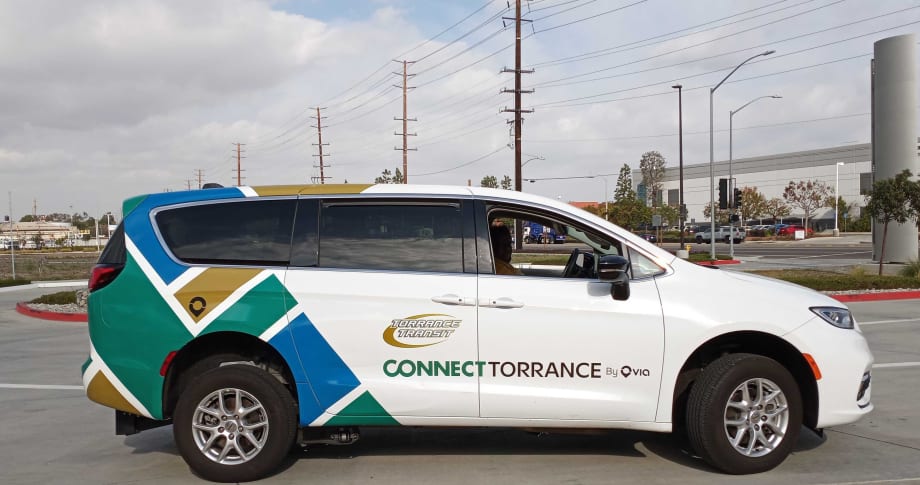
Connect Torrance serves key commercial and employment areas and is funded through a mix of LA Metro’s Measure M and R funds, the South Bay Cities COG, and Torrance Transit’s budget.
Photo: Via
In METRO's latest installment, we take a look at the latest news from suppliers including Masabi, Via, and more.
Photo: METRO
Biz Briefscovers the latest supplier news in the motorcoach and public transit industries.
In METRO's latest installment, we take a look at the latest news from suppliers including Masabi, Via, and more.
Madison’s Metro Transit, Masabi Launch Open Payments
Metro Transit in Madison, Wis., has expanded its fare system to include Open Payments. This allows riders to tap a contactless bank card or mobile wallet, such as Apple Pay or Google Pay, to board without buying a ticket or registering. The system also supports daily, weekly, and monthly fare capping.
The move reflects Metro Transit's ongoing push for convenience and efficiency. It was launched seven months after introducing Account-Based Ticketing (ABT) with Metro Fast Fare cards and a new mobile app. Riders can now pay using smartcards, mobile apps, or contactless payments, reducing cash use, streamlining boarding, and lowering operational costs.
Powered by Masabi’s Justride platform, the system integrates seamlessly with Metro Transit’s existing infrastructure. Onboard validators and multi-door boarding on BRT vehicles further reduce dwell times and improve service reliability across the network.
CATS Relaunches Vanpool Program with Enterprise Partnership
The Charlotte Area Transit System (CATS) has relaunched its vanpool program in partnership with Enterprise, offering residents and commuters a more convenient, flexible, and cost-effective transportation option in the greater Charlotte area.
The revamped program includes fuel-efficient vehicles, improved customer service, and a new “flexible” vanpool option for hybrid workers, allowing participants to pay per day when commuting.
Designed for groups of 4 to 15 people with similar routes and schedules, vanpools help reduce commuting costs while promoting shared mobility.
California’s Connect Torrance Expands Service
In partnership with Via, the City of Torrance, Calif., is expanding service hours and coverage for Connect Torrance, the city’s curb-to-curb on-demand transit program, following strong early results since its launch in December 2024.
Designed to provide a convenient, affordable alternative to private vehicle use, the service has earned 4.9 out of 5 stars from riders. Monthly ridership doubled between January and May; average pickup times were just 9.5 minutes. Operational efficiency has also improved, with declining ride and mile costs.
Connect Torrance serves key commercial and employment areas and is funded through a mix of LA Metro’s Measure M and R funds, the South Bay Cities COG, and Torrance Transit’s budget. The city continues refining service based on rider feedback, with expansion plans.
Hitachi Rail Completes ‘Most Complex Signaling Upgrade’ on London Underground
According to a company press release, Hitachi Rail has completed the most technically challenging phase of Transport for London’s Four Lines Modernization (4LM) project — its largest-ever signaling upgrade — on the Circle, District, Hammersmith & City, and Metropolitan lines.
The milestone centers on the Neasden Depot, the Underground’s largest, and required intricate integration between legacy interlocking systems and Hitachi’s Communications-Based Train Control (CBTC) technology. The deployment also included live testing with the Jubilee Line’s SelTrac system, all completed with real-time switching and minimal passenger disruption.
The 4LM program covers nearly 40% of the Tube network and is one of the world’s most complex signaling upgrades. It aims to improve reliability, frequency, and safety.
More Technology

From Hardware to Digital Partner: Luminator Charts Its Next Chapter
CEO Magnus Friberg discusses Luminator’s shift toward becoming a digital partner, the growing importance of software and interoperability, and how AI can help agencies improve operations and passenger experience.
Read More →
Beyond the Checklist: A Structured Approach to Transit Maintenance
Reliability-Centered Maintenance helps transit agencies move beyond routine checklists to focus limited resources on the assets and failures that have the greatest impact on safety, reliability, and service.
Read More →
NJ TRANSIT Advances Bus Technology Upgrades Across Statewide Fleet
More than 1,500 buses now feature upgraded technology designed to improve arrival predictions and provide free Wi-Fi, with deployment expected to reach nearly 2,000 buses by the end of 2026.
Read More →

Building a Flexible Path to Transit Electrification
John Hroncich discusses BAE Systems’ modular and scalable approach, lessons learned from decades of real-world operations, and how agencies can identify electrification strategies that fit their fleets.
Read More →
Biz Briefs: Alstom Lands Canadian Contract, LYT to Supply California TSP, and More
In METRO's latest installment, we take a look at recent news from Complete Coach Works, Beep, FlixBus, and more partnerships making headlines across the transportation sector.
Read More →
From Legacy Silos to Conversational Intelligence
What if transit leaders could ask any operational question and get a trusted answer in seconds? Conversational AI is transforming how agencies use their data.
Read More →
USDOT Announces Rail Vehicle Replacement Grants, Chattanooga AV Shuttle Funding
More than $191 million in federal funding will help three transit agencies replace aging rail vehicles and support a new autonomous shuttle service in Chattanooga.
Read More →
Bus Tech Talk: Keeping Transit Technicians Ahead of the Technology Curve
LA Metro’s Obed Mejia discusses technician training, evolving maintenance technology, fleet replacement, and strategies for getting the most out of today’s transit fleets.
Read More →
Biz Briefs: RIPTA Unveils New Frontrunners, Clevland RTA Adds New Siemens, and More
In METRO's latest installment, we take a look at recent news from Siemens, Prevost, Dodge, and more partnerships making headlines across the transportation sector.
Read More →
Why Simulating Pedestrian Movement Has Become Essential for Modern Rail Stations
Pedestrian microsimulation is helping rail planners identify bottlenecks, test station designs, and prepare complex transit hubs for growing passenger volumes.
Read More →