



Calif.'s GCTD breaks ground on ops, maintenance facility
The new facility will replace an outdated and deteriorating bus garage located on a three-acre site that was originally built in the 1970’s for a much smaller fleet.

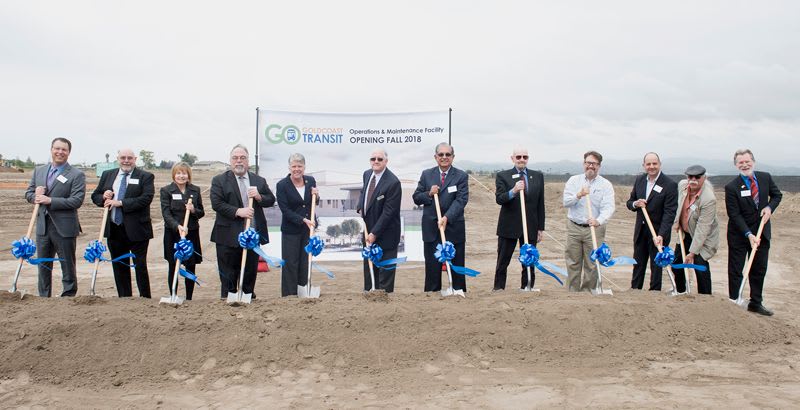
Officials at the GCTD groundbreaking event. Photo: GCTD
Officials at the GCTD groundbreaking event. Photo: GCTD
Gold Coast Transit District (GCTD), Ventura County, Calif.'s largest provider of public transit, broke ground on the future home of its new Operations and Maintenance facility that will support future transit needs for thousands of riders in Ventura County.
The new facility, expected to open in late 2018, will replace an outdated and deteriorating bus garage located on a three-acre site that was originally built in the 1970’s for a much smaller fleet. Once built, the new “green facility” will allow GCTD to maintain a future fleet of up to 125 buses and will include an administration and operations building, an eight-bay maintenance and repair building, a compressed natural gas (CNG) fuel station and bus wash.
Noted Darren Kettle, Executive Director of Ventura County Transportation Commission, “This is the largest transportation infrastructure project in the last 10 years.”
“We have to keep our buses, equipment and facilities in good shape so that people can rely on public transit to get to work, school and appointments,” said Steve Brown, GM. “This new facility is an example of how investing in transit will help us meet the needs of our riders for decades to come.” Brown specifically recognized Congresswoman Lois Capps for helping to secure a $15 million earmark grant that turned GCTD’s vision into a reality.
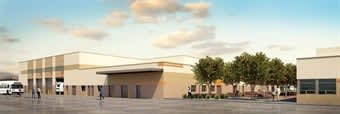
GCTD's new operations and maintenance facility (rendering shown) is expected to be LEED certified.
GCTD strives to be a leader in sustainable transportation service. With that in mind, the new facility, designed by architects Maintenance Design Group and RNL, will meet all California Green Building Standards Code (CALGreen) requirements and is expected to be Leadership in Energy and Environmental Design (LEED) certified.
Environmentally sensitive construction will include energy efficient lighting, low-flow water fixtures, and day-lighting for office areas and bus maintenance bays. The building is also being positioned and designed in such a way that will take maximum advantage of the sun and wind, helping to decrease lighting, heating and air conditioning costs. As the new facility will use 100% LED lighting, the costs will be comparable to the lighting costs at the current facility, though it will be three times in size.
More Management

METRO Opens Submissions for 2026 Motorcoach Awards
Nominations are now being accepted for METRO Magazine’s Operator of the Year and Innovative Operator of the Year awards.
Read More →
New York MTA Advances Final Contract for Second Avenue Subway Expansion
Contract Four is the largest in the Second Avenue Subway Phase 2 project and includes construction of station infrastructure, tracks, and signals for the subway expansion, MTA officials said. Work on Contract Four will begin in 2027.
Read More →
Transit Agencies Highlight Safety Gains at National Summit
Leaders from 15 major transit systems shared crime-reduction results and safety initiatives while discussing the role of continued federal support.
Read More →

NITA Names New Leadership, Expands Reduced-Fare Program at First Board Meeting
The new regional transit authority appointed its first board chair and interim executive director while extending reduced fares across CTA, Metra, and Pace for eligible riders.
Read More →
Beyond the Checklist: A Structured Approach to Transit Maintenance
Reliability-Centered Maintenance helps transit agencies move beyond routine checklists to focus limited resources on the assets and failures that have the greatest impact on safety, reliability, and service.
Read More →
APTA 2026 Nominating Committee Selects Leadership Slate, Names Chair and Vice Chair Nominees
Leadership changes will help shape the association’s priorities and its representation of the transportation industry during the 2026–2027 term.
Read More →
DART Launches Major Security, Fare Enforcement Initiative
The 90-day demonstration will deploy coordinated security teams at five light rail stations while testing controlled access and gathering data to guide future investments.
Read More →
Advancing Fare Collection Through Technology and Innovation
Learn about delivering 1300 gates at 91 stations while managing fare evasion. Explore the large scale deployment, solution customization and real-world results that affect the region. Prepare for deployment in your region now.
Read More →
Game Day in Motion: Moving Millions During the 2026 World Cup
Between packed transit stations and team motorcoaches, see how agencies and operators across North America tackled the transportation demands of the 2026 FIFA World Cup.
Read More →
Surface Transportation Extension Averts Shutdown, Leaves Transit Funding Gap
The stopgap keeps federal transportation programs moving, but missing advance funding could complicate the transit and rail projects agencies are planning next.
Read More →