



Chicago Set to Add Service on 30 Bus Routes
The changes to the bus schedules will be implemented as part of the agency’s scheduling process, whereby bus employees are able to “pick” their work assignments at designated times throughout the year.

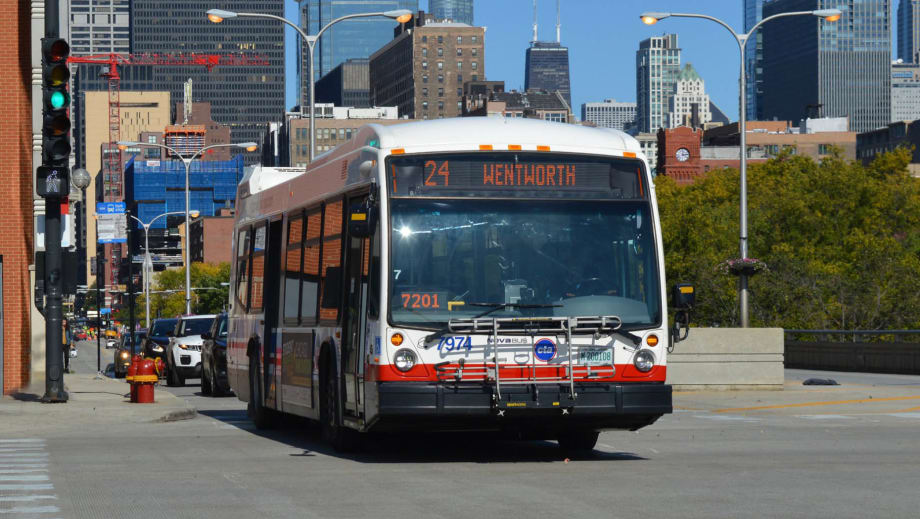
Starting March 24, 29 Chicago Transit Authority bus routes will return to near pre-COVID-19 scheduled service levels.
Photo: CTA/Nova Bus
Chicago Transit Authority (CTA) customers will see more scheduled bus service across the system in the coming weeks — the latest step in the agency’s efforts to better serve customers across the region with improved service.
Nearly 30 bus routes will receive additional service in the coming weeks, as CTA continues an aggressive recruitment and hiring effort to add the staff needed to provide more service.
The changes to the bus schedules will be implemented as part of the agency’s scheduling process, whereby bus employees are able to “pick” their work assignments at designated times throughout the year. The scheduling process is included in the collective bargaining agreement with union representing bus employees.
“This new service is a down payment on our commitment to bring service back to pre-pandemic scheduled service levels,” said CTA President Dorval R. Carter Jr. “And while this additional service will definitely benefit our customers, our job is not done — we know we have much more work to do and we’re committed to it.”
CTA’s Bus Route Changes
Starting March 24, 29 bus routes will return to near pre-COVID-19 scheduled service levels. The agency is targeting a diverse network of bus routes that have recently experienced strong ridership recovery and provide a critical transit network throughout Chicago.
Most of the new services will be introduced during weekdays, with additional Saturday service on a couple of routes.
The scheduled bus service improvements in 2024 will continue to be based on expected bus operator hiring trends. CTA is telling its customers to expect improved service when new schedules go into effect, but the agency will take every opportunity to make additional schedule changes as personnel are added to the workforce throughout the "pick," which will continue to improve service delivery.
Looking at Adding Rail Service Too
Later this spring, CTA will look to make improvements to scheduled rail service as new operators are added to revenue service following the successful completion of their training.
Throughout the spring and summer, rail services will be added where demand is greatest, namely during the morning and afternoon rush periods on weekdays along the Red, Green, Brown, and Purple lines, as well as the O’Hare Branch of the Blue Line.
CTA has made significant progress in hiring new bus and rail operators to address workforce shortages and the usual trends of attrition. CTA plans to train up to 200 new operators, double the number in 2023.
On the bus side, CTA hired 1,000 new bus operators in 2023 to get very close to its optimal staffing levels. CTA will continue to publish its staffing levels — along with many other measures of agency performance — at transitchicago.com/performance.
More Management

METRO Opens Submissions for 2026 Motorcoach Awards
Nominations are now being accepted for METRO Magazine’s Operator of the Year and Innovative Operator of the Year awards.
Read More →
New York MTA Advances Final Contract for Second Avenue Subway Expansion
Contract Four is the largest in the Second Avenue Subway Phase 2 project and includes construction of station infrastructure, tracks, and signals for the subway expansion, MTA officials said. Work on Contract Four will begin in 2027.
Read More →
Transit Agencies Highlight Safety Gains at National Summit
Leaders from 15 major transit systems shared crime-reduction results and safety initiatives while discussing the role of continued federal support.
Read More →

NITA Names New Leadership, Expands Reduced-Fare Program at First Board Meeting
The new regional transit authority appointed its first board chair and interim executive director while extending reduced fares across CTA, Metra, and Pace for eligible riders.
Read More →
Beyond the Checklist: A Structured Approach to Transit Maintenance
Reliability-Centered Maintenance helps transit agencies move beyond routine checklists to focus limited resources on the assets and failures that have the greatest impact on safety, reliability, and service.
Read More →
APTA 2026 Nominating Committee Selects Leadership Slate, Names Chair and Vice Chair Nominees
Leadership changes will help shape the association’s priorities and its representation of the transportation industry during the 2026–2027 term.
Read More →
DART Launches Major Security, Fare Enforcement Initiative
The 90-day demonstration will deploy coordinated security teams at five light rail stations while testing controlled access and gathering data to guide future investments.
Read More →
Advancing Fare Collection Through Technology and Innovation
Learn about delivering 1300 gates at 91 stations while managing fare evasion. Explore the large scale deployment, solution customization and real-world results that affect the region. Prepare for deployment in your region now.
Read More →
Game Day in Motion: Moving Millions During the 2026 World Cup
Between packed transit stations and team motorcoaches, see how agencies and operators across North America tackled the transportation demands of the 2026 FIFA World Cup.
Read More →
Surface Transportation Extension Averts Shutdown, Leaves Transit Funding Gap
The stopgap keeps federal transportation programs moving, but missing advance funding could complicate the transit and rail projects agencies are planning next.
Read More →