




RELATED: University Transportation Centers get $300M in grants
Current planning, funding won't meet future transportation demands: report
The Beyond Traffic 2045 report is a comprehensive study of the major trends that will shape our nation’s transportation system over the next thirty years.
January 10, 2017
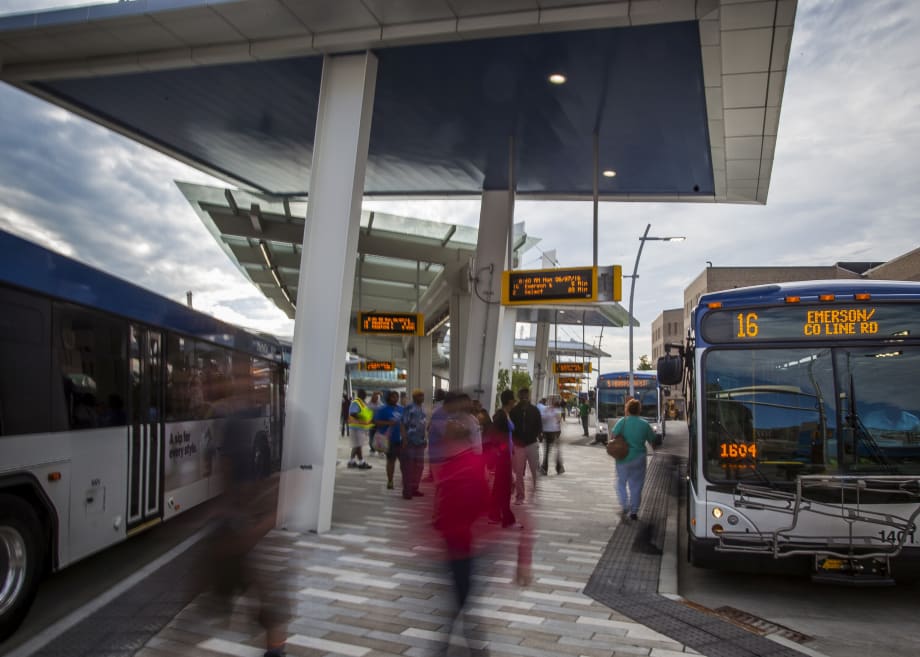
Indianapolis Transit Center. Photo: Axis Architecture and Interiors
4 min to read
Indianapolis Transit Center. Photo: Axis Architecture and Interiors
The U.S. transportation system, and the current planning and funding mechanisms, will not meet the demands presented by trends including population growth, climate change, and new technologies like driverless cars, according to a new federal report. Transportation Secretary Anthony Foxx on Monday, released the final Beyond Traffic 2045 report highlighting transportation challenges the U.S. will face over the next three decades.
“Beyond Traffic started a long overdue conversation about the whether our transportation infrastructure will keep pace with our changing country,” said Secretary Foxx. “The final report again shows that if we do not invest in our infrastructure, we will let conditions move us backwards.”
Beyond Traffic 2045 was the product of more than two years of research and study by the U.S. Department of Transportation (U.S. DOT). Secretary Foxx and U.S. DOT leaders also held public meetings in eleven cities across the country in late 2015 to explore the challenges facing each of the emerging megaregions.
The report is a comprehensive study of the major trends that will shape our nation’s transportation system over the next thirty years. The report looks at broader trends, such as population growth and increasing freight volume, as well as issues of economic opportunity, transportation funding, and emerging technologies, to identify the key transportation challenges that the U.S. will face.
Questions and trends explored in Beyond Traffic 2045 include:
How we move – America’s population is expected to grow by 70 million by 2045, and by 2050, three-quarters of Americans could live in eleven emerging megaregions – larger geographic clusters in spanning multiple cities and communities.
How we move things – Freight volume is expected to increase by more than 40 percent, partly driven online shopping, adding extra demand to our transportation networks.
How we adapt – Predicted rises in global temperatures and mean sea levels, and more frequent and intense storm events, could drastically affect highways, bridges, public transportation, coastal ports, and waterways.
How we move better – Automation and robotics will affect all modes of transportation, improving infrastructure maintenance and travel safety, and enabling the mainstream use of autonomous vehicles.
How we grow opportunity – Middle- and low-income American households spend, on average, nearly 20% of their income on transportation and 40% on housing — higher shares than for wealthier Americans.
How we align decisions and dollars – Federal gasoline-tax revenues have failed to keep up with our transportation needs and could decline further as vehicle fuel efficiency improves, and inflation further erodes purchasing power.
As the title suggests, one of the key issues examined in Beyond Traffic 2045 is the cost of increasing traffic congestion. It finds that the average American driver in a city or a suburb will spend an entire work week sitting in traffic, the annual cost of congestion delays and lost fuel is $160 billion, and that truck congestion alone will cost $28 billion in wasted time and fuel this year.
In his introduction to the report, Secretary Foxx outlines three strategies that need to be employed to ensure that America is able to meet the challenges of the next 30 years:
Take better care of our legacy transportation systems to keep our roads, bridges, and ports in good repair.
Fund and prioritize new projects based on future projections, not outdated models of how people moved in the past.
Use technologies and better design approaches that will allow us to maximize the use of our old and new transportation assets.
DOT Designates Beyond Traffic Innovation Centers
In conjunction with the release of Beyond Traffic 2045, Secretary Foxx designated 18 Beyond Traffic Innovation Centers across the country to lead research on the transportation challenges outlined in the report. The centers are non-profit institutions of higher education and non-profit organizations, which convene leaders and other key decision-makers in each of eleven megaregions around the U.S., as well as in rural communities, to discuss these challenges and coordinate related research, curriculum, outreach, and other activities.
Beyond Traffic Innovation Centers:
Cascadia/Pacific Northwest megaregion: University of Washington
Florida megaregion: Florida International University
Front Range megaregion: University of Denver
Great Lakes/Midwest megaregion: Center for Neighborhood Technology, Ohio State University and University of Michigan
Gulf Coast megaregion: Texas Southern University
Northeastern megaregion: Northeastern University and Rutgers University
Mid-Atlantic megaregion: University of Virginia
Northern California megaregion: University of California, Berkeley
Southern California megaregion: California State University, San Bernardino
Piedmont/Southern megaregion: Clemson University
Sun Corridor megaregion: University of Arizona
Texas Triangle megaregion: University of Texas, Austin
Centers serving rural areas: Montana State University, University of Alaska-Fairbanks, and Michigan Tech University
The full list of Beyond Traffic Innovation Centers and more information about Beyond Traffic 2045 is available at: www.transportation.gov/beyondtraffic.
More Management

METRO Opens Submissions for 2026 Motorcoach Awards
Nominations are now being accepted for METRO Magazine’s Operator of the Year and Innovative Operator of the Year awards.
Read More →
New York MTA Advances Final Contract for Second Avenue Subway Expansion
Contract Four is the largest in the Second Avenue Subway Phase 2 project and includes construction of station infrastructure, tracks, and signals for the subway expansion, MTA officials said. Work on Contract Four will begin in 2027.
Read More →
Transit Agencies Highlight Safety Gains at National Summit
Leaders from 15 major transit systems shared crime-reduction results and safety initiatives while discussing the role of continued federal support.
Read More →

NITA Names New Leadership, Expands Reduced-Fare Program at First Board Meeting
The new regional transit authority appointed its first board chair and interim executive director while extending reduced fares across CTA, Metra, and Pace for eligible riders.
Read More →
Beyond the Checklist: A Structured Approach to Transit Maintenance
Reliability-Centered Maintenance helps transit agencies move beyond routine checklists to focus limited resources on the assets and failures that have the greatest impact on safety, reliability, and service.
Read More →
APTA 2026 Nominating Committee Selects Leadership Slate, Names Chair and Vice Chair Nominees
Leadership changes will help shape the association’s priorities and its representation of the transportation industry during the 2026–2027 term.
Read More →
DART Launches Major Security, Fare Enforcement Initiative
The 90-day demonstration will deploy coordinated security teams at five light rail stations while testing controlled access and gathering data to guide future investments.
Read More →
Sponsored•September 9, 2026
Advancing Fare Collection Through Technology and Innovation
Learn about delivering 1300 gates at 91 stations while managing fare evasion. Explore the large scale deployment, solution customization and real-world results that affect the region. Prepare for deployment in your region now.
Read More →
Game Day in Motion: Moving Millions During the 2026 World Cup
Between packed transit stations and team motorcoaches, see how agencies and operators across North America tackled the transportation demands of the 2026 FIFA World Cup.
Read More →
Surface Transportation Extension Averts Shutdown, Leaves Transit Funding Gap
The stopgap keeps federal transportation programs moving, but missing advance funding could complicate the transit and rail projects agencies are planning next.
Read More →