



[Exclusive] After several months, is London Night Tube service working?
In many ways the results of this overnight Tube service is not remarkable to the casual visitor, or new resident in London. This is a large and busy city, and many people depend on public transport as the only logical means of travelling around.

![[Exclusive] After several months, is London Night Tube service working?](https://assets.bobitstudios.com/image/upload/f_auto,q_auto,dpr_auto,c_limit,w_920/TfL-NewTube-TfL-6_1768143783571_d6qksh.jpg)
TfL
TfL
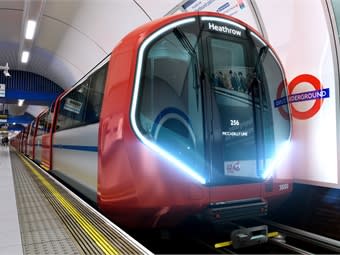
After many years of proposals, debates, and discussions, overnight Underground (Tube) service began in London in late summer 2016. Service is limited to overnight on Friday and Saturday and includes selected lines. By December 2016, overnight services were in operation on the Central (most of), the entire Victoria, the entire Jubilee, the Northern (excluding the branch via Bank in the City), and the majority of the Piccadilly lines. Services run approximately every 10 minutes from the usual service closing time between 12:30 a.m. and 1 a.m. through the night, until the typical service start times around 6 a.m. on Saturday mornings or 7 a.m. on Sunday mornings. Stations remain staffed and standard Oyster and contactless cards can be used for payment at the standard rates. Otherwise, it is a normal, albeit less frequent, Underground service.
The remaining Underground lines and part of the Transport for London-controlled (TfL) Overground service are also planned to offer overnight service in due course. This includes the District, Hammersmith & City, and Bakerloo lines, but this is awaiting the completion of significant signaling, track, and station upgrade work.
In many ways the results of this overnight Tube service is not remarkable to the casual visitor, or new resident in London. This is a large and busy city, and many people depend on public transport as the only logical means of travelling around. Night time activity, particularly in the West End and Shoreditch, is a vibrant and significant part of the overall London economy. Also, the public transport network is a core means of enabling late, and early morning, workers to get to and from their jobs across the city. Onward, early morning travel from London’s airports and railways are also enabled by these services.
Service launch
The service was launched several months later than planned, following a wave of directly related labor strikes by train drivers and station staff in the summer of 2016. It is also the culmination of over a decade of multi-billion pound investment in London’s public transport infrastructure to get the infrastructure to a position where the assets were in a state where a number of overnight periods could be used for passenger service.
The starting point for this story, though, is the long-held assumption that the Underground simply could not offer overnight service. For many decades, the system had been starved of investment and struggled to provide reliable service in the core operating hours. The overnight periods were used for extensive amounts of maintenance and cleaning that were needed to keep the fragile systems functioning. Let alone, was it considered wise to place more strains on these systems by offering up more service in these overnight periods. It should also be remembered that the London Underground deep level lines use a very restricted tunnel size — hence the colloquial name “Tube.” The dimensions for the tunnels provide no room for staff access adjacent to the train path. Thus, there is no potential to have staff work on track assets during service hours. The line must be fully closed and powered off for any maintenance access.
London also operates Underground services in shallow surface cuttings or tunnels as well as above ground. These shallow surface lines are known as the “sub-surface” lines and include all of the District, Hammersmith & City, Metropolitan, and Circle lines. Large suburban parts of the other lines, such as the Northern, Piccadilly, Bakerloo, and Central lines, are above ground. On these lines, there is the potential for maintenance during service hours, but TfL’s operating model confines most maintenance to overnight periods, as well as line closures.
City-wide government was re-established in London in 2000, with the election of the first London-wide Mayor and the establishment of Transport for London under his control. This recreated a link between local political desires and the operation of the city’s public transport system. An early Mayoral priority was winning more funding from the national UK government to modernize the public transport system, and particularly the Underground, which had become a persistent source of embarrassment and irritation to Londoners.
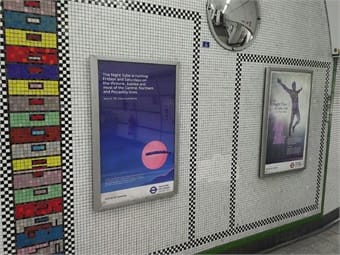
London Night Tube promotional posters – Tottenham Court Road Station.
This goal was achieved in the mid-2000s and thereupon began a series of massive investments into the system. It is hard to imagine now, if not recall, how unreliable the Underground used to be by the late 1990s. Any journey simply had to include an element for “delays.” Several billions of pounds later of investment on new trains, signaling, tracks, station refurbishments, ticketing systems, and the resulting closures of large parts of the network on weekends over many months at a time has led to the current much more reliable and efficient service. The pinnacle of the system’s operational reliability was reached during the Olympic Games in 2012, when all-time system peak loads were carried. London has since continued to grow in population and employment and new system peak loads have since been reached.
The focus on the maintenance of the Underground system, as well as innovative management at TfL, has allowed more efficiency to be brought to these processes. This has subsequently revealed that a modern Underground service could still be delivered while releasing the overnight periods on weekends.
Beyond the issues of maintenance and reliability, there are also assumptions about the demand for such a late night service and the question as to whether it would it be an effective use of the public transport assets. Furthermore, would late night users be more likely to abuse the system and cause increased levels of public disturbance? Since 2000, ridership on the Underground after 10 p.m. has increased at twice the rate of the average all-day demand. Also, the demand on the 100-plus routes of the Night Bus network has increased by over 170%.
Setting up service
Modifications to the system in order to deliver the Night tube have included flow control gates in certain interchange stations to prevent late night access to lines that were not part of the Night Tube service, as well as the recruitment of part time train drivers and station staff to support the late night operation.
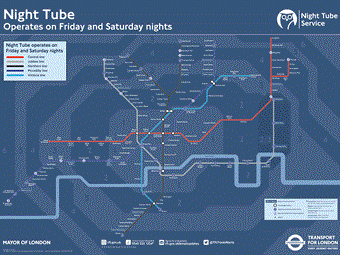
Night Tube map.
It should also be noted that with the exception of a few services, most of the extensive national rail lines in the London area do not provide overnight service. The model for maintenance on these lines results in these overnight periods being reserved for maintenance activities.
As part of the Night Tube service, London Buses reviewed their extensive Night Bus network to support late night transport to and from the now served Tube stations and to consider removing or reducing service on some of the most frequent routes that paralleled Underground lines. Over 30 routes were modified or considered for modification, but importantly, TfL decided to continue to offer customers the choice of using the extensive late-night bus network or the Night Tube in many circumstances, and in essence, grow the overall market for late night transport.
A mode of transport that has certainly been impacted by the Night Tube would be the taxi trade — both black cabs as well as private hire. The Night Tube offers an attractive alternative to journeys, particularly from the central area, that would have otherwise been tempted to use taxis.
An early concern about anti-social behavior on the new services has not been a major issue, due the involvement of the British Transport Police (the dedicated national railway police force in the UK) in the development and roll out of the service.
A further concern from TfL as well as local residents was the light night noise from train service, as well as customers at stations. Much of the Tube network is above ground and immediately adjacent to residential areas. And, many of the tunnels pass beneath densely populated residential areas. The above mentioned rebuilding program has offered London Underground the opportunity to significantly improve the general state of their infrastructure and they have also used this to reduce the noise profile of the system. This work continues. Additionally, new policies have been put in place to minimize platform noise at above ground stations in residential areas.
The proposal to offer overnight service on the Underground eventually became a political issue in the London Mayoral elections. While it would take a long time to deliver, it was part of the election campaigns in May 2012 and 2016. The implementation of the Night Tube was finally announced in late 2013. The Mayoral pressure was a key element in getting the service finally launched last year, and sooner than it may have otherwise happened if it was only related to technical issues.
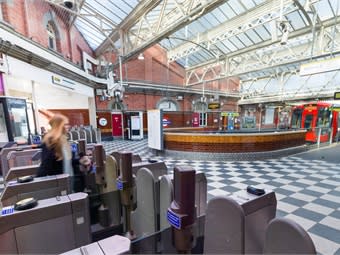
Hammersmith station.
TfL
It had been predicted that 163,000 trips per weekend would be made on the new service. However, by late 2016, over 225,000 trips were being made per weekend.
But, as a long-time resident of London who particularly enjoys the freedom from owning a car that this city offers, what does the Night Tube personally mean? TfL was very active in promoting the commencement of the late-night services via its extensive media and communication channels in 2016. Awareness of these new services was high, even if you didn’t consider yourself in the immediate market for a Tube trip in the middle of the night on a weekend.
Testing it out
While I’m not a regular overnight traveler on the public transport system, a journey home on a Saturday night a few weeks ago demonstrated the powerful impact of the Night Tube as part of the integrated and 24-hour public transport network in this city. While for a number of years I have had excellent overnight 10 minute frequency direct bus service from the West End to my home in southwest London, as part of the expansion and improvement of bus services in the city, I decided to take the Tube via an alternative route at about 2 a.m. from Waterloo station in central London. If anything, the whole experience was perfectly non-eventful. Entering the station using my standard Oyster card and walking downstairs to the still quite busy platforms, I just missed a Northern line train. The next train was indicated as being in less than 10 minutes and arrived quite full with many customers alighting at the station. The Northern Line is known as “always” being busy. Customers were standing in the rather crowded train for at least the next six to seven stations and well into south London. Upon arrival at the penultimate station for a short bus ride home, there were several dozen people leaving the Tube station. The bus stop “countdown” sign indicated several night buses would be arriving in the next 10 minutes — a mix of buses that paralleled the Northern Line, as well as other pre-Night Tube bus routes. At 2:30 a.m. in outer London, it was a busy street scene of night buses, taxis, people walking, and a few late-night shops still open. I was home, 45 minutes after boarding the Tube at Waterloo. While the Night Tube is a long time in arriving in this city, this early morning journey was a completely uneventful, but very convenient experience.
Giles K. Bailey is a director at Stratageeb Ltd., a London based consultancy assisting businesses think about their strategic vision and innovation.
More New Mobility

From Hardware to Digital Partner: Luminator Charts Its Next Chapter
CEO Magnus Friberg discusses Luminator’s shift toward becoming a digital partner, the growing importance of software and interoperability, and how AI can help agencies improve operations and passenger experience.
Read More →
Biz Briefs: Alstom Lands Canadian Contract, LYT to Supply California TSP, and More
In METRO's latest installment, we take a look at recent news from Complete Coach Works, Beep, FlixBus, and more partnerships making headlines across the transportation sector.
Read More →
CharterUP’s Armir Harris on Technology, AI, and the Future of Group Mobility
In a recent episode of METROspectives, CharterUP Founder/CEO Armir Harris discussed the company’s evolution from an online charter bus marketplace into a technology platform supporting public- and private-sector mobility and much more.
Read More →
Jacksonville’s NAVI Project Charts a New Course for Autonomous Public Transportation
Through its NAVI program, JTA is showing how autonomous vehicles, intelligent infrastructure, and coordinated operations can work together to deliver everyday public transportation.
Read More →
Biz Briefs: Luminator Marks Milestone and More
From manufacturers and suppliers to transit agencies and motorcoach operators, these updates offer a snapshot of the projects, partnerships and business moves driving the industry forward.
Read More →
New Tricks for Old Bureaucracies: Joshua Schank on Making Transit Innovation Stick
Former LA Metro Chief Innovation Officer Joshua Schank discusses why good ideas aren't enough, how transit agencies can overcome resistance to change, and why today's challenges demand more innovation.
Read More →
How DART's GoPass Is Redefining Regional Mobility
Serving 14 transit agencies, GoPass simplifies multimodal travel by allowing riders to plan, pay for, and manage an entire trip through one app.
Read More →
Biz Briefs: OCTA Taps Clean Energy for Hydrogen Station, Stadler to Supply Via Rail Vehicles, and More
From manufacturers and suppliers to transit agencies and motorcoach operators, these updates offer a snapshot of the projects, partnerships and business moves driving the industry forward.
Read More →CharterUP Expands Into New Mobility and Autonomous Transportation
Vice President of New Mobility Stephen Joos discusses how CharterUP is leveraging its nationwide transportation network, technology platform, and autonomous vehicle partnerships to expand into workforce mobility, campus shuttles, and transit solutions.
Read More →
METRO Magazine Announces 2026 Innovative Solutions Awards Winners
Projects Recognized for Advancing Mobility Through Technology, Accessibility, Workforce Innovation, and Operational Excellence
Read More →