FTA Report Finds Public Transit Ridership Up 17% Nationwide in 2023
The increase reflects more Americans choosing to take buses, subways, light rail, and other modes to travel to work, school, services, and weekend activities across the country and came as transit agencies better understood ridership needs following travel pattern changes during the pandemic.
The 2023 National Transit Summary and Trends report provides an annual snapshot of public transportation based on data submitted by 3,000 transit agencies to the National Transit Database.
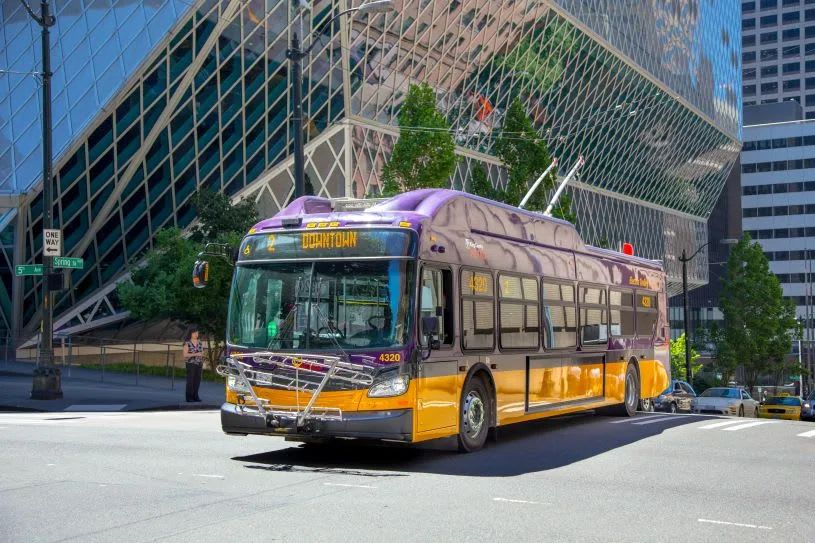
Photo: King County Metro
3 min to read
According to a recent Federal Transit Administration (FTA) report on transit trends, ridership in the U.S. continues to increase, growing by more than 17% nationwide from 2022 to 2023.
The increase reflects more Americans choosing to take buses, subways, light rail, and other modes to travel to work, school, services, and weekend activities across the country and came as transit agencies better understood ridership needs following travel pattern changes during the pandemic.
Ad Loading...
Overall U.S. Numbers
Transit agencies provided 6.9 billion trips, an increase of 17.3% from 2022. Those same transit agencies moved passengers 35 billion miles, an increase of almost 17% from 2022.
With that year-over-year-growth, public transportation grew nearly twice as fast as domestic air travel between 2022 and 2023, the most recent year national transit reports were recorded.
“Our nation’s public transportation systems continue to punch above their weight, providing billions of trips covering billions of miles for millions of people all across our nation,” said FTA Deputy Administrator Veronica Vanterpool. “This report shows an upward trend in people using transit, which provides many benefits, including less time wasted in traffic, fewer carbon emissions and better air quality.”
Providing Job Opportunities
In the past year, 10,000 new workers have entered the transit industry, and salaries have increased more than $1 billion.
At the end of 2023, more than 388,000 people worked in public transportation, filling jobs in operations, maintenance, and administration.
Ad Loading...
The growth rate for jobs in the transit industry exceeds other occupations. Between 2022 and 2023, the number of transit jobs grew by 4%, while growth in all occupations across the country was 2% for the same period.
The growth rate for jobs in the transit industry exceeds other occupations. Between 2022 and 2023, the number of transit jobs grew by 4%, while growth in all occupations across the country was 2% for the same period.
Photo: SORTA
Report Details
The 2023 National Transit Summary and Trends report provides an annual snapshot of public transportation based on data submitted by 3,000 transit agencies to the National Transit Database (NTD).
Reporting comes from federally supported transit systems, which report metrics regularly during the year for the report that comes out each fall. Congress established the NTD in 1974 to support local and state planning efforts.
The transit data offers a window into travel trends, workforce data, and transit system conditions.
The 3,000 transit providers operate all over the country, from large metropolitan regions to small urban places and rural areas. While most transit trips occur in large urban regions where transit helps manage traffic congestion and supports walkable communities, nearly one-third of transit trips (28%) are taken in smaller urban and rural areas.
Ad Loading...
High-capacity transit systems like light rail and bus rapid transit (BRT) increased substantially between 2013 and 2023. Transit rail miles increased by 12%, and miles traveled via BRT gained 44%, the largest increase among transit modes. The increase reflects the introduction of several new BRT systems.
Finding Trends
The report, which also analyzes trends over the last decade, found that between 2013 and 2023, the number of zero-emission buses increased four-fold.
The report also shows a significant increase in improving accessibility for people with disabilities.
In 2023, nearly 84% of the nation’s transit stations were considered fully accessible per the Americans with Disabilities Act — stations that include modifications such as platforms for level boarding and ramps — an increase of 4.6% over the last decade.
Contract Four is the largest in the Second Avenue Subway Phase 2 project and includes construction of station infrastructure, tracks, and signals for the subway expansion, MTA officials said. Work on Contract Four will begin in 2027.
The new regional transit authority appointed its first board chair and interim executive director while extending reduced fares across CTA, Metra, and Pace for eligible riders.
Reliability-Centered Maintenance helps transit agencies move beyond routine checklists to focus limited resources on the assets and failures that have the greatest impact on safety, reliability, and service.
The 90-day demonstration will deploy coordinated security teams at five light rail stations while testing controlled access and gathering data to guide future investments.
Learn about delivering 1300 gates at 91 stations while managing fare evasion. Explore the large scale deployment, solution customization and real-world results that affect the region. Prepare for deployment in your region now.
Between packed transit stations and team motorcoaches, see how agencies and operators across North America tackled the transportation demands of the 2026 FIFA World Cup.
The stopgap keeps federal transportation programs moving, but missing advance funding could complicate the transit and rail projects agencies are planning next.