



Los Angeles Union Station marks 80th Anniversary
First commissioned in 1933, Union Station was designed by father and son architect team of John and Donald Parkinson.

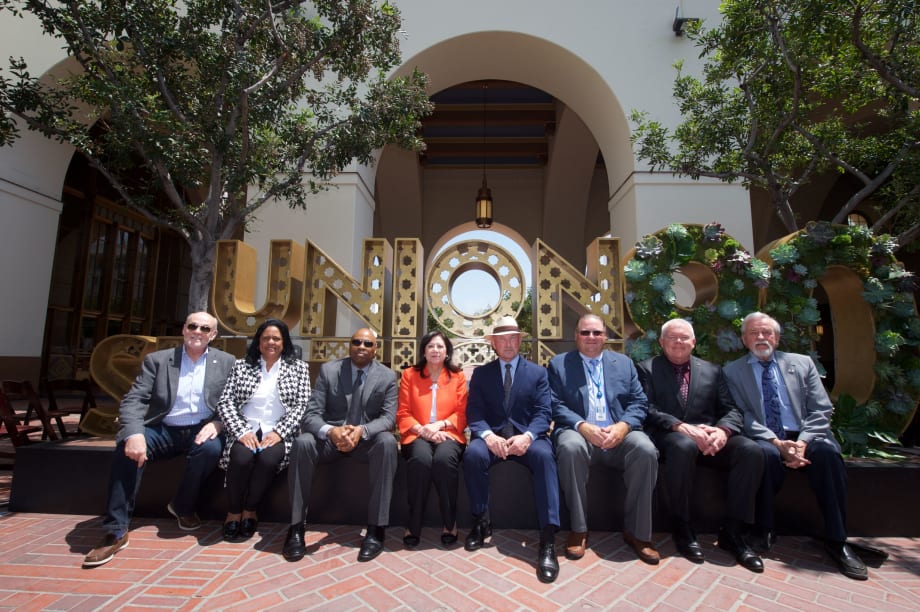
Los Angeles Metro CEO Phil Washington (third from left) was joined by elected officials and representatives from Metrolink, Amtrak, and Caltrans to mark the milestone.
LA Metro
Los Angeles Metro CEO Phil Washington (third from left) was joined by elected officials and representatives from Metrolink, Amtrak, and Caltrans to mark the milestone.
LA Metro
Elected officials, Los Angeles County Metropolitan Transportation Authority (Metro), Metrolink, Amtrak, and Caltrans executives and stakeholders celebrated Los Angeles Union Station’s 80th Anniversary. The “last of the great railway stations” opened its doors to the public on May 3, 1939.
First commissioned in 1933, Union Station was designed by father and son architect team of John and Donald Parkinson with an innovative blend of Spanish Colonial, Mission Revival, and Art Deco architecture now referred to as Mission Modern. The cost, $11 million.
Union Station began its journey servicing 33 trains and 7,000 passengers per day and has evolved into a vibrant transportation center in the heart of Los Angeles serving more than 100,000 passengers daily with 440 trains on 14 platforms.
This regional transportation hub houses Metro’s Red, Purple, and Gold lines’ Amtrak’ and Metrolink, while the Patsaouras Transit Plaza, in the East Portal area, offers essential bus connections with approximately 1,500 arriving and departing buses every day. Those services include Megabus, FlyAway, Greyhound and Bolt, USC Shuttle plus local service from Metro, and other municipal lines including Foothill Transit, Antelope Valley Transit Authority (AVTA), Santa Monica Big Blue Bus, LADOT Dash, and Orange County Transit Agency.
“Union Station’s regional connectivity embodies Metro’s transportation revolution,” said Metro CEO Phillip A. Washington. “The improvements to Union Station will significantly increase regional rail capacity, prioritize pedestrian and bicycle mobility, improve safety, and enhance the customer experience.”
Since acquiring the station in 2011, Metro has lead a $48.6 million comprehensive planning and restoration program to bring this magnificent train station back to its original glory and prepare for the future with improvements for passengers on a local and regional scale.
Metro has also incorporated amenities for active transportation, which include Metro Bike Share and a Metro Bike Hub with facilities for storing, repairing, or buying bicycle parts and accessories.
Restoration improvements include restoring the façade, wood and metal work at the station; an upgraded wayfinding signage program; a new heating, ventilation, and air condition system that includes an emergency power system; and expanded and improved public restrooms. Additionally, the Fred Harvey Room, closed since 1967, has once again opened its doors housing the Imperial Western Beer Company.
Metro’s Link US Project will play a critical role in transforming Union Station by extending the rail tracks over the 101 freeway to increase regional rail capacity and accommodate a future California High-Speed Rail system. The project also includes a new passenger concourse that will improve the design and management of public spaces with new plazas, transit, and retail amenities to enhance the customer experience.
Additionally, the 19-mile West Santa Ana Branch Light Rail Transit Corridor Project is studying an alternative to connect Union Station to the southeast cities of Los Angeles County. This light rail line is expected to connect with Metro’s Green and Blue Lines, Regional Connector, and the L.A. County regional transit network, serving transit-dependent commuters with a reliable and safe travel option.
Another key project includes the Union Station Forecourt and Esplanade improvements that will enhance safety and connectivity. The improvements will transform Union Station’s front door on the west side of the station by removing the existing surface parking lot and replacing it with a new civic plaza, a new esplanade on Alameda Street for pedestrian and bicyclists and a new grand crossing between the station and El Pueblo, the birthplace of the City of Los Angeles.
More Management

METRO Opens Submissions for 2026 Motorcoach Awards
Nominations are now being accepted for METRO Magazine’s Operator of the Year and Innovative Operator of the Year awards.
Read More →
New York MTA Advances Final Contract for Second Avenue Subway Expansion
Contract Four is the largest in the Second Avenue Subway Phase 2 project and includes construction of station infrastructure, tracks, and signals for the subway expansion, MTA officials said. Work on Contract Four will begin in 2027.
Read More →
Transit Agencies Highlight Safety Gains at National Summit
Leaders from 15 major transit systems shared crime-reduction results and safety initiatives while discussing the role of continued federal support.
Read More →

NITA Names New Leadership, Expands Reduced-Fare Program at First Board Meeting
The new regional transit authority appointed its first board chair and interim executive director while extending reduced fares across CTA, Metra, and Pace for eligible riders.
Read More →
Beyond the Checklist: A Structured Approach to Transit Maintenance
Reliability-Centered Maintenance helps transit agencies move beyond routine checklists to focus limited resources on the assets and failures that have the greatest impact on safety, reliability, and service.
Read More →
APTA 2026 Nominating Committee Selects Leadership Slate, Names Chair and Vice Chair Nominees
Leadership changes will help shape the association’s priorities and its representation of the transportation industry during the 2026–2027 term.
Read More →
DART Launches Major Security, Fare Enforcement Initiative
The 90-day demonstration will deploy coordinated security teams at five light rail stations while testing controlled access and gathering data to guide future investments.
Read More →
Advancing Fare Collection Through Technology and Innovation
Learn about delivering 1300 gates at 91 stations while managing fare evasion. Explore the large scale deployment, solution customization and real-world results that affect the region. Prepare for deployment in your region now.
Read More →
Game Day in Motion: Moving Millions During the 2026 World Cup
Between packed transit stations and team motorcoaches, see how agencies and operators across North America tackled the transportation demands of the 2026 FIFA World Cup.
Read More →
Surface Transportation Extension Averts Shutdown, Leaves Transit Funding Gap
The stopgap keeps federal transportation programs moving, but missing advance funding could complicate the transit and rail projects agencies are planning next.
Read More →