



March Networks Unveils RideSafe XT with Sleep Mode
Purpose-built for the specific requirements of today's transportation industry, the new March Networks solution reduces security risk, keeps passengers and operators safer, and gathers more conclusive evidence than is possible today with legacy solutions, according to the company.

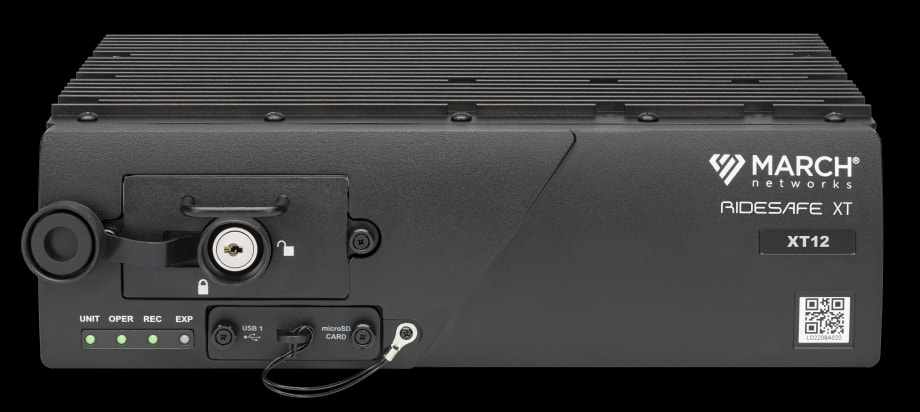
RideSafe XT uses the leading NVIDIA® System on Chip (SoC) technology and leverages a hardened Linux operating system (OS), which reduces the cyberattack footprint and offers end-to-end encryption to protect sensitive data.
March Networks
March Networks unveiled the new RideSafe XT IP NVR recording platform at APTA EXPO in Orlando, Fla.
RideSafe XT delivers a first-of-its-kind Sleep Mode capability enabled by artificial intelligence (AI) to help transit agencies eliminate damage and risk when buses are out of service.
"Vandalism is a common and expensive problem for transit agencies, as buses are often targeted while out of service and when they have no ability to record motion or unusual activity while powered down," said Net Payne, chief sales & marketing officer at March Networks. "Sleep Mode with March Networks' RideSafe XT is the first capability on the market to leverage AI video analytics to detect people near a vehicle and instantly begin recording, saving transit agencies potentially hundreds of thousands of dollars every year. RideSafe XT futureproofs a transit agency for all of its growing video and analytics needs."
The Latest from March Networks
Purpose-built for the specific requirements of today's transportation industry, the new March Networks solution reduces security risk, keeps passengers and operators safer, and gathers more conclusive evidence than is possible today with legacy solutions, according to the company.
Buses normally are equipped with legacy recorders and standard motion sensor timers, which cost $300 to $450 per unit, are powered by the bus battery, and are slow to initialize and record unusual activity. Often, perpetrators have moved to another side of the bus or out of the area altogether before cameras are triggered and recording begins.
RideSafe XT units, however, switch to low-power mode when buses are out of service and record directly to the NVRs SD card, based on configurable rules around parameters such as motion. This allows for around-the-clock recording coverage, with multiple cameras recording from multiple angles.
The accurate AI-enabled analytics detect the difference in motion of people versus animals or even weather, so that video is recorded only when necessary. Then, when the bus is returned to its full power state, video automatically synchronizes with the March Networks RideSafe XT network video recorder (NVR), which is available in 8, 12 and 16 channel models.
RideSafe XT
RideSafe XT uses the leading NVIDIA® System on Chip (SoC) technology and leverages a hardened Linux operating system (OS), which reduces the cyberattack footprint and offers end-to-end encryption to protect sensitive data. The plug-and-play solution can operate as a standalone unit that is programmable through embedded software, or it can be remotely managed and monitored through March Networks' Command for Transit video management solution (VMS), or other Transit Management Solutions (TMS).
The compact RideSafe XT, with its rugged design, includes solid-state storage, integrated power supply, and battery backup. It is also compliant with the U.S. National Defense Authorization Act (NDAA), adheres to SAE J1455 specifications, and provides IP65 protection from dust and moisture. The RideSafe XT NVR is available for all U.S. federal funding/projects.
More Security and Safety

Transit Agencies Highlight Safety Gains at National Summit
Leaders from 15 major transit systems shared crime-reduction results and safety initiatives while discussing the role of continued federal support.
Read More →
DART Launches Major Security, Fare Enforcement Initiative
The 90-day demonstration will deploy coordinated security teams at five light rail stations while testing controlled access and gathering data to guide future investments.
Read More →
RTD Launches NextRide App to Consolidate Trip Planning, Fares, Security Reporting
The app expands on RTD’s existing NextRide web application and allows customers to view real-time vehicle locations and service alerts, purchase and store digital fares, and access customer support.
Read More →

TAPTCO Updates OSHA Compliance Training for Transit Maintenance Operations
The revamped program addresses 26 OSHA standards for maintenance facilities, with TAPTCO pointing to training, documentation, and everyday shop hazards as continuing challenges for transit operations.
Read More →
How VaporVision Adds Value to Transit Door Systems
Wabtec engineers explain how the system improves doorway detection, strengthens diagnostics and gives transit agencies and OEMs greater operating flexibility.
Read More →
FRA Announces $5.3B in Rail Investments, Including $2B for Amtrak
Funding will support grade-crossing improvements, infrastructure upgrades, and new Amtrak equipment in 23 states.
Read More →
Chicago, Maryland Expand Non-Law-Enforcement Safety, Rider Support
The CTA and MTA are launching new programs aimed at de-escalation, crisis response, rider assistance, and greater transparency.
Read More →
LA Metro, City of West Hollywood, and Partners Advance Smarter Bus Lane Enforcement
The award-winning partnership combines AI-powered detection with human oversight to improve bus reliability, accessibility, and enforcement efficiency.
Read More →
LA Metro Reports 57% Decline in Homelessness on Transit System Since 2024
The agency's latest homelessness count offers new data on how care-based services and cross-sector partnerships can complement traditional transit security strategies.
Read More →
FTA Launches 'Transit Moves America' Dashboard to Highlight Agency Safety and Performance
The online dashboard transforms National Transit Database information into a public-facing resource that allows users to compare transit agencies on key operational and safety metrics.
Read More →