




Miss This? MBTA Joins Federal Renewable Fuel Standard Program
Boston's MBTA Celebrates Accessibility Upgrade at Franklin Station
The agency's innovative mini-high platform design brings level boarding to the Franklin/Foxboro Commuter Rail.
October 22, 2025
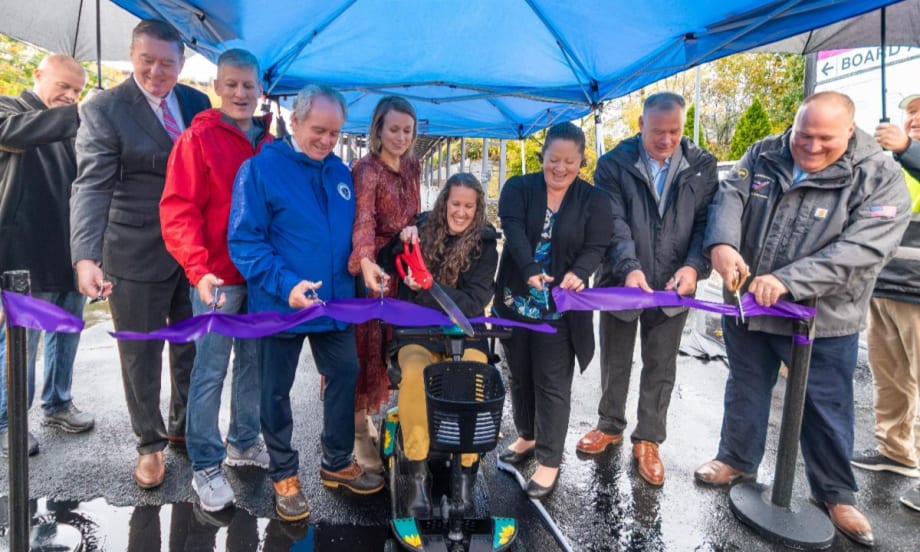
MBTA Leadership, Franklin officials, and community advocates cut a ribbon at Franklin Station.
Photo: MBTA
2 min to read
The Massachusetts Bay Transportation Authority (MBTA) held an official ribbon-cutting ceremony to honor accessibility upgrades at Franklin Station on the MBTA's Franklin/Foxboro Commuter Rail line.
The project ensures all riders can now experience stair-free, level boarding, a critical improvement from the station's previous platform, which required stairs to board trains. The station officially reopened in March 2025.
"I am proud of the teams across MBTA for continuing to deliver these projects, making it easier for everyone to use Commuter Rail," said Interim MassDOT Secretary and MBTA General Manager Phillip Eng. "Under the leadership of the Healey-Driscoll Administration, we are committed to delivering meaningful projects like this one in Franklin. There are more commuter rail stations accessible today than ever in MBTA history, and we're not done yet."
MBTA Chief Operating Officer Ryan Coholan also noted installation of new lighting, signage, electronic message boards with audio, a new canopy, tactile warning strips, benches, and trash receptacles.
"We also repaved the parking lot and relocated the accessible spaces right next to the ramp, significantly increasing the number of spaces from three to seven," Coholan said.
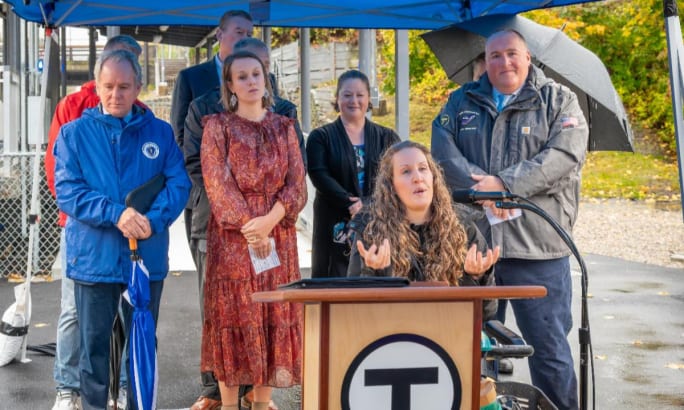
Franklin Commission on Disability Chairperson Ali Rheaume speaks during the ribbon-cutting event at Franklin Station.
Photo: MBTA
"In line with the vision of the MBTA Communities Law and HLC's mission, these improvements to the Franklin Commuter Rail station increase accessibility, livability, and the possibility of building transit-oriented housing that can accommodate the Massachusetts residents who need it," said Ed Augustus, secretary of the Executive Office of Housing and Livable Communities.
"I moved to this community because of access to two train stations," said State Representative Jeffrey Roy. "One was here when I moved here, and the second was on its way. We very much embrace it."
To achieve stair-free, level boarding, the MBTA pursued an innovative solution by designing and installing a freestanding mini-high platform on top of the original infrastructure.
More Management

METRO Opens Submissions for 2026 Motorcoach Awards
Nominations are now being accepted for METRO Magazine’s Operator of the Year and Innovative Operator of the Year awards.
Read More →
New York MTA Advances Final Contract for Second Avenue Subway Expansion
Contract Four is the largest in the Second Avenue Subway Phase 2 project and includes construction of station infrastructure, tracks, and signals for the subway expansion, MTA officials said. Work on Contract Four will begin in 2027.
Read More →
Transit Agencies Highlight Safety Gains at National Summit
Leaders from 15 major transit systems shared crime-reduction results and safety initiatives while discussing the role of continued federal support.
Read More →

NITA Names New Leadership, Expands Reduced-Fare Program at First Board Meeting
The new regional transit authority appointed its first board chair and interim executive director while extending reduced fares across CTA, Metra, and Pace for eligible riders.
Read More →
Beyond the Checklist: A Structured Approach to Transit Maintenance
Reliability-Centered Maintenance helps transit agencies move beyond routine checklists to focus limited resources on the assets and failures that have the greatest impact on safety, reliability, and service.
Read More →
APTA 2026 Nominating Committee Selects Leadership Slate, Names Chair and Vice Chair Nominees
Leadership changes will help shape the association’s priorities and its representation of the transportation industry during the 2026–2027 term.
Read More →
DART Launches Major Security, Fare Enforcement Initiative
The 90-day demonstration will deploy coordinated security teams at five light rail stations while testing controlled access and gathering data to guide future investments.
Read More →
Sponsored•September 9, 2026
Advancing Fare Collection Through Technology and Innovation
Learn about delivering 1300 gates at 91 stations while managing fare evasion. Explore the large scale deployment, solution customization and real-world results that affect the region. Prepare for deployment in your region now.
Read More →
Game Day in Motion: Moving Millions During the 2026 World Cup
Between packed transit stations and team motorcoaches, see how agencies and operators across North America tackled the transportation demands of the 2026 FIFA World Cup.
Read More →
Surface Transportation Extension Averts Shutdown, Leaves Transit Funding Gap
The stopgap keeps federal transportation programs moving, but missing advance funding could complicate the transit and rail projects agencies are planning next.
Read More →