



Metro Transit breaks ground on new Mall of America Transit Center
This is the first major renovation for the 25-year-old transit center, which was upgraded in 2004 when the METRO Blue Line opened.

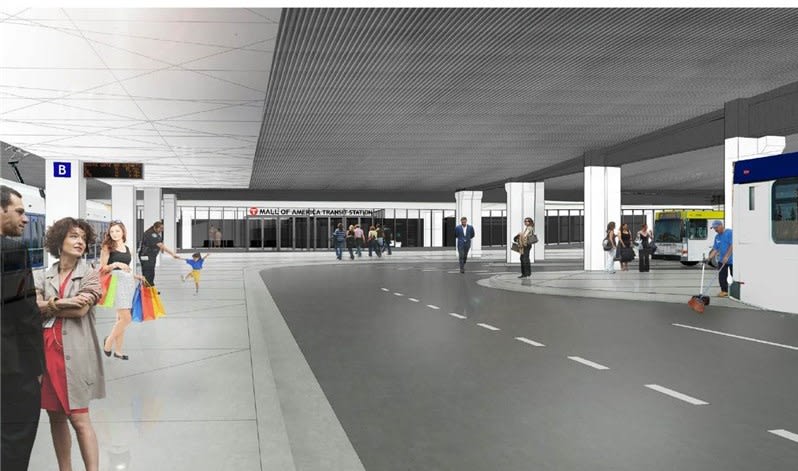
The transit center sees more than 5,600 boardings a day, as a connection point for light rail, the Red Line, and dozens of Metro Transit and Minnesota Valley Transit Authority bus routes.
Rendering via Metro Transit
The transit center sees more than 5,600 boardings a day, as a connection point for light rail, the Red Line, and dozens of Metro Transit and Minnesota Valley Transit Authority bus routes.
Rendering via Metro Transit
Regional leaders joined the Metropolitan Council and Minnesota’s Metro Transit to break ground on renovations to Mall of America Transit Center — the state's busiest transit hub.
“This transit center is a critical hub for our entire region,” said Metropolitan Council Chair Alene Tchourumoff. “Thousands of people come here every day, whether headed to work, to shop or take in entertainment, or simply a connection point as they head home for the day. This renovation will provide a safer, more efficient, and overall more enjoyable experience for those customers who know that transit provides accessibility to jobs and opportunity.”
Safety is a major factor in the redesign. The current vehicle entrance to the transit center is used by regular mall employees and contractors, in addition to transit vehicles. The renovation will create a bus-only entrance, cutting down on the time delay created by traffic back-ups. Also, buses will no longer cross the light-rail tracks, providing improved safety for bus customers. The transit center will also provide customers with a direct connection to the mall’s east entrance.
This is the first major renovation for the 25-year-old transit center, which was last upgraded in 2004 when the METRO Blue Line opened. The transit center sees more than 5,600 boardings a day, as a connection point for light rail, the Red Line, and dozens of Metro Transit and Minnesota Valley Transit Authority bus routes.
The $25 million project includes funding from the City of Bloomington, as well as Metro Transit, Minnesota State bonds, federal CMAQ grants, and the former Counties Transit Improvement Board (CTIB). Hennepin County Commissioner Peter McLaughlin was the Chair of CTIB before it disbanded in 2017.
The Triple Five Group, which owns Mall of America, is providing the land for the new transit center. Mall of America officials say they’re looking forward to the completion of the project. The transit center will be easier to find, with greater aesthetic appeal, improving the visitor experience.
The transit center will also include improved lighting, a family restroom, emergency telephones, and NexTrip real-time departure signs. Inside the building, there will be a new police substation along with a new operator breakroom.
“Millions of Metro Transit riders, the Mall of America and our region have been well-served by this transit center and those that developed it,” Metro Transit GM Brian Lamb said. “For that we are thankful. Now, thanks to our commitment to those same people, we can look forward to the next step in the evolution of transit service here at the Mall of America.”
Construction is expected to be completed in late 2019.
More Management

METRO Opens Submissions for 2026 Motorcoach Awards
Nominations are now being accepted for METRO Magazine’s Operator of the Year and Innovative Operator of the Year awards.
Read More →
New York MTA Advances Final Contract for Second Avenue Subway Expansion
Contract Four is the largest in the Second Avenue Subway Phase 2 project and includes construction of station infrastructure, tracks, and signals for the subway expansion, MTA officials said. Work on Contract Four will begin in 2027.
Read More →
Transit Agencies Highlight Safety Gains at National Summit
Leaders from 15 major transit systems shared crime-reduction results and safety initiatives while discussing the role of continued federal support.
Read More →

NITA Names New Leadership, Expands Reduced-Fare Program at First Board Meeting
The new regional transit authority appointed its first board chair and interim executive director while extending reduced fares across CTA, Metra, and Pace for eligible riders.
Read More →
Beyond the Checklist: A Structured Approach to Transit Maintenance
Reliability-Centered Maintenance helps transit agencies move beyond routine checklists to focus limited resources on the assets and failures that have the greatest impact on safety, reliability, and service.
Read More →
APTA 2026 Nominating Committee Selects Leadership Slate, Names Chair and Vice Chair Nominees
Leadership changes will help shape the association’s priorities and its representation of the transportation industry during the 2026–2027 term.
Read More →
DART Launches Major Security, Fare Enforcement Initiative
The 90-day demonstration will deploy coordinated security teams at five light rail stations while testing controlled access and gathering data to guide future investments.
Read More →
Advancing Fare Collection Through Technology and Innovation
Learn about delivering 1300 gates at 91 stations while managing fare evasion. Explore the large scale deployment, solution customization and real-world results that affect the region. Prepare for deployment in your region now.
Read More →
Game Day in Motion: Moving Millions During the 2026 World Cup
Between packed transit stations and team motorcoaches, see how agencies and operators across North America tackled the transportation demands of the 2026 FIFA World Cup.
Read More →
Surface Transportation Extension Averts Shutdown, Leaves Transit Funding Gap
The stopgap keeps federal transportation programs moving, but missing advance funding could complicate the transit and rail projects agencies are planning next.
Read More →