



Minn. Metro Transit honored as 2016 'System of the Year'
Those accomplishments include growing ridership, expanding access, advances in sustainability and overall success in system safety. Metro Transit was selected among agencies from across North America that provide more than 20 million annual passenger trips.

Metro Transit
Metro Transit
Minneapolis' Metro Transit is celebrating a top national award that recognizes its record ridership and success in a range of areas, including safety, operations, maintenance and community relations.
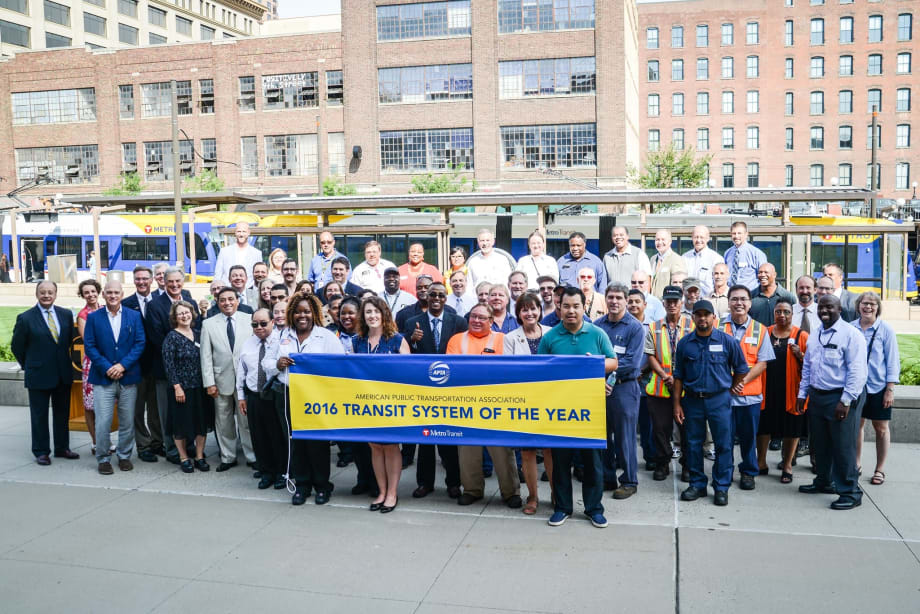
The agency has received the American Public Transportation Association's (APTA) 2016 Outstanding Public Transportation System Achievement Award. The prestigious annual award, also known as System of the Year, reflects accomplishments made between 2013 and 2015.
Those accomplishments include growing ridership, expanding access, advances in sustainability and overall success in system safety. Metro Transit was selected among agencies from across North America that provide more than 20 million annual passenger trips.
After opening the METRO Green Line in 2014, Metro Transit saw its highest ridership in 30 years. More than 85.8 million rides were taken in 2015. In addition to record ridership, Metro Transit was recognized for successes in system safety, reliability, community relations, workforce development, sustainability and financial management, among other areas.
Growth in the Metro Transit Police Department, enhanced operator training and highly visible safety campaigns have improved system safety. Carefully-managed maintenance programs have doubled vehicle reliability over the last decade. And $16 million in savings have been realized through the expanded use of hybrid-electric buses, solar energy and other sustainability efforts. New transit information tools, fare programs for students and expanded bus service have also made transit more accessible.
Metro Transit
In 2015, Metro Transit began working with local groups to shape ongoing bus stop improvements, launched a groundbreaking program that provides job-seekers a path to full-time Mechanic Technician roles and formed an outreach team to ensure residents were both heard from and involved in the decision-making process.
“Metro Transit’s success is a reflection of the talent and dedication shown by each of our 3,200 employees who work together to provide the essential services our region depends on, as well as the enduring relationships we’ve built with our customers and partners,” General Manager Brian Lamb said. “Being named APTA’s System of the Year is a humbling and high honor, and one that can be celebrated by all who helped bring us to this point.”
Local elected, business and community leaders were on-hand Wednesday, Aug. 10, at the Union Depot in St. Paul to join Metro Transit and Metropolitan Council leadership and staff as the award was announced. The award will be presented at APTA’s Annual Meeting in Los Angeles in September.
Metro Transit also unveiled a new decal noting the award, which will be added to all of its buses and trains. The agency also announced a customer and staff appreciation event that will be held on Saturday, Sept. 24, at the Target Field Station amphitheater.
More Management

METRO Opens Submissions for 2026 Motorcoach Awards
Nominations are now being accepted for METRO Magazine’s Operator of the Year and Innovative Operator of the Year awards.
Read More →
New York MTA Advances Final Contract for Second Avenue Subway Expansion
Contract Four is the largest in the Second Avenue Subway Phase 2 project and includes construction of station infrastructure, tracks, and signals for the subway expansion, MTA officials said. Work on Contract Four will begin in 2027.
Read More →
Transit Agencies Highlight Safety Gains at National Summit
Leaders from 15 major transit systems shared crime-reduction results and safety initiatives while discussing the role of continued federal support.
Read More →

NITA Names New Leadership, Expands Reduced-Fare Program at First Board Meeting
The new regional transit authority appointed its first board chair and interim executive director while extending reduced fares across CTA, Metra, and Pace for eligible riders.
Read More →
Beyond the Checklist: A Structured Approach to Transit Maintenance
Reliability-Centered Maintenance helps transit agencies move beyond routine checklists to focus limited resources on the assets and failures that have the greatest impact on safety, reliability, and service.
Read More →
APTA 2026 Nominating Committee Selects Leadership Slate, Names Chair and Vice Chair Nominees
Leadership changes will help shape the association’s priorities and its representation of the transportation industry during the 2026–2027 term.
Read More →
DART Launches Major Security, Fare Enforcement Initiative
The 90-day demonstration will deploy coordinated security teams at five light rail stations while testing controlled access and gathering data to guide future investments.
Read More →
Advancing Fare Collection Through Technology and Innovation
Learn about delivering 1300 gates at 91 stations while managing fare evasion. Explore the large scale deployment, solution customization and real-world results that affect the region. Prepare for deployment in your region now.
Read More →
Game Day in Motion: Moving Millions During the 2026 World Cup
Between packed transit stations and team motorcoaches, see how agencies and operators across North America tackled the transportation demands of the 2026 FIFA World Cup.
Read More →
Surface Transportation Extension Averts Shutdown, Leaves Transit Funding Gap
The stopgap keeps federal transportation programs moving, but missing advance funding could complicate the transit and rail projects agencies are planning next.
Read More →