



MTA Restores 24-Hour Subway Service
The subway system was closed overnight for the first time in the agency’s 116 years in May 2020, to allow the MTA to undertake an unprecedented cleaning regimen to protect employees and customers from COVID-19.
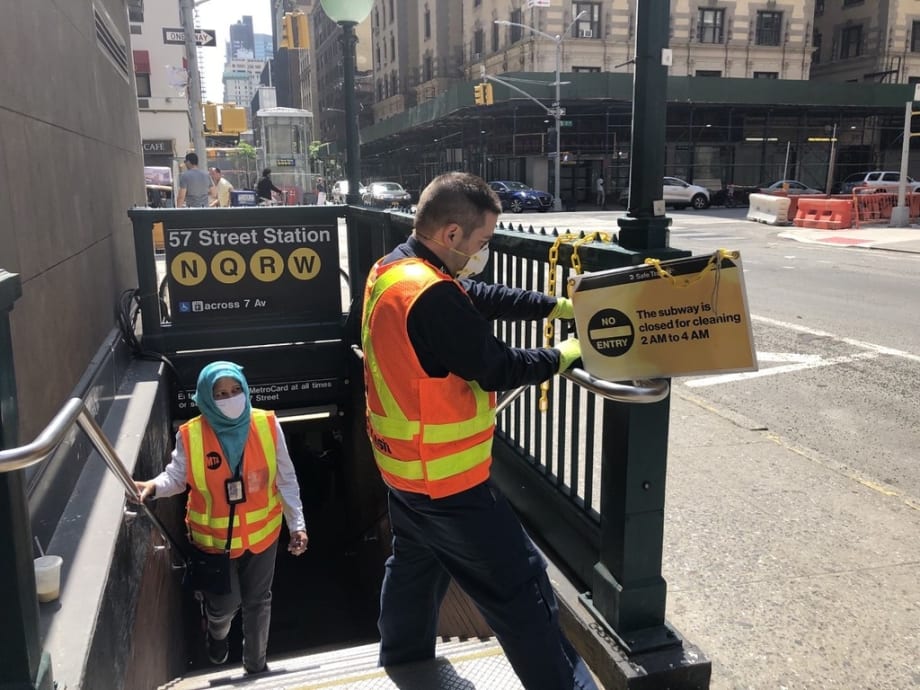
The unprecedented cleaning regimen on subways, buses, paratransit, and commuter rails will continue.
MTA
New York’s Metropolitan Transportation Authority (MTA) re-launched 24-hour subway service on Monday as the state continues its economic and social reopening.
The subway system was closed overnight for the first time in the agency’s 116 years in May 2020, to allow the MTA to undertake an unprecedented cleaning regimen to protect employees and customers from COVID-19. When it began, the closure covered 1 a.m. to 5 a.m.; on February 15 Gov. Cuomo announced a partial resumption of overnight service, reducing the overnight closure in half, from 2 a.m. to 4 a.m.
The resumption of overnight subway service comes as subway ridership is trending upward toward a recovery. On Friday, March 12 subway ridership hit the 1.9 million mark for the first time since the onset of the COVID-19 pandemic a year ago. On April 9, subway ridership surpassed the two million mark, and on May 10 surpassed the 2.2 million riders, a new single-day record. The news comes on the heels of the MTA's multifaceted communications and marketing #TaketheTrain and #TaketheBus campaigns aimed at bringing customers back to the system.
“The subway returning to 24-hour service is a signal that we are closer than we have ever been to normal life,” said Sarah Feinberg, interim president of NYC Transit. “We would not be at this point without the sacrifice and dedication of the whole NYC Transit team. It is thanks to their heroic effort throughout this pandemic — coming into work, moving essential workers, keeping the system as clean as it has ever been — that we can return New York City to the city that never sleeps.”
Prior to the pandemic, average weekday ridership totals on subways routinely exceeded 5.5 million. That figure fell by more than 90% to a low of roughly 300,000 daily trips last April as the number of COVID-19 cases peaked in the New York City area. The low point of bus ridership was 278,067 on April 12, 2020. Average weekday ridership in April 2020 was 463,763. MTA employees continued to provide service for the frontline healthcare professionals and other essential workers who needed to get to work during some of the most troubling days in New York City history.
The unprecedented cleaning regimen on subways, buses, paratransit, and commuter rails will continue. Stations will be disinfected at least twice daily and rolling stock at least once daily. Since the May 6 closure a year ago the MTA has piloted disinfecting methods such as ultraviolet light, antimicrobial sprays which will allow the disinfecting to remain at high levels. Masks are still required while riding mass transit; mask compliance on subways and buses has been nearly universal with 98% compliance on subways and 99% on buses.
In an effort to get New York fully vaccinated and reopened, under the leadership of Gov. Cuomo, the MTA partnered with SOMOS Community Care, Northwell Health, and Westchester Medical Center on eight pop-up vaccination sites throughout its operating region. Customers and MTA employees can get vaccinated at the sites. Anyone who received the vaccine at these pop-up locations received either a free seven-day MetroCard or free round-trip Long Island Rail Road or Metro-North ticket.
The effort to help get every New Yorker vaccinated comes as the MTA gets its workforce vaccinated. The MTA has stood up employee vaccination sites throughout its region. More than 30,000 employees have received at least their first dose of the vaccine.
The MTA will also continue to protect its employees and customers with personal protective equipment. So far, the MTA has acquired nearly 27 million masks to date. In addition to the over eight million masks available for customers, the authority has also made available 750,000 2-oz. bottles of hand sanitizer. Additionally, the MTA has distributed to its workforce 18.7 million masks, 20.3 million pairs of gloves, 122,000 gallons of hand sanitizer, 260,000 7-oz., and 2-oz. bottles of hand sanitizer, 13.7 million individual sanitizing cleaning wipes, 277,000 gallons of cleaning solution, and 18,000 face shields.
More Management

Indian River Transit’s Community-Focused Approach Earns National Recognition
Named APTA’s 2026 Outstanding Public Transportation System in its size category, Florida’s Indian River County transit system continues to grow ridership through fare-free service and a focus on evolving community needs.
Read More →
ENC Lands MATA Contract and More in Biz Briefs
In this edition of Biz Briefs, we spotlight the latest developments shaping the future of mobility.
Read More →
From Surviving to Thriving: Building Stronger Transportation Organizations
Bus Business Consultants founder Brian Dickson shares lessons on leadership, organizational health, and creating options for long-term success in a changing transportation industry.
Read More →

Everett Transit, Community Transit Outline Consolidation Agreement
The proposed agreement calls for a 50% increase in bus service in Everett, a new microtransit zone, continued paratransit service, and the transfer of Everett Transit operations to Community Transit.
Read More →
Strada360’s Steve Lassey on Turning Transit Data Into Better Decisions
From breaking down data silos to preparing for AI, Strada360 CEO Steve Lassey discusses how transit agencies can use technology to improve operations, customer information, and long-term decision-making.
Read More →
People Movement: Phil Washington Joins HNTB, Denver RTD Launches CEO Search, and More
In this edition, we also spotlight recent personnel moves at STV, the Eno Center for Transportation, and more, highlighting the people taking on new roles across the transportation industry.
Read More →
SEPTA Details Accelerate Vision for Transit System
The plan outlines investments in trolley modernization, new Metro and Regional Rail vehicles, accessible stations, and more frequent bus and rail service.
Read More →
FTA Ends Direct Oversight of MBTA Safety Actions
The federal agency closed its remaining special directive to the Massachusetts Department of Public Utilities following a safety review that began in 2022.
Read More →
Report: Transit Bus Manufacturing Supports 34,100 Jobs, $5.1B in GDP
The “Buses Mean Business” report examines the transit bus manufacturing industry’s economic footprint, supply chain, and rising demand for vehicle replacements.
Read More →
LIT Marks 10-Year Milestone at Annual Summit
Hosted by the COTA from September 10 to 13, the Summit carried the theme “Celebrating 10 Years of Excellence, Leadership, and Impact,” with every part of the program honoring the people, agencies, and partners who built LIT over its first decade.
Read More →