




In the Macro: How Micromobility Impacts Cities…And You
NABSA’s Third Annual Report Shows Improved Shared Micromobility
NABSA worked with Toole Design and the University of California Berkeley Transportation Sustainability Research Center to help develop the report.
August 3, 2022
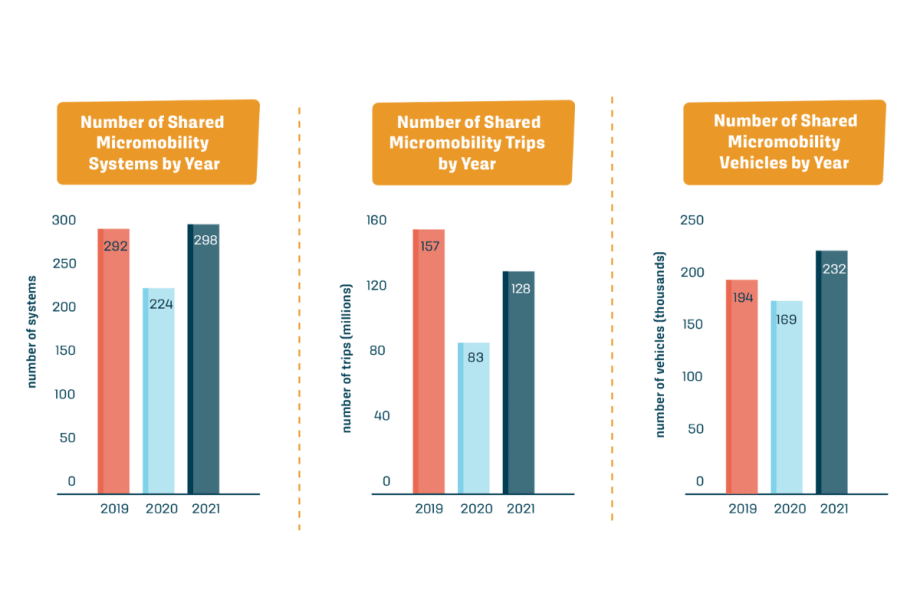
The report is composed of survey results, statistics gathered from performance reports released by shared micromobility systems, and data from GBFS.
Photo: NABSA
3 min to read
The North American Bikeshare and Scootershare Association (NABSA) presented the third annual Shared Micromobility State of the Industry Report for North America.
The 2021 State of the Industry Report shows shared micromobility’s success as a climate action tool, facilitator of mode shift, and a transportation equity and access solution that improves public health, local economies, and existing transportation ecosystems.
The report also highlights how some public agencies have already integrated shared micromobility into transportation, climate, equity, and public health policies as examples of how more agencies at all levels of government can utilize shared micromobility toward these public goals.
“In this important time globally, as we face climate, equity, and transportation challenges, shared micromobility is a tool for policymakers and communities to utilize towards creating the transportation networks that serve people, communities, and our planet better,” said Samantha Herr, NABSA executive director. “By quantifying and tracking the benefits and impact of shared micromobility, and demonstrating year-over-year success and growth, the Shared Micromobility State of the Industry Report is an important tool in our advocacy work.”
At least 128 million trips were taken on shared micromobility in 2021, an increase from 2020, and monthly ridership began exceeding 2019 levels mid-year. In addition, the number of vehicles in operation and cities with shared micromobility systems exceeded pre-pandemic levels, at 232,000 and 298, respectively.
Data in the report also shows that 37% of shared micromobility trips replace a car trip. By replacing car trips in 2021, shared micromobility offset approximately 54 million pounds of CO₂ emissions. By replacing car trips and generating new trips, North Americans gained an estimated 15.5 million hours of additional activity. Sixty-three percent of riders also reported that they use shared micromobility to connect to transit.
According to agencies and operators who responded to workforce diversity questions, 81% of respondents stated that diversity is part of every hiring conversation, and 71% reported that their staff had completed cultural competency or diversity training. This is an increase of 10% and 16% from 2020 respectively. When compared to Census data, the report also demonstrates better representation of people of color and very low-income riders in 2021 than in 2020.
The 2021 report features another new section that provides insights into the roles and relationships associated with integrating shared micromobility with public transit. Responses to the agency survey indicated that more than half of transit agencies are involved in station planning, and 37% of transit agencies co-promote or co-market shared micromobility alongside their services.
E-bikes were present in 50% of cities with a bikeshare system — an increase of 6% from 2020 and 22% from 2019 — and e-bikes were ridden approximately 36% more than regular pedal bikes. Additionally, the percentage of cities with shared e-scooter systems increased from 58% in 2020 and 52% in 2019 to 64% in 2021.
"Shared micromobility enables one of the most efficient ways to make short trips and it's great to see that it continues to gain a foothold in North America,” said Lina Fedirko of the ClimateWorks Foundation. “The near doubling of trips on e-bikes, from 9.9 million in 2020 to 18.8 million in 2021, mirrors the appetite for e-bikes that we're also seeing in Europe. I think for people that are used to traveling at fast speeds via cars or transit, e-bikes are emerging as an appealing bridge mode of transport that feels more personal, active, enjoyable, and definitely climate-friendly."
More New Mobility

From Hardware to Digital Partner: Luminator Charts Its Next Chapter
CEO Magnus Friberg discusses Luminator’s shift toward becoming a digital partner, the growing importance of software and interoperability, and how AI can help agencies improve operations and passenger experience.
Read More →
Biz Briefs: Alstom Lands Canadian Contract, LYT to Supply California TSP, and More
In METRO's latest installment, we take a look at recent news from Complete Coach Works, Beep, FlixBus, and more partnerships making headlines across the transportation sector.
Read More →
CharterUP’s Armir Harris on Technology, AI, and the Future of Group Mobility
In a recent episode of METROspectives, CharterUP Founder/CEO Armir Harris discussed the company’s evolution from an online charter bus marketplace into a technology platform supporting public- and private-sector mobility and much more.
Read More →
Jacksonville’s NAVI Project Charts a New Course for Autonomous Public Transportation
Through its NAVI program, JTA is showing how autonomous vehicles, intelligent infrastructure, and coordinated operations can work together to deliver everyday public transportation.
Read More →
Biz Briefs: Luminator Marks Milestone and More
From manufacturers and suppliers to transit agencies and motorcoach operators, these updates offer a snapshot of the projects, partnerships and business moves driving the industry forward.
Read More →
New Tricks for Old Bureaucracies: Joshua Schank on Making Transit Innovation Stick
Former LA Metro Chief Innovation Officer Joshua Schank discusses why good ideas aren't enough, how transit agencies can overcome resistance to change, and why today's challenges demand more innovation.
Read More →
How DART's GoPass Is Redefining Regional Mobility
Serving 14 transit agencies, GoPass simplifies multimodal travel by allowing riders to plan, pay for, and manage an entire trip through one app.
Read More →
Biz Briefs: OCTA Taps Clean Energy for Hydrogen Station, Stadler to Supply Via Rail Vehicles, and More
From manufacturers and suppliers to transit agencies and motorcoach operators, these updates offer a snapshot of the projects, partnerships and business moves driving the industry forward.
Read More →CharterUP Expands Into New Mobility and Autonomous Transportation
Vice President of New Mobility Stephen Joos discusses how CharterUP is leveraging its nationwide transportation network, technology platform, and autonomous vehicle partnerships to expand into workforce mobility, campus shuttles, and transit solutions.
Read More →
METRO Magazine Announces 2026 Innovative Solutions Awards Winners
Projects Recognized for Advancing Mobility Through Technology, Accessibility, Workforce Innovation, and Operational Excellence
Read More →