




RELATED: 68% of Nashvillians support paying higher taxes for improved public transit
Nashville mayor unveils $5.2 billion transportation plan
It includes 26 miles of Nashville’s first-ever light rail system, four rapid bus routes, a dramatic increase in the service and frequency of the bus system, and a strategy of service and infrastructure improvements.
October 18, 2017
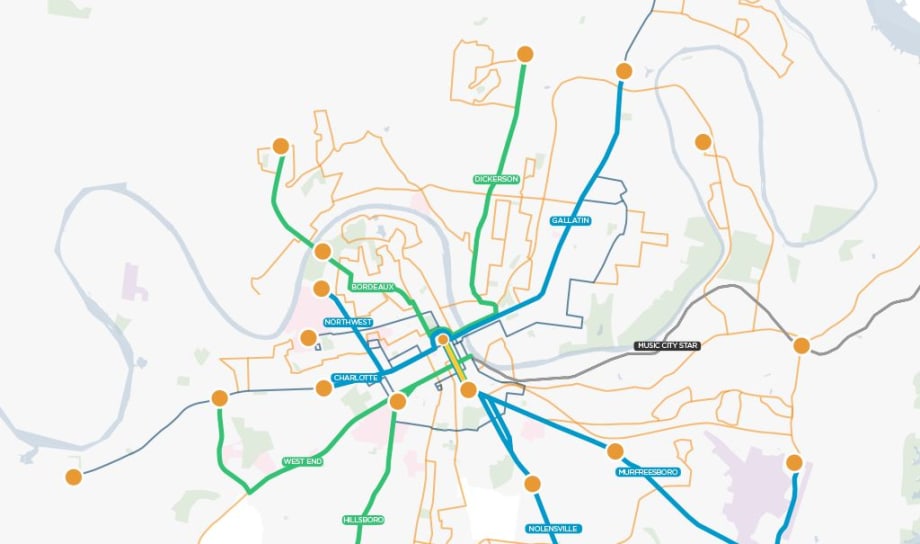
The Let's Move Nashville transportation plan includes 26 miles of the city’s first-ever light rail system, four rapid bus routes, a dramatic increase in the service and frequency of the bus system, and a strategy of service and infrastructure improvements. Map courtesy Let's Move Nashville
4 min to read
The Let's Move Nashville transportation plan includes 26 miles of the city’s first-ever light rail system, four rapid bus routes, a dramatic increase in the service and frequency of the bus system, and a strategy of service and infrastructure improvements. Map courtesy Let's Move Nashville
Nashville Mayor Megan Barry unveiled$5.2 billion transportation plan that includes 26 miles of the city’s first-ever light rail system, four rapid bus routes, a dramatic increase in the service and frequency of the bus system, and a strategy of service and infrastructure improvements.
The plan, Let’s Move Nashville: Metro’s Transportation Solution, aligns with the IMPROVE Act passed earlier this year. In early 2018, Metro Council members will be asked to put the plan on the ballot for the May 2018 countywide vote.
The $5.2 billion infrastructure investment will be funded by a range of fees, including business, sales and tourism taxes. The Let's Move Nashville plan originated after many years of study and community engagements through the nMotion strategic plan, which was led by MTA and RTA, as well as coordination at the state and local level.
Details of the plan are:
Existing bus service improvements with state-of-the-art electric buses and more cross-town routes, 15-minute peak service on busy routes and buses running 20 hours of every day.
Rapid Bus along Dickerson Road, Hillsboro Road, West End Avenue and the Bordeaux route, which will include signal prioritization, queue jumps, and infrastructure improvements to move transit riders faster to their destination.
Light Rail on our busiest corridors – Gallatin Road, Nolensville Road, Charlotte Avenue and Murfreesboro Road to the airport. There will also be a light rail line using existing rails that will run along the Northwest Corridor to Buchanan Street near Tennessee State University. The network will begin operations in 2026 and be completed by 2032.
Underground tunnel downtown serving the region’s job, economic and entertainment center while connecting the light rail network from north to south.
Neighborhood Transit Centers that offer safe and comfortable access to the entire system.
Transportation network enhancements such as better sidewalks, traffic synchronization and signal improvements, and fixing dangerous intersections.
Metro’s transportation solution would not be possible without the passage of the IMPROVE Act earlier this year. This legislation, in addition to funding road and bridge projects across the state, authorized local government to collect surcharges on various taxes and fees currently being assessed by the local government, if approved by voters by referendum. Metro will seek federal grants where available, while also utilizing four surcharges to fund the project implementation and long-term maintenance of the system:
One-half percent sales tax surcharge beginning in July of 2018, and graduating to one percent in 2023. A recent study released by the Nashville Area Chamber of Commerce shows that nearly half (47%) of sales tax collections in Davidson County are generated by out-of-county residents.
One-quarter percent surcharge on the hotel/motel tax, graduating to three-eighths of a percent in 2023. The Convention Center Authority, which is funded in part by local hotel taxes and fees, is anticipated to help pay for the transit system by constructing a SoBro station for light rail and rapid bus service. Additionally, the Metro Nashville Airport Authority has agreed in principle to fund a light rail spur from Murfreesboro Road to the Airport with terminal access.
20% surcharge on the rental car tax. Metro currently charges a 1 percent tax on the gross proceeds derived from the lease or rental of any passenger motor vehicle, truck or trailer for a period of five days or less. This 20% surcharge would result in a total of 1.2% surcharge on rental cars.
20% surcharge on the business and excise tax. Businesses in Davidson County are assessed a business and excise tax based on a variety of classifications established under TCA 67-4-708. If a business currently pays $1,000 in such a tax, this surcharge would result in an additional $200 annually.
“It’s important to me that we are equitable and fair with the taxes used to pay for transit, while understanding the need for a bold, comprehensive transportation system that will address Nashville’s needs now and in the future,” said Mayor Barry. “This is a balanced funding proposal that will ensure that visitors and out-of-county residents who may use our roads or transit system will pay their fair share along with residents who will have access to better jobs and transportation options as a result of this proposal.”
The proposal will eliminate fares for Nashville residents living at or below the federal poverty level. Mayor Barry intends to create an affordability and transit task force in the coming weeks to address the needs of working families, and to continue to shape policies around affordable housing and supporting small-businesses. The task force will also help determine the best ways to use the Transit-oriented development district legislation, which will allow Metro to capture and invest revenues along the transit corridors into affordable housing.
In an effort to engage and inform the community on Metro’s transportation solution, the Mayor’s Office, Metro Public Works, and MTA will be hosting a series of open houses throughout Davidson County, starting with neighborhoods along the light rail corridors.
Once the transit improvement plan is fully reviewed by the community and approved by an independent CPA firm with criteria set forth by the Tennessee State Comptroller’s Office, the Metro Council will be asked to consider an ordinance that will authorize the plan to be placed on the ballot for the May 1, 2018 election.
More Management

LIT Marks 10-Year Milestone at Annual Summit
Hosted by the COTA from September 10 to 13, the Summit carried the theme “Celebrating 10 Years of Excellence, Leadership, and Impact,” with every part of the program honoring the people, agencies, and partners who built LIT over its first decade.
Read More →
People Movement: Dan Dipert Coaches Adds Third-Generation Leader, Keolis Names New Valley Metro VP/GM, and More
In this edition, we also cover recent appointments and announcements at the Wabtec, SilverRide, HNTB, and more, showcasing the individuals helping to shape the future of transportation.
Read More →
METRO Opens Submissions for 2026 Motorcoach Awards
Nominations are now being accepted for METRO Magazine’s Operator of the Year and Innovative Operator of the Year awards.
Read More →

New York MTA Advances Final Contract for Second Avenue Subway Expansion
Contract Four is the largest in the Second Avenue Subway Phase 2 project and includes construction of station infrastructure, tracks, and signals for the subway expansion, MTA officials said. Work on Contract Four will begin in 2027.
Read More →
Transit Agencies Highlight Safety Gains at National Summit
Leaders from 15 major transit systems shared crime-reduction results and safety initiatives while discussing the role of continued federal support.
Read More →
NITA Names New Leadership, Expands Reduced-Fare Program at First Board Meeting
The new regional transit authority appointed its first board chair and interim executive director while extending reduced fares across CTA, Metra, and Pace for eligible riders.
Read More →
Beyond the Checklist: A Structured Approach to Transit Maintenance
Reliability-Centered Maintenance helps transit agencies move beyond routine checklists to focus limited resources on the assets and failures that have the greatest impact on safety, reliability, and service.
Read More →
APTA 2026 Nominating Committee Selects Leadership Slate, Names Chair and Vice Chair Nominees
Leadership changes will help shape the association’s priorities and its representation of the transportation industry during the 2026–2027 term.
Read More →
DART Launches Major Security, Fare Enforcement Initiative
The 90-day demonstration will deploy coordinated security teams at five light rail stations while testing controlled access and gathering data to guide future investments.
Read More →
Sponsored•September 9, 2026
Advancing Fare Collection Through Technology and Innovation
Learn about delivering 1300 gates at 91 stations while managing fare evasion. Explore the large scale deployment, solution customization and real-world results that affect the region. Prepare for deployment in your region now.
Read More →