




Ferry Exciting News: Feds Make Historic Funding Available to Modernize Passenger Ferry Service
New FTA Funding Aims to Modernize Ferry Services, Reduce Emissions
In total, FTA is awarding 23 grants across 11 states and the U.S. Virgin Islands.
January 27, 2023
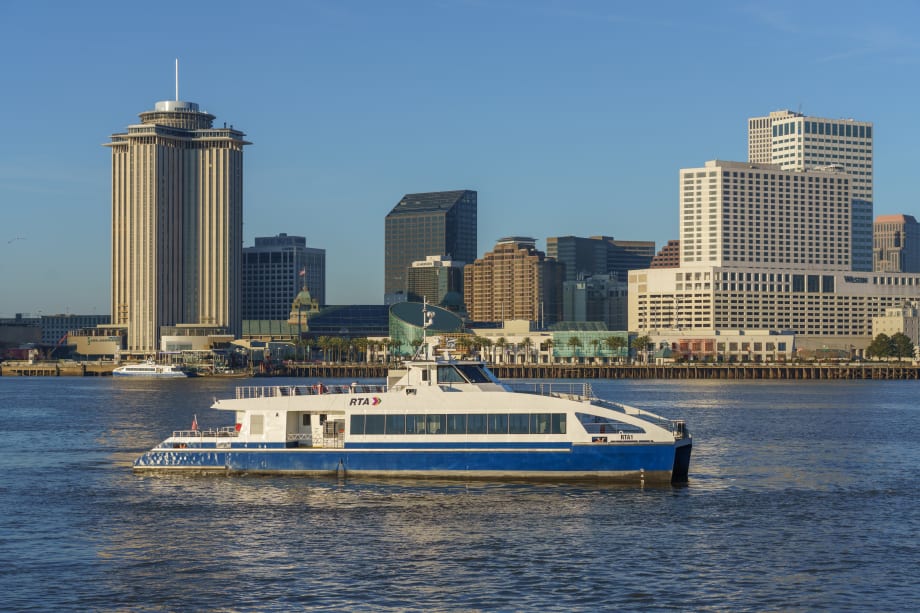
Grants will fund projects including the replacement of old vessels, the expansion of fleets, and build new terminals and docks.
Credit:
New Orleans RTA
3 min to read
The U.S. Department of Transportation’s Federal Transit Administration (FTA) announced $384.4 million in federal funding to expand and improve the nation’s ferry service in communities, as well as accelerate the transition to zero-emission transportation.
In total, FTA is awarding 23 grants across 11 states and the U.S. Virgin Islands, according to its news release.
Grants will fund projects including the replacement of old vessels, the expansion of fleets, and build new terminals and docks. For the state of Alaska, the award means nearly $286 million of investment in the Alaska Marine Highway, which serves remote locations throughout the state.
Nearly $100 million of the national grants will go toward low- and no-emission ferries, helping decrease greenhouse gas emissions from the transportation sector.
“With these grants, we are improving and expanding ferry service in the communities that rely on waterways the most — often in more rural, remote regions — connecting people to jobs, services, and city centers while cutting climate pollution,” said Pete Buttigieg, U.S. Transportation secretary.
FTA's Ferry Service for Rural Communities Program provides competitive funding to states for ferry service in rural areas. FTA is awarding $252.4 million to eight projects in four states.
FTA's Electric or Low-Emitting Ferry Pilot Program provides competitive funding for electric or low-emitting ferries and charging equipment that reduces greenhouse gas emissions by using alternative fuels or on-board energy storage systems. FTA said it is awarding $97.6 million to seven projects in seven states.
Additionally, FTA's Passenger Ferry Grant Program supports capital projects to establish new ferry services and repair and modernize ferry vessels, terminals, and facilities and equipment in urbanized areas. FTA is awarding $34.4 million to eight projects in six states and the U.S. Virgin Islands.
“Today’s announcement represents a record amount of support for transit ferries in our country,” said Nuria Fernandez, FTA administrator. “And thanks to the President’s Bipartisan Infrastructure Law, for the first time ever, we are able to provide competitive grant funds for passenger ferry service in rural areas and help ferry operators reduce their climate impact.”
Some selected ferry projects include:
The Alaska Department of Transportation & Public Facilities, which is receiving six grants for nearly $286 million, will build passenger ferries to replace or modernize older vessels and make dock upgrades in several communities. The grants will improve the condition and quality of the Alaska Marine Highway System, which runs 3,500 miles and serves 35 communities, particularly for people in remote locations with high transportation costs.
The Maine Department of Transportation will receive $28 million through the Electric or Low-Emitting Ferry Pilot Program to build a hybrid-electric vessel to replace a 35-year-old vessel. The new hybrid-electric vessel will reduce greenhouse gas emissions and promote environmental sustainability for the roughly 600 residents of the island of Islesboro, a rural community in upper Penobscot Bay that relies on passenger ferry service.
The Massachusetts Bay Transportation Authority (MBTA) will receive $6.6 million through the Passenger Ferry Grant Program to modernize the Hingham Ferry dock to improve safety and accessibility and ensure it stays in a state of good repair. MBTA will stabilize the ferry dock, reconstruct walkways, upgrade lighting, safety, and security systems, and facilitate backup power.
More New Mobility

From Hardware to Digital Partner: Luminator Charts Its Next Chapter
CEO Magnus Friberg discusses Luminator’s shift toward becoming a digital partner, the growing importance of software and interoperability, and how AI can help agencies improve operations and passenger experience.
Read More →
Biz Briefs: Alstom Lands Canadian Contract, LYT to Supply California TSP, and More
In METRO's latest installment, we take a look at recent news from Complete Coach Works, Beep, FlixBus, and more partnerships making headlines across the transportation sector.
Read More →
CharterUP’s Armir Harris on Technology, AI, and the Future of Group Mobility
In a recent episode of METROspectives, CharterUP Founder/CEO Armir Harris discussed the company’s evolution from an online charter bus marketplace into a technology platform supporting public- and private-sector mobility and much more.
Read More →
Jacksonville’s NAVI Project Charts a New Course for Autonomous Public Transportation
Through its NAVI program, JTA is showing how autonomous vehicles, intelligent infrastructure, and coordinated operations can work together to deliver everyday public transportation.
Read More →
Biz Briefs: Luminator Marks Milestone and More
From manufacturers and suppliers to transit agencies and motorcoach operators, these updates offer a snapshot of the projects, partnerships and business moves driving the industry forward.
Read More →
New Tricks for Old Bureaucracies: Joshua Schank on Making Transit Innovation Stick
Former LA Metro Chief Innovation Officer Joshua Schank discusses why good ideas aren't enough, how transit agencies can overcome resistance to change, and why today's challenges demand more innovation.
Read More →
How DART's GoPass Is Redefining Regional Mobility
Serving 14 transit agencies, GoPass simplifies multimodal travel by allowing riders to plan, pay for, and manage an entire trip through one app.
Read More →
Biz Briefs: OCTA Taps Clean Energy for Hydrogen Station, Stadler to Supply Via Rail Vehicles, and More
From manufacturers and suppliers to transit agencies and motorcoach operators, these updates offer a snapshot of the projects, partnerships and business moves driving the industry forward.
Read More →CharterUP Expands Into New Mobility and Autonomous Transportation
Vice President of New Mobility Stephen Joos discusses how CharterUP is leveraging its nationwide transportation network, technology platform, and autonomous vehicle partnerships to expand into workforce mobility, campus shuttles, and transit solutions.
Read More →
METRO Magazine Announces 2026 Innovative Solutions Awards Winners
Projects Recognized for Advancing Mobility Through Technology, Accessibility, Workforce Innovation, and Operational Excellence
Read More →